1
Chapter 5
where:
V= the velocity in each interval
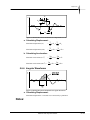
To obtain the peak displacement, the Minimate Plus integrates each wave segment of the entire
waveform between zero crossings, selects the largest, then divides the value by half. Note that this
is not necessarily at the peak velocity of the waveform.
e. Peak Vector Sum (PVS)
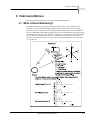
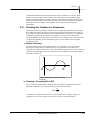
The figure below displays three event waveforms. The figure illustrates the procedure of
graphically calculating peak vector sums. Measured magnitudes are tabulated for six different
times and represent velocities in each of the three axes. The vector sum represents the resultant
particle velocity magnitude and is calculated by squaring and adding the magnitudes and taking
the square root.
PVS =
T2 + V 2 + L2
where:
T = particle velocity along the transverse plane
V = particle velocity along the vertical plane
L = particle velocity along the longitudinal plane
Figure 5.10 Calculating the Peak Vector Sum.
The Minimate Plus calculates the peak vector sum for each point of the sampled waveforms and
displays the largest value. Note that this is not necessarily at the peak velocity for an individual
waveform.
5.5.2. Sound Pressure
The Minimate Plus calculates two sound pressure indicators, peak sound pressure and zero
crossing frequency.
a. Peak Sound Pressure (PSP)
The Minimate Plus checks the entire event waveform and displays the largest sound pressure
called the Peak Sound Pressure (PSP), also referred to as the Peak Air Over–Pressure. Results
appear on the Minimate Plus display.
b. Zero Crossing Frequency (ZC Freq)
The Zero Crossing Frequency calculation for sound pressure is the same calculation used for
ground vibrations. Please see above for a complete discussion.
5–10
Minimate Plus Operator Manual