1
UCl4 SYNTHESIS STANDARD OPERATING PROCEDURE
Set Up:
1. Before beginning synthesis, the hood and Schlenk line need to be cleared of all other
reaction set ups or equipment.
2. The hood needs to be cleaned and protective sheet laid down.
3. All equipment is kept in a yellow radioactive bag above the liquid waste bottles and only
used for UCl4 synthesis.
***WARNING*** This is a radical reaction! The synthesis should be done only with the
knowledge of Suzanne and other group members. Never attempt this reaction while working
alone!
Procedure:
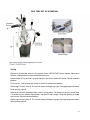
1. A 250 mL three neck round bottom is filled about halfway with hexachloropropene and a
stir bar. The three necks are fitted with a thermometer/septum (use a lot of grease to get
a good seal with the thermometer), a reflux condenser (connected to Schlenk line), and
a glass stopper. Don’t forget to grease joints.
2. Purge the system with flowing argon for about 15 min.
3. With consistent stirring the round bottom is heated to 190°C. (Don’t heat a closed
system!! Make sure your reaction is open to the argon manifold.
4. About 5 grams of UO3 are weighed out.
5. Once the hexachloropropene has reached 190 °C, a small portion of the UO3 is slowly
added through the open neck with argon purge. The reaction will foam slightly. Do not
add more UO3 until the temperature has stabilized back to 190°C (about 15-30 minutes
to allow the reaction to settle). (Remember, this is a radical reaction!!! So make sure that
the UO3 that you have added has reacted before you added any more.)
6. Then continue adding small portions of UO3 slowly in 10-15 minute increments until all
of the UO3 has been used or the foam of the reaction begins to become too great (if it
travels up the neck of the flask).
7. After the last portion of UO3 is added to the flask the round bottom should be resealed
and allowed to stir overnight at 190°C. (Make sure the reaction is left open to the argon
manifold!)
8. In the morning the flask should be allowed to cool to room temperature.
9. Under purge, switch the septum/thermometer and reflux condenser for a glass stopper
and a stopcock vacuum adapter.
10. The reaction should be placed under vacuum on the schlenk line to remove any air
(don’t forget the trap, some volatiles form during the reaction).
11. Then it should be taped closed with electrical tape, and brought into the glove box.
12. The insoluble green precipitate should be filtered off from the orange liquid, rinsed with
DCM (until the rinse is clear) and dried.
Clean up:
1. All glass pieces should be cleaned in Radioactive waste hood with Ethanol/HCL and
acetone.
2. Any disposable piece must be placed in the solid radioactive waste buckets.
21