1
Theory of operation
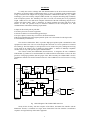
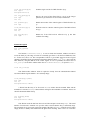
The transceiver employs an isochronous serial protocol [4]. Data is sent in frames, consisting
of one or more words. A word consists of a start bit, 16 data bits (MSB first), an even parity bit and a
stop bit. The transmitting sequence is started by taking /TXRQ low. /TXB goes low to indicate that
the transmitter is busy. The transmit strobe, /TS, marks the instants at which new data must be
applied at the parallel input port. This sequence of events is matched to the operation of the transmit
FIFO, such that its current contents are sent as a single frame.
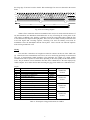
CK
STATE
idle
start
D15
D14
D13
D4
D3
D2
D1
D0
parity
stop
start
D15
D14
D13
D4
D3
D2
D1
D0
parity
stop
idle
idle
idle
TXRQ
TS
TXB
Word 1
Word 2
Frame
Fig. 2: Transmitter timing diagram
The data stream is Manchester modulated, which is essentially an exclusive-OR of the NRZ
data with the shift register clock. This combines data and clock information into a single signal and
removes DC components from the data stream, which is necessary to allow transformer coupling of
the twisted pair wire interconnect.
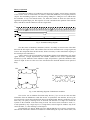
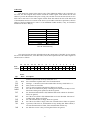
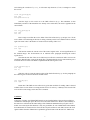
A mere exclusive-OR of clock and data would produce glitches in the Manchester code output
signal. Therefore, a simple asynchronous state machine (ASM) has been used to implement this
function [5,6]. This ASM takes clock and data as input, and produces a glitch-free Manchester data
stream as output. It does so at the cost of one extra macrocell in the PLD and half a clock period of
delay.
Ck D
M=0
00
Ck
M=1
01
Ck
Ck D
Ck D
D
M
Ck D
10
M=0
Ck
11
M=1
Fig. 3: State and timing diagrams of Manchester modulator
The receiver uses an MAD85 from Data Delay Devices [7] to recover the clock and data
information from the Manchester coded data stream. A synchronous state machine, driven by the
recovered clock, converts the serial data back into 16 bit parallel format. Data are put into the receiver
FIFO only if no parity or framing errors are detected. The detection of a single error entails the
rejection of the remainder of the frame being received. The receiver treats consecutive words, i.e.,
words separated by only a single stop bit, as a single frame, and will signal its readiness only at the
end of the frame, i.e., after detecting a second stop bit.
Upon detection of a start bit, /RXB goes low to indicate that the receiver is busy. It remains low
until the end of the frame. Parallel received data is available during the stop and continue states, and
2