1
Chapter 4
NI-DNET Programming Techniques
Change-of-State (COS) I/O
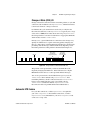
Change-of-State I/O connections use the same timing scheme as cyclic I/O
connections, but in addition to the ExpPacketRate, COS I/O sends data
to the master whenever a change is detected.
For COS I/O, the cyclic transmission is used solely to verify that the
I/O connection still exists, so the ExpPacketRate is typically set to a large
value, such as 10,000 (10 seconds). Given such a large ExpPacketRate,
the main performance concerns for COS I/O are an appropriate MAC ID,
and if needed, a nonzero InhibitTimer.
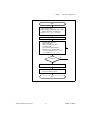
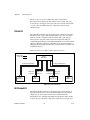
In many cases, a given COS I/O device cannot detect data changes very
quickly. If a COS device is capable of detecting quickly changing data,
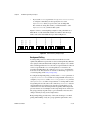
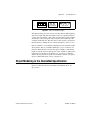
there is a chance that it could transmit many COS messages back-to-back,
precluding other I/O messages and thus dramatically impairing overall
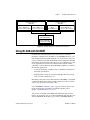
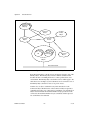
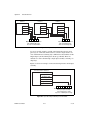
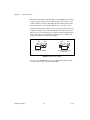
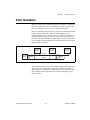
DeviceNet performance. This problem is demonstrated in Figure 4-5.
Back to Back
COS I/O Data
Changing Frequently
COS I/O
0 ms
5 ms
10 ms
Some of the
Other I/O May
Have Timed Out
15 ms
20 ms
Figure 4-5. Congestion Due to Back-to-Back COS I/O
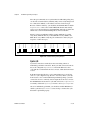
This problem can be prevented if you increase the MAC ID of the
frequently changing COS I/O device. If the COS device has a higher
MAC ID than other devices, it cannot preclude their I/O messages.
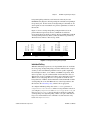
You can also prevent back-to-back COS I/O messages if you set the
InhibitTimer driver attribute using ncSetDriverAttr. After
transmitting COS data, the I/O connection must wait InhibitTimer
before it can transmit COS data again. A reasonable value for
InhibitTimer would be the smallest ExpPacketRate of an
I/O connection with a larger MAC ID than the COS I/O device.
Automatic EPR Feature
For cyclic I/O connections, a valid ExpPacketRate is required for
your call to ncOpenDnetIO. For COS I/O connections, a nonzero
ExpPacketRate is recommended for your call to ncOpenDnetIO but
can be set to a large value.
© National Instruments Corporation
4-7
NI-DNET User Manual