1
or microprocessor cycles.
I've always used VOX to key the radio for both SSB and digital modes. To prevent hot-switching of
T/R relays, nearly all modern rigs include circuitry that delays RF by about 10 msec after VOX or
PTT is initiated, and also delay PTT to power amps by that amount. For this reason, VOX works very
well, and greatly simplifies the interface to radios. I'm a contester and 6M weak signal Dxer, so I use
power amps (a Ten Tec Titan and an Elecraft KPA500), and I make several thousand digital QSOs in a year.
Fast forward several years to 2014. I had not been active using JT65 for a year or so, but when I got back
to it, I loaded WSJT-X and started using it for the mid-summer 6M Sporadic-E season. With WSJT-X, I'm
seeing occasional JT65 decodes of -22 signals, and -24 decodes of JT9 signals.
The Tascam US100 was discontinued soon after I bought it, and has been replaced by several new
models, some with more features, but all more expensive than the US100. The Numark Stereo IO has
also been discontinued, and it's replacement is not suitable for our uses. Among current Tascam models,
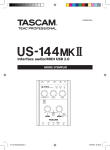
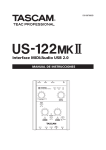
the US122, US144, and the recently discontinued US125 have all of the relevant features we need,
plus some we don't, at about $100. All of these models are likely to be found on the used market, and
amazon recently showed some US125s at a closeout price. In addition to B&H Photo, Sweetwater and
Full Compass are two other widely respected vendors of audio gear. I've known the Full Compass owners
for nearly 40 years, and still do business with them.
New Favorites, March 2015: N8LP alerted me to them – they are the ASUS Xonar U5 and U7 that he
recommends for use with his LP-Pan SDR hardware. I've tested both for RTTY, JT65, and JT9, and both
work quite well – even on a crowded band with a dozen decodes per pass, I often saw JT65 decodes in
the range of -24, and JT9 at -26. I paid $70 for the U5 at B&H Photo. N6NUL loaned me his U7 to test.
The U5 comes with drivers for Win XP through Win 7, the U7 comes with drivers for Win 7 through
Win 8.1 I tested on a Thinkpad running Win 7-64 Pro.
Alternatives: Certainly there are other products that will work well, and others that have issues. A local
ham who is quite active in RTTY contesting suggested a tiny interface that New Egg sells for about $18
under the GWC brand. I bought one and tested it. It's q u i t e compact, but of poor build quality.
It decodes fine – when it works – but I found connections to it to be intermittent.
The SignalLink USB has been sold into ham channels for many years. A support applications note I saw a
few years ago on the DX Engineering website described symptoms and fixes that strongly suggest to me
that the unit has a Pin One Problem. A recent QST piece by OZ1PIF in the Hints and Kinks column shows
how to improve it's mediocre weak signal performance, but fails to notice it's Pin One Problem. I don't
recommend it.
I view specialized “do everything” ham interfaces as overly complicated to set up and over-priced. Some
have interconnect cables that look like an invitation to RFI. If you're using VOX to key the radio, all you
need for digital modes is one of these USB interfaces.
Rig Control If you also want software to control the radio (for contesting or general logging) you also
need an RS232 interface. For many years, I've used either the hardware RS232 port built into a Port
Extender for my Thinkpads, or a Quatech DSP-100 PCMCIA card that provides two hardware RS232
ports. Newer vintage computers no longer support these cards, nor do they have RS232 ports, so you'll
need some form of USB to RS232 interface. USB to RS232 interface cables are widely available at low
cost. Make sure that the one you buy uses the FTDI chipset (and watch out for counterfeits).
Links to Current Products (May 2015)
http://www.bhphotovideo.com/c/product/1086995-REG/asus_xonar_u5_sound_card.html
http://www.bhphotovideo.com/c/product/1053131-REG/asus_xonar_u7_7_1_usb.html
How Do You Know If You Need A Better Interface? If you run JT65 or JT9 using JT65-HF or WSJT-X, it's
easy to tell. If you regularly see decodes of weak signals with indicated levels in the range of -19 to -22,
you've got a nice sound card with input level set well. If you rarely see decodes below about -14 to -16,
you either need a better interface, or you need to more carefully set the input level to the one you have.
Setting Sound Card Input Level is important to achieving maximum signal-to-noise performance. With the