1
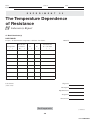
E X P E R I M E N T
2 2
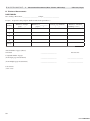
The Temperature Dependence
of Resistance
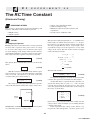
INTRODUCTION AND OBJECTIVES
electrical applications, it is important to know temperature coefficients and to take into account the temperature
dependence of resistances. In this experiment, this temperature dependence will be investigated and the temperature
coefficients of some materials determined.
After performing this experiment and analyzing the
data, you should be able to:
The electrical resistance of all substances varies somewhat
with temperature. For pure metals and most alloys, the resistance increases with increasing temperature. However,
for some substances, such as carbon and many electrolytes
(conducting solutions), the resistance decreases with increasing temperature. Then, too, for some special alloys [for
example, constantan (55% Cu–45% Ni)] the resistance is
virtually independent of temperature over a limited range.
The temperature dependence of resistance for a substance is commonly expressed in terms of its temperature
coefficient of resistance, which is the fractional change in
the resistance per degree change in temperature. For many
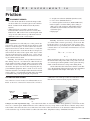
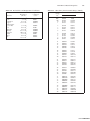
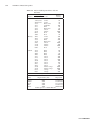
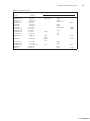
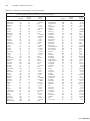
1. Explain how the resistances of common metallic conductors vary with temperature.
2. Discuss the temperature coefficient of resistance for
various materials and the differences among them.
3. Describe what is meant by the exponential temperature coefficient of a thermistor.
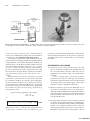
• Immersion vessel and stirrer
• Thermometer
• Immersion heater and power source (or Bunsen
burner and stand or hot plate)
• 2 sheets of Cartesian graph paper
EQUIPMENT NEEDED
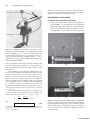
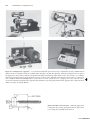
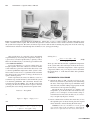
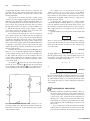
• Slide-wire Wheatstone bridge assembly (with a 3-V
battery and a single-pole, single-throw switch)
• Standard decade resistance box
• Copper coil (and optional constantan or manganese coil)
• Thermistor
where R is then the resistance of the conductor at some
temperature T (oC), and Ro is the resistance at To 5 0 oC.
The linearity of the temperature dependence is only
approximate, but Eq. 22.2 can be used over moderate
temperature ranges for all but the most accurate work.
In contrast to pure metals, which have positive temperature coefficients of resistance (increase in resistance
with increase in temperature), some materials have negative temperature coefficients (decrease in resistance with
an increase in temperature). Carbon is an example, and
negative temperature coefficients of resistance generally
occur in materials of intermediate conductivity, or semiconducting materials.
Carbon has a relatively small negative temperature
coefficient of resistance compared to other semiconducting materials. Such materials with large negative temperature coefficients are used in commercial components
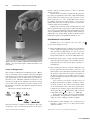
called thermistors. A thermistor is a thermally sensitive
resistor made of semiconducting materials such as oxides
of manganese, nickel, and cobalt.
Because of relatively large (negative) temperature
coefficients, thermistors are very sensitive to small temperature changes and are used for temperature measurements
THEORY
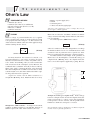
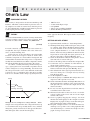
The change in resistance, DR, of a substance is proportional to the change in temperature, DT . This change in
resistance is commonly expressed in terms of the fractional
change DR/Ro, where Ro is the initial resistance. For many
substances, for example metals, the change in resistance is
to a good approximation a linear function of temperature:
DR
5 aDT
Ro
(22.1)
where the constant of proportionality a is called the
temperature coefficient of resistance and has the units of
inverse temperature, 1/ oC, or oC21.
For the change in temperature DT 5 T 2 To, it is convenient to take the initial temperature To as 0 oC and with
DR 5 R 2 Ro. Eq. 22.1 can be written
R 2 Ro
5 aT
Ro
or
R 5 Ro 1 RoaT 5 Ro(1 1 aT)
(22.2)
325
www.ATIBOOK.ir