1
Network Camera
User’s Manual
Version: 1.2
Date: 04/10/2007
Content
1.
Preface ................................................................................................................................. 2
2.
Product Specifications........................................................................................................... 2
3.
Product Installation ............................................................................................................... 4
A.
Hardware Installation......................................................................................................... 4
B.
Monitor Setting .................................................................................................................. 4
C.
IP Assignment ................................................................................................................... 5
D. Install ActiveX Control ....................................................................................................... 7
4.
Live Video ............................................................................................................................. 9
5.
Configuration ...................................................................................................................... 11
A.
System ............................................................................................................................ 11
B.
Network ........................................................................................................................... 14
C. A/V Setting ...................................................................................................................... 18
D. Event List ........................................................................................................................ 22
6.
Network Configuration ........................................................................................................ 26
7.
Factory Default ................................................................................................................... 28
8.
Package Contents............................................................................................................... 29
Appendix .................................................................................................................................... 30
1
1. Preface
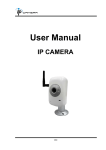
PiXORD P405 is a CMOS network Camera. It builds in web server. User views real-time
video via IE browser. P405 supports MPEG-4 video compression which provides smooth
and high quality video. The video can be stored in the SD card, and can be playback
remotely.
P405 is an easy-to-use network camera which is designed for home security application.
2. Product Specifications
z MPEG-4 compression
z Supports SD card for local recording
z Wireless network connection (Optional)
z 2-way audio
z Online firmware upgrade
z Real-time video recording
z Compatible with Microsoft Windows Media Player
2
Hardware
CPU
ARM 9 ,32 bit RISC
RAM
64MB
ROM
8MB
Image sensor
1/4” CMOS
Microphone
Built-in
Network
Ethernet
10/100 Base-T
Network Protocol
HTTP, TCP/ IP, SMTP, FTP, PPPoE, DHCP, DDNS, NTP
Wireless (Optional)
Wireless
802.11b/g
WEP
64/128 bit
System
Video Resolution
640x480, 320x240, 160x120
Video adjust
Brightness, Contrast, Saturation, Hue
Image snapshot
Yes
Full screen monitoring
Yes
Compression format
MPEG-4
Video bitrate adjust
CBR, VBR
Motion Detection
Yes, 3 different areas
Triggered action
Mail, FTP, Save to SD card
Pre/ Post alarm
Yes, configurable
Security
Password protection
Firmware upgrade
HTTP mode, can be upgraded remotely
Simultaneous connection
Up to 10
Audio
Yes, 2-way
SD card management
Recording trigger
Motion Detection, IP check, Network break down (wire only)
Video format
AVI
Video playback
Yes
Delete files
Yes
Web browsing requirement
OS
Hardware
Windows 2000, XP, 2003, Microsoft IE 6.0 or above
Suggested
Intel-C 2.0GHz, RAM: 512MB, Graphic card: 64MB
Minimum
Intel-C 1.6GHz, RAM: 256MB, Graphic card: 32MB
3
3. Product Installation
A. Hardware Installation
1. Connect power adaptor
2. Connect Ethernet cable
3. Set up the network configurations according to the network environment. For further
explanation, please refer to chapter 6, “Network Configuration for P405”.
B. Monitor Setting
1. Right-Click on the desktop. Select [Properties]
4
2. Change color quality to “Highest (32bit)”.
C. IP Assignment
IP Installer is a utility that provides an easier, more efficient way to configure the IP
address and network settings of the network camera. It even provides a convenient way to
set the network settings for multiple devices simultaneously using the batch setting
function. Moreover, IP Installer can save the network settings for all devices as a backup
and restore them when necessary.
z Always consult your network administrator before assigning an IP address to your
server in order to avoid using a previously assigned IP address.
z Ensure the network camera is powered on and correctly connected to the network.
z MAC Address: Each network camera has a unique Ethernet address (MAC address)
shown on the sticker of the camera.
z One final note, although the IP Installer is able to find and configure any network
camera on the LAN except those that are behind a router, it is a good idea to set the
host PC to the same subnet. In order to connect to the Web-based user interface of
the network camera, the host PC must be in the same subnet. For more information
about subnets, please consult your network administrator.
1. Use the software, “IP Installer” to assign the IP address of P405. The software is in
the attached software CD.
2. Click “IP Installer” from the CD menu to start the installation.
5
3. Once IP Installer has been successfully installed on the computer,
double click the IP Installer icon on the desktop, or select it from Start
> Programs > PiXORD Corporation > IP Installer > IP Installer.
4. The IP Installer window is displayed below. Click the menu bar Tool > Search
Network Device to search the network camera in the LAN.
5. From the list, select the device with the MAC Address that corresponds to the
device that is to be configured.
6. Double click the item to open the Property Page dialog box for the selected device
or click the menu bar View > Property.
7. After filling in the properties, click
[Synchronize] button to
complete the configuration
settings and save in the network
camera and PC immediately. If
click [OK] button, the
configuration is only be saved in
the PC.
6
8. To access the Web-based UI of the selected unit, run the View > Open Web on the
menu bar.
9. If the device has been configured correctly, the default Web browser will open to the
home page of the selected device.
D. Install ActiveX Control
For the first time to view the camera video via IE, it will ask you to install the ActiveX
component.
If the installation failed, please check the security setting for the IE browser.
1. IE Æ Tools Æ Internet Options… Æ Security Tab Æ Custom Level… Æ
Security Settings Æ Download unsigned ActiveX controlsÆ Select “Enable” or
“Prompt”.
2. IE Æ Tools Æ Internet Options… Æ Security Tab Æ Custom Level…
ÆInitialize and script ActiveX controls not marked as safe Æ Select “Enable”
or “Prompt”.
7
1
2
3
4
5
When popup the following dialogue box, click [Yes].
8
4. Live Video
Start the IE browser, type the IP address of the network
camera in the address field. It will show a dialogue box.
Key-in the user name and password. The default user
name and password are “admin” and “admin”.
When connect to the P405. The following GUI shows.
r
s
n
o
p
q
t
c Languages: Select the language to display the user interface. There are English,
d
e
f
g
Traditional Chinese, and Simplified Chinese can be selected.
Size: Select the resolution to display the live video.
[Snap Shot]: Video Snapshot.
[Configuration]: Get into the administration page.
Chatting: P405 supports 2-way audio. Click the “Chatting” check box. Then you can
9
h
i
use microphone which connect to the PC to talk to server side, which is P405 side.
Shows how many users connect to this network camera.
Show system time, video resolution, and video refreshing rate.
Double-click the video, it will change to full screen mode. Press [Esc] key or double-click
the video again, it will change back to normal mode.
Right-Click the mouse on the video, it will show a pop-up menu.
1. [Snapshot]: Save the video as a jpg picture.
2. [Record Start]: Record the video in the local PC. It will ask you where to save the video.
To stop recording, right-click the mouse again, and select [Record Stop]. The saved
video format is AVI. Use Microsoft Media Player to play the recorded file.
3. [Mute]: Turn off the audio. Click again to turn on it.
4. [Full Screen]: Full-screen mode.
10
5. Configuration
Click [Configuration] to get into the administration page. Click [Live Video] to back to the
live video page.
A. System
1. System Information
Set up the camera name, select language, and set up the camera time.
a. Server Name: This is the Camera name. This name will show on the IP Installer.
b. Select language: There are English, Traditional
Chinese, and Simplified Chinese can be
selected. When change, it will show a dialogue
box for the confirmation of changing language.
11
c. Server time setting: Use NTP or Input Date & Time manually.
d. Click [Apply] to save the settings.
2. User Management
P405 supports three different user groups: administrator, general user, and
anonymous user.
12
a. Anonymous User Login:
Yes: Allow anonymous login.
No: Need user name & password to access this network camera.
b. Add user:
Type the user name and password, then click [Add/Set].
c. Click [Edit] or [Remove] to modify the user.
3. System Update
To update the firmware online, click [Browse…] to select the firmware file. Then click
[Upgrade] to the procedure.
Reboot system: Re-start the network camera
Factory default: Delete all the settings in this network camera and backs to the
factory default values.
13
B. Network
1. IP Setting
P405 supports DHCP and static IP.
z Static IP: Type IP address, subnet mask, gateway, and DNS manually.
z DHCP: Using DHCP, P405 will get all the network parameters automatically.
2. PPPoE
14
a. Select [Enabled] to use PPPoE.
b. Key-in Username and password for the ADSL connection.
c. Send mail after dialed: When connect to the internet, it will send a mail to a
specific mail account. For the mail setting, please refer to “Mail and FTP”
settings.
3. DDNS
P405 supports DDNS (Dynamic DNS) service.
a. DynDNS:
i.
ii.
iii.
iv.
Select [Enable] to enable this service
Key-in the DynDNS server name, user name, and password.
Set up the IP refreshing rate in “Schedule Update” field.
Click [Apply].
15
b. Camddns service:
i.
ii.
iii.
Key-in user name.
Set up the IP refreshing rate in “Schedule Update” field.
Click [Apply].
c. DDNS Status
This field will display the message to indicate the status of DDNS:
z Updating: Information update
z Idle: Stop service
z DDNS registration successful, can now log by
http://<username>.ddns.camddns.com: Register successfully.
z Update Failed, the name is already registered: The user name has
already been used. Please change it.
z Update Failed, please check your internet connection: Network
connection failed.
z Update Failed, please check the account information you provide: The
server, user name, and password may be wrong.
16
4. Wireless Setting (This feature is optional)
This feature supports 802.11 b/g wireless connection.
a. Mode: Follow the wireless AP
you use to set up the parameter
in this field.
b. Operation Mode: Select “Auto”,
it will detect the wireless mode,
or you can select by yourself.
c. SSID: Select “Default” is
recommended.
d. Security: P405 supports “WEP”
and “WPA-PSK” security
encryption.
17
C. A/V Setting
1. Image Setting
a. Adjust “Brightness”, “Contrast”, “Hue”, “Saturation” and “AE Reference” to get
clear video.
b. It will get clear vision in low light condition, when “Day / Night” is enabled. The
frame rate will slow down when this mode is “On”.
18
2.
Video Setting
a. Basic Mode
i.
Resolution
There are 3 resolutions to choose.
z VGA – 640X480
z CIF – 320X240
z QCIF – 160X120
ii.
Quality
There are 5 levels to adjust, the higher the quality is, the bigger the file
size is.
iii.
Video System
z Please select “60Hz” if you are in America, Taiwan…
z Please select “50Hz” if you are in Europe, China…
19
b. Advanced Mode
i.
Resolution
There are 3 resolutions to choose.
z VGA – 640X480
z CIF – 320X240
z QCIF – 160X120
ii.
Bitrate Control Mode
There are CBR (Constant Bit Rate) and VBR (Variable Bit Rate) to use.
z CBR;64Kbps~4Mbps
z VBR:Q=3~30
iii.
Video Frame Rate
The video refreshing rate per second.
iv. GOP Size
It means "Group of Pictures". The higher the GOP is, the better the
quality is.
v.
Video System
z Please select “60Hz” if you are in America, Taiwan…
z Please select “50Hz” if you are in Europe, China…
20
3.
Audio
P405 supports 2-way audio.
a. For network camera to local PC, select [Enabled] to start this function.
b. For local PC to network camera, check “Chatting” in the browsing page.
The Audio will not be smooth when enable SD card recording function
simultaneously.
21
D. Event List
P405 provides multiple event settings.
1. Event Setting
a. Motion Detection
P405 allows 3 areas motion detection. When motion is triggered, it can send the
video to some specific mail addresses, transmit the video to remote FTP server,
and save video to local SD card.
To set up the motion area, click [Area 1:], [Area 2:] or [Area 3:] button. Using
mouse to drag the area on the video. Click [Apply] when you finish one area
22
setting, and then set up another area if necessary.
To enable the motion detection, enable the check box of area, and then select
the actions when the motion is triggered.
b. Network IP Check
For the use of recording software, P405 supports the detection of this
connection. Whenever the connection is down, it records the video to SD card to
make sure the video recording is continuous. To use this function:
i. Select [Enabled].
ii. Key in the IP address of the PC which is installed the recording software.
iii. Select the interval time between the network detections.
iv. Check the check box of “Save to SD card”
v. Click [Apply] button.
This function is only enabled in wire connection.
2. Mail & FTP
To send out the video via mail or ftp, please set up the configuration first.
23
3. SD card
Please Insert SD card before use it. Make sure pushing SD card into the slot
completely.
Note: The use of the SD card will affect the operation of the P405 slightly,
such as affecting the frame rate of the video.
ÆÆ
a. Playback
i.
It will show the capacity of the SD card. Click the date listed on this page,
it will show the list of the video.
ii.
The video format is AVI. Click the video to start Windows Media Player to
play it.
To delete the video, check it, and then click Del. When the SD card is full,
iii.
it will remove the earliest video automatically.
24
b. Record Setting
The Pre/ Post Alarm are adjustable in P405.
25
6. Network Configuration
1. Configuration 1
z
z
z
z
Internet Access: ADSL or Cable Modem
IP address: One real IP or one dynamic IP
Only P405 connects to the internet
For fixed real IP, set up the IP into P405. For dynamic IP, start PPPoE.
2. Configuration 2
26
z
z
z
z
z
Internet Access: ADSL or Cable Modem
IP address: More than one real IP or one dynamic IP
P405 and PC connect to the internet
Device needed: Switch Hub
For fixed real IP, set up the IP into P405 and PC. For dynamic IP, start
PPPoE.
3. Configuration 3
z
z
z
z
z
Internet Access: ADSL or Cable Modem
IP address: one real IP or one dynamic IP
HLC-830 and PC connect to the internet
Device needed: IP sharing
Use virtual IP, set up port forwarding in IP sharing.
27
7. Factory Default
To recover the default IP address and password, please follow the following steps.
1. Press and hold the button in the back of P405.
2. Power on the camera. Don’t release the button during the system booting.
3. It will take around 30 seconds to boot the camera.
4. Release the button when camera finishes proceed.
5. Re-login the camera using the default IP (http://192.168.1.200), and user name
(admin), password (admin).
28
8. Package Contents
1. PiXORD P405 Network Camera
2. Adapter
3. Ethernet Cable
4. CD title (User manual, IP installation Utility)
29
Appendix
The compatible list of SD card
ADATA 4G
OK
PRETEC 128M
OK
ADATA 512M
OK
Photofast 256M
OK
Blast 128M
OK
Phast 256M
OK
Canon 16M
OK
PK 128M
OK
GiGATEK 128M
OK
Q0000 16M
OK
Kingston 128M
OK
READY 128M
OK
Kingston 256M
OK
SiliconPower 128M
OK
Kingston 512M
OK
SiliconPower 256M
OK
Kingston 64M
OK
TEKQ 256M
OK
Kingmax 256M
OK
TEKQ 128M
OK
LEXAR Media 16M
OK
Toshiba 32M
OK
Mio Ma 32M
OK
Toshiba 256M
OK
SanDisk 32M
OK
Toshiba 128M
OK
SanDisk 128M
OK
TwinMOS 128M
OK
SanDisk 256M
OK
TwinMOS 256M
OK
SanDisk 1G
OK
Traveler 64x2M
OK
Trancend 256M
OK
Trancend 128M 45X
OK
Trancend 512M
OK
UMAX 128M
OK
Panasonic 16M
OK
U-TEK 128M
OK
Panasonic 64M
OK
30