1
Project Abstract
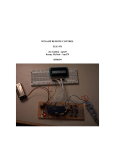
Applications of digital imaging range from amateur photography to machine vision. This project
shows how a CMOS ‘Camera On a Chip’ image sensor can be used to build a high resolution web camera.
An I2C bus controls the image sensor, and the pixel data is buffered in SDRAM to be uploaded through the
parallel port to be displayed on a PC. The external hardware, FPGA design, and software application for
the camera will be described in this paper. Introduce myself
System Overview
Motivation for the design
For my senior project at Oregon Institute of Technology, I wanted something creative and flashy that
would challenge me as an engineer. The design needed to demonstrate my skills to prospective employers
in a job market that is centered on experience. The original idea behind the project was to place a camera
on a RC car. Then the car could be controlled much like a racing game from a computer.
Appropriate technology and implementation style
After much research on image sensors, the choice to use CMOS over CCD became clear. CCD
sensors typically offer superior image performance, CMOS sensors consume less power and are easier to
interface and control. (http://www.dalsa.com/markets/ccd_vs_cmos.asp) The Kodak KAC-1310 CMOS
sensor I chose integrates the analog to digital converters in the sensor, so all I/O ports to the sensor are
digital.
An FPGA was appropriate to control the sensor and buffer the data while minimizing component
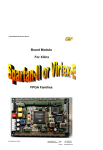
count. I chose a XESS XSA-100 Spartan II development board to interface between the parallel port and
the image sensor. With 100k gates and 16Mb of storage, I had enough room and speed to implement
everything I needed.
Design methodology and why it methodology was chosen
After short consideration, VHDL was chosen over Verilog to implement the design. I prefer the strong
type checking of the language, and it also eased the integration of two third party cores into my design. The
general design mythology was to take large, already built components and assemble them together. Then I
implemented the glue code and controllers myself. The task was still daunting. Implementing someone
else’s code can be more difficult then writing it from scratch.
Satisfying the system requirements
My project specification calls for capture of high resolution images through the parallel port. In the
now completed design, the host PC can repeatedly capture an image from the camera and write it out to a
bitmap. The limited bandwidth of the parallel port restricts the video frame rate, but this was certainly
expected.