1
2006:322 CIV
MASTER'S THESIS
Alpha
a usability study
Ellen Andersson
Marielle Bergström
Luleå University of Technology
MSc Programmes in Engineering
Computer Science and Engineering
Department of Computer Science and Electrical Engineering
Division of Media Technology
2006:322 CIV - ISSN: 1402-1617 - ISRN: LTU-EX--06/322--SE
ALPHA
a usability study
Ellen Andersson & Marielle Bergström
Master of Science in Computer engineering
Luleå University of technology
Department of Computer science and Electrical engineering
2006
Abstract
This Masters Thesis has been performed at TeliaSonera in Luleå, Sweden, 2006.
TeliaSonera has gradually since 2003 implemented Alpha, a new system which aims at
assisting operators working in customer service at TeliaSonera. Alpha falls in the category of
standard systems, purchased from Oracle and modified by TietoEnator. A standard system
implies certain constrains both regarding the implementation process as well as on the
organization.
Today operators working in customer service complain about Alpha; they feel that the system
is hard to use. This thesis contains a usability study of Alpha. It discusses the usability issues
considering both the conditions of customer service and the boundaries of standard systems. It
also discusses possible aids for improvement. An alternative help system is one solution to
ease the operators’ situation. Making the system more consistent by performing small changes
in the user interface is another.
A flash prototype was developed to demonstrate the suggested improvements to the existing
help function. The prototype has a more active character than the existing help function in
Alpha. It is brought closer to the application resulting in easier access, which may lead to
increased usability. In addition to the improved accessibility it offers several possibilities for
searching help which all leads to the same goal of finding correct information fast. A
consequence of this will be satisfied customers.
This thesis concludes that the general standard system design means usability tradeoffs. It is
hard to completely satisfy all users because of their varying area of use. The thesis also
concludes that some of these usability issues can be bypassed by having a supporting help
system. It is not possible to change Alpha to fit the users’ needs completely; it is too
expensive and takes time. Instead a suitable help system can be developed as a complement to
the main system.
Ellen Andersson
Marielle Bergström
I
Table of content
1
Introduction
1
2
Theory
3
2.1
Research procedures.................................................................................................... 3
2.2
User interface design................................................................................................... 4
2.2.1
What is a good user interface? .................................................................................... 4
2.2.2
Ten usability heuristics................................................................................................ 4
2.2.3
Navigating in the interface .......................................................................................... 4
2.2.4
Minimized/maximized application.............................................................................. 5
2.2.5
Beginners versus experts user level ............................................................................ 5
2.3
Standard systems ......................................................................................................... 6
2.3.1
Software cost ............................................................................................................... 7
2.4
Help systems ............................................................................................................... 7
2.4.1
What beginners need ................................................................................................... 8
2.4.2
What intermediate users need ..................................................................................... 8
2.4.3
What expert users need ............................................................................................... 9
2.4.4
Wizards........................................................................................................................ 9
2.5
Acceptance of Standard systems ................................................................................. 9
3
Methods
11
3.1
Opening general study............................................................................................... 11
3.2
Improvement suggestions.......................................................................................... 12
3.3
Prototype development.............................................................................................. 12
3.4
Validating the prototype............................................................................................ 12
4
Summary of the survey
13
5
Improvement suggestions
15
5.1.1
Responsibilities of the standard system provider, Oracle ......................................... 15
5.1.2
TeliaSonera’s responsibilities ................................................................................... 20
5.1.3
TeliaSonera’s and Oracle’s shared Responsibilities ................................................. 20
6
The prototype
22
6.1
The help system......................................................................................................... 22
6.2
The wizard................................................................................................................. 27
7
Result
29
7.1
Results from the prototype evaluation ...................................................................... 29
7.2
Results from the Interview with the establishment team .......................................... 31
8
Discussion
32
8.1
TeliaSonera’s standard system, Alpha ...................................................................... 32
8.2
Acceptance of Alpha ................................................................................................. 34
8.3
Alpha; considering the graphical user interface........................................................ 35
8.3.1
Usability heuristics.................................................................................................... 35
8.3.2
Navigating Alpha ...................................................................................................... 37
8.3.3
Beginners and experts in Alpha ................................................................................ 37
8.4
Help system ............................................................................................................... 37
8.4.1
Prototype development.............................................................................................. 38
Ellen Andersson
Marielle Bergström
II
8.4.2
Prototype evaluation.................................................................................................. 38
9
Conclusions
39
9.1
Propositions for further studies ................................................................................. 40
10
References
41
APPENDIX A
42
Result of the usability survey ................................................................................................... 42
APPENDIX B
45
1
Interviews
45
1.1
Prototype evaluation interviews ................................................................................ 45
1.1.1
Prototype evaluation interview 1............................................................................... 45
1.1.2
Prototype evaluation interview 2............................................................................... 46
1.1.3
Prototype evaluation interview 3............................................................................... 47
1.2
Interview with the establishment team...................................................................... 48
APPENDIX C
51
Questions from the prototype evaluation interviews................................................................ 51
Ellen Andersson
Marielle Bergström
III
1 Introduction
TeliaSonera AB is one of the leading telecommunication operators in the Nordic and Baltic
countries, Russia and selected Eurasian markets. They offer telecommunication services for
voice (fixed/mobile), images, data, information, transactions and entertainment. One of
TeliaSonera’s most important goals is simplicity. Their product should be easy to use.
This thesis is concentrating on the Swedish part of the company; TeliaSonera Sweden and the
problems they face. The telecom operator market has stepwise, since late 90s, turned into a
public market. Today the competition is full blown and TeliaSonera has faced a severe loss of
customers.
TeliaSonera Sweden is divided into different departments, each responsible for specific areas
such as private customer service, technical support and invoice service. Customer service
employ about 3,400 persons, they give service and support to customers through the
telephone. About 20 million phone calls are handled yearly. TeliaSonera is a customer
oriented company; the policy is to meat each customer with intimacy in a way that creates
value for money. In this environment the customer service function is an absolutely vital part
of TeliaSonera Sweden.
Customer service has certain goals to meet besides helping customers. The calls should be
short and effective but also aim to sell supplement services. Since the information about the
customers are stored in a database there has to be a well working computer system to manage
the information and at the same time help customer service to simplify their tasks in order to
achieve their goals.
Today customer service uses a wide range of computer systems. This is a result from
introducing new systems for almost every new service. This leads to long waiting times when
the users have to toggle between the systems to collect all necessary information about the
customer. This means that the customer sometimes has to wait a long time and might not get
the help they need because the operator cannot find correct information or do not know where
to look. Sometimes the operator cannot help the customer at all and has to direct the call to
another department. The call can be directed many times before reaching an operator with
suitable competence. This is a problem.
Alpha is a new computer system that has been introduced to customer service, in the long run
Alpha intends to replace a number of old systems. Its main goal is giving the user
comprehensive information (i.e. a 360 degree view) about the customer. Via the new solution
customers are supposed to be helped in a more efficient way without being directed to
different departments. Alpha also supports development of new services and offers in an
easier way than before. This is important for TeliaSonera in order to reduce the time it takes
before new products reaches the market. Fast introduction is essential to stay competitive.
Alpha is based upon on an ERP platform called E-business suite developed by Oracle, a world
leading database developer. On top of Oracle’s platform TeliaSonera has developed
customized applications in order to fulfill their specific needs. One example is the forms for
configuring a phone connection which is made specific for TeliaSonera. The integration and
customizing of Alpha are made by TietoEnator.
Ellen Andersson
Marielle Bergström
1
The name Alpha stands for
•
•
•
•
•
Work procedures
Profitability
Products
Intellectual capital
The deal
Arbetssätt
Lönsamhet
Produkter
Human kapital
Affären.
However, today Alpha is far from finished even though it is in use by some departments. It is
constantly under development in different areas. For example private customer service (as a
whole) has not yet been introduced to Alpha. This means that only some customer
information has been converted to Alphas database and the vision about seeing all
information about the customer is not yet met. New functionality will stepwise be introduced
to the system and extensive development projects are ongoing in the broadband area. Since
Alpha is a standard system it is not built to fit TeliaSonera exactly, implying adjustments of
work procedures. Until the work procedures are completely adapted there will be
dissatisfaction among the users which might lead to unsatisfied customers as well. Even
though TietoEnator have customized the software, they cannot change everything. Their
changes must always lie within the boundaries that a standard system offers. This is where our
work begins. How can one change Alpha to make it more usable to customer service? And
maybe even more important; is it possible?
The purpose of our work is to evaluate Alpha and make suggestions for improvement of the
graphical user interface in order to make the system more usable. If this will be obtained the
employees will be able to do an efficient job, as a consequence, TeliaSonera will take one step
closer to their goal of being Sweden’s best customer service.
To limit the project the main focus is set on those working in customer service in the
enterprise segment. Technical issues such as response time and equipment such as mouse and
keyboard are not considered. When improving a standard system there are some extra issues
to consider. Changes have to stay within the boundaries of the standard system otherwise they
will be too extensive and costly and the whole idea with a standard system will be lost.
Ellen Andersson
Marielle Bergström
2
2 Theory
The theories that our work is based on are stated in the following chapter. It covers research
procedures, user interface design and different theories about help and standard systems.
Acceptance of the system is something that also seemed relevant and was brought to our
attention during our time at TeliaSonera.
2.1
Research procedures
This section is about qualitative and quantitative methods which describe factors that need to
be considered before making surveys and interviews. The following paragraphs are
conclusions taken from Carlsson via his books [1] and [2].
There are many ways one can perform a search, but they are usually divided into two main
groups, qualitative and quantitative. Qualitative methods consist of research procedures which
focus on describing data. It can explain why people think in a certain way, or why/how
something works. Quantitative methods do not focus on the reason behind the result. Instead
fixed data and stating results are important. The result should be well founded in the research
material and it should be fairly easy to measure.
Another thing that separates the two methods is the determination of the survey population. In
the quantitative search the population is described in detail before the survey starts in contrary
to the qualitative search which starts at once. Qualitative studies have no fixed timeframe and
the researcher will continue his study as long as new relevant information appears. [1]
It is up to the researcher to choose the method which supports his research questions the most.
No single method or group of methods is best suited for all types of research. In some cases it
is not possible to choose one of these methods and then it is justified to use both. In both
methods it is important to guarantee the validity and reliability of the material. Validity is
defined as the methods ability to measure what is intended. The reliability of a method is the
degree of precision at which it operates. To increase the validity one can measure with two
independent methods and thereby verify the results. It is required that a measurement has to
lead to the same result if it is repeated by someone else independent of the first. It is also
important for the researcher to interpret the result. Objectivity is also of great importance
otherwise the result will undoubtedly be colored. [1]
The qualitative interview can be described as an unstructed and flexible interview which is
similar to an ordinary conversation. This interview concentrates on deep information rather
than broad. Other types of interviews are more structured and can be compared to those found
in a questionnaire. The structured interviews are bound to present specified questions and the
order of the questions is decided. The interviewer’s role is simply to read questions and note
the answers; a glorified questionnaire. Similar behavior is requested in all interviews and the
goal is to be as neutral as possible. These types of interviews are often used when the
questionnaire is long and the questions hard, it is also suitable when it consists of many open
questions. Participating observations is when interviews and observations is made in the
participant’s natural environment. [2]
In a quantitative survey it is rather important to state how well the studied sample represents
the entire population. In a qualitative search this is not of equal importance even though
studying more people will make new aspects of the problem viewable. In the selection of
participants it is necessary for the researcher to think about what potential participants are
Ellen Andersson
Marielle Bergström
3
expected to contribute with. It is important for the participators to have an interest in the
survey, it will motivate them to give correct information. It is hard to check whether the
information is valid or not. There is always a risk that the participant gives incorrect
information and most likely this is not done on purpose. The researcher and the participant
can simply have different perspectives which makes one thing valid for the participant but not
for the researcher
2.2
User interface design
This section contains guidelines for what to consider when making a good user interface. It
talks about the user; how he works and thinks, and how his user level influences his behavior.
User heuristics is an important part of interface design; they simplify the evaluation process
and can be a good support when designing applications.
2.2.1 What is a good user interface?
According to Finley and Beale in [3] the problem with designing a good user interface lies in
both satisfying the user while still constructing a realistic technical solution. Often technology
receives the highest priority which leads to neglected users. Of course both must be
considered but it is not obvious that the priority must be the technology, at least if the user
satisfaction is a goal. There is no point having a system with advanced functionality if the
users cannot use it. [3]
2.2.2 Ten usability heuristics
When designing a user interface there are, according to Rogers and Sharp in [4], ten
checkpoints to consider. The explanations of these heuristics are stated below. Later on they
will be used to evaluate Alpha.
1. Visibility of system status – always keep users informed what is going on through
providing appropriate feedback within reasonable time.
2. Match between system and the real world – speak the users’ language, use words,
phrases and concepts familiar to the user, rather than system-oriented terms.
3. User control and freedom – provide ways of allowing users to easily escape from
places they unexpectedly find themselves in, by using clearly marked ‘emergency
exits’.
4. Consistency and standards – avoid making users wonder whether different words,
situations, or actions mean the same thing.
5. Help users recognize, diagnose, and recover from errors – use plain language to
describe the nature of the problem and suggest a way of solving it.
6. Error prevention – where possible prevent errors occurring in the first place.
7. Recognition rather than recall – make objects, actions, and options visible.
8. Flexibility and efficiency of use – provide accelerators that are invisible to novice
users, but allow more experienced users to carry out tasks more quickly.
9. An esthetic and minimalist design – avoid using information that is irrelevant or rarely
needed.
10. Help and documentation – provide information that easily can be searched and
provides help in a set of concrete steps that can easily be followed.
2.2.3 Navigating in the interface
In [5] Cooper talks about navigating the interface. He states that it is of great interest that the
most frequently used commands are especially quick and easy to invoke. The problem is to, in
advance, find out which commands that are used the most. It is not possible to know which
Ellen Andersson
Marielle Bergström
4
the most frequent used commands will be. What one user uses daily might not be used at all
by another. Placing all commands in front making them equally available would be the ideal,
but hardly possible. Different ways to navigate and invoke commands must be offered and
allowing users to personalize their toolbar might be a good way.
In the same way, commands should be given multiple executing paths, users must also be
given alternatives for using the mouse or the keyboard. Beginners are known to prefer the
mouse while frequent users like to remember keyboard shortcuts, but everyone uses both in
their own favorite combination. [5]
After a user evaluation of a prototype the user population might be divided in half. One half
prefers the function and the other dislikes it. For example one group might like the dropdown
menu while the other prefers the toolbar. Arguments for each option might be equally valid.
To this kind of splits there is no other solution than satisfying both groups. It is important to
separate between personal tastes and results from user testing. If you find a significant group
with similar opinion, they must be satisfied even if there are three or four conflicting groups.
[5]
2.2.4 Minimized/maximized application
Minimized applications are used in many different forms, but their usefulness can be
questioned. Cooper claims in [5] that the icons are always covered and necessary information
is invisible and states that minimized applications suites those with small screens. A user who
uses few applications during the day is not helped. They have no need for running multiple
programs with overlapping windows. Zooming and reorganizing windows is bad design. The
solution is to use something familiar to windows start bar. It able smoothly changes from one
window to the other without the need of rescaling and position the window on the screen. [5]
2.2.5 Beginners versus experts user level
It is important to know which knowledge-level the target users have. Factors concerning
experience are therefore discussed in the following section. These are discussed in [5] by
Cooper.
All software users are at one point beginners. Some will eventually become experts, but they
are a small minority. Most users will never become experts of a particular program, and will
stay at an intermediate level forever. It is hard if not impossible to find the balance between
adapting the user interface to suit the beginner as well as the expert. Most software developers
must be considered to be experts of their program and they tend to develop user interfaces for
other experts. Unfortunately few expert users exist. Another bad design idea is adding too
simple beginner help aids. It is often used to compensate for the complex interface developed
by expert. These aids might have a condescending tone and are therefore often ignored
completely. Even if they are used by beginners, users do not stay at the beginner level long
and the help soon becomes offensive. To predict a good user interface level it is necessary to
understand the users’ learning curve. [5]
Most users stay at a beginner level but struggle to improve their performance. Their skills are
changing and depend on how frequent they use the program. It is important to let the
beginners find an easy way to move from the beginner to the intermediate state while
preventing beginner aids to bother the experts. If a user’s learning do not progress
satisfactorily and move beyond the beginner level fast enough they will avoid using the
program. No one appreciates to feel incompetent at their work. [5]
Ellen Andersson
Marielle Bergström
5
“Nobody wants to remain a beginner. It is merely a rite of passage everyone must pass
through. Good software shortens that passage without bringing attention to it“. [5]
Another important issue is the experts influence on less experienced users. When a buyer
considers a software application he will trust the experts’ opinion. But just because an expert
considers a program good, it might not mean that the program is good for an intermediate
user. However, intermediate users usually know that advanced features exists, even though
they may not know how to use them, but it works as a motivator for them and will motivate
them to buy and use the product. [5]
2.3
Standard systems
This section contains the definition of a standard system and also covers the pros and cons of
this type of systems.
According to Törngren and Magnusson in [6] the definition of a standard system is; a
complete system that can be employed instantly, more or less. Tailored systems have to be
developed from scratch and can therefore not be employed directly. A standard system is a
general system that is built on one or several computer systems. One reason for choosing a
standard system is to avoid reinventing existing solutions. Often changes have to be done to
the standard system as well as the organization of the purchasing company to achieve a fully
functional system.
A standard system has to be flexible, it is supposed to fit various types of companies and their
wide range of needs. When bought it often lacks up to a fifth of the functionality says
Törngren and Magnusson in [6]. Sometimes companies realize that there is missing
functionality which might be hard to compensate for after the purchase. A reason for this can
be sloppy problem analyze and lacking demand specification which entice them to invest in
an unsuitable software. Adjusting the software to fit the organization might also be tricky. The
functionality of a standard system is not always completely utilized, often standard systems
are complex which makes the user unaware of the complete functionality. To get a more
successful system companies often change their organization to fit the system and this can
cause problems.
It is cheaper to purchase a standard system than a tailored system. This depends on the fact
that several companies can use it. The buying companies can be considered to share the
development and maintenance costs of the system. One disadvantage of the standard system is
that it makes the purchaser dependent on the developer. The developer lacks knowledge of the
buyer’s organization, but they still have to rely on the system that the developer creates. It is
also possible that the developer will forbid the buyer to make further developments in the
system leaving the buyer totally dependent on the developer’s competence. A reason for this
might be to secure future sales of updates and further developments for the developer. [6]
Törngren and Magnusson argue in [6] that a company cannot expect to use a standard system
as a weapon in the competition with competing companies. If they use the same systems they
will receive the same advantages. Therefore the competition cannot continue in that area and
other steps must be taken to win the constantly ongoing competition.
A standard system developer creates distance between themselves and the buyer by handling
their contacts through several middlemen. Furthermore the implementation is often done by a
third party. The relationship when making a tailored system is the opposite of this, it is very
tight. [6]
Ellen Andersson
Marielle Bergström
6
2.3.1 Software cost
It might be hard to realize that the cost of software is higher than that of hardware. The
common thing to forget is one part of the software cost is the cost of installing, training and
supporting the users. Another thing that should be included in the expenses for software is the
loss of income. The employees will not generate an income to the company while learning
and training. Their productivity might also be decreased while their user level is in the
beginner state. The cost of lost opportunities might be of the highest value. One conclusion
from this is never to let software decisions depend solely on the cost of the software it self,
even investments in new hardware might be justified. The key is to compare the total cost of a
new software solution which includes every cost until the program is up and running in full
scale, not just the price of the software itself. [5]
2.4
Help systems
This section discusses which issues to consider when designing a good help system for a
software application. It talks about different types of help systems and how the user perceives
them.
Help systems are used to give the user a better understanding on how to use the software.
There are many ways one can offer a user manual for a program. The worst way is offering
help through the program documentation. Another poor way is offering user manuals through
an online help system. It will make the user responsible for finding a way to use the program,
and it relies on the fact that the online help is discovered. Ultimately online help is not
important, the same way one does not read the TV manual. But still there must be a reference
document where users who wish to gain deeper knowledge can find definite answers. The key
to make a successful reference document is to supply good tools for navigation. An index is
an example of a good navigation tool. What makes the reference manual better than a
hardcopy is the increased search functionality. Whether it is better or not depends on how
good the index is, not on the quality of the search tool. Having a professional indexer is
necessary to create a good index, however, very few indexes are done by professionals says
Cooper in [5]. The user will accept a poorly written entry more certainly than he would
forgive a missing one. Therefore even if the number of entries is large the index would
probably be benefited by doubling the entries. [5]
The concept of an online help function is weak and it would be better if it is presented
transparently over the program or built right into the face of it. An example is the underscore
mark of letters in menus which indicates the Alt-letter shortcut. Another option is to have an
extra menu containing a list of shortcuts. This method is explicit and therefore pedagogic.
New users can see that multiple ways for executing commands exist and there is an easy way
for finding and learning. All programs should offer this kind of shortcut menu item says
Cooper in [5].
Tool tips are effective and a usable help. More help of that sort would be useful. Tool tips can
be extended and visual symbols can be used to indicate optional commands. For example, a
tiny symbol could be placed on every tool tip that has shortcuts to visually make the user
aware of the functionality. [5]
According to Fisher, Lernke and Schwab in [7] there are two major architectural differences
between help systems. These are called active and passive systems. A passive help system
gives help only when consulted. It does not know anything about the user’s actions or
knowledge. Active systems on the other hand, are built to know exactly what the user is
Ellen Andersson
Marielle Bergström
7
doing. They are designed to give guidance and suggestions based on what the system knows
about the user. They interfere with the user, trying to give support. Active systems are
considered to be much closer to the application than passive help systems. There has to be
some communication between the application and the active system, otherwise the system is
in no way of knowing what the user is doing and can therefore not provide guidance. Passive
systems do not need to know anything, making communication unnecessary.
Adelheit [8], talks about active help systems. It describes how they assembled a group of
users that had to learn a new application with help from an active help. Observing those users
it showed that some of the users did not read the information material before the test.
However, it did not matter because the help system adjusted to the user’s level.
According to Tattersall [9], one can classify help systems into three different categories;
divorced, separated and integrated. A divorced system does not know anything about the
application, it gives help only when consulted and help usually comes in large chunks of prestored text. A separated system has some knowledge about the application. It communicates
with the application and adapts somewhat to the user. In this category help comes in prestored text as well. However, some modifications to the text have been made. The third
category; the integrated system, is totally integrated in the application. It knows all about the
user and its actions and is able to interact with the user in order to provide the best possible
help.
The role of a help system is not to provide help for absolute beginners; they stay away from
the help anyhow. It is too complex. Basic functionality should be self-explanatory. Otherwise
it is unacceptably bad and no help will help. Help systems are for intermediate and expert
users. [5]
2.4.1 What beginners need
Beginners must be considered as both intelligent and busy. They need some instructions but
not too much, and the process should be fast. They lack time and reading heavy manuals that
describe everything in detail are not of interest. What they need and want is to understand
cause and effect, getting a basic understanding is important.
Beginners need extra help that can and should disappear when they become intermediates.
This means that the extra help cannot be fixed in the interface. Another bad option is online
help. Online help is the correct tool to use for reference information, beginners need
understanding. A guided tour which can be constructed with dialogs is more suitable.
Beginners rely on menu commands, which might be slow but are detailed and reliable. The
toolbars can be a distraction. [5]
2.4.2 What intermediate users need
As the users become more and more familiar with the interface they want to find new ways to
make their work more efficient. They want faster access to tools; they make more use of tool
tips and toolbars and are motivated to read in the reference material to learn as long as it is not
too much at once. The online help function is therefore a tool for intermediate users. Users
will navigate the online help function by the index so it must be clear and structured. The
users will demand that the tools in their working set are placed with in reach, both easy to find
and remember. [5]
Ellen Andersson
Marielle Bergström
8
2.4.3 What expert users need
Experts primarily demand faster access to their working set of tools, which might be quite
large. They will occasionally look for advanced functionality and will use it a lot to make
their work more efficient. An expert is eager to learn more and wants to find new ways to use
the program in his work. Experts appreciate new features. [5]
2.4.4 Wizards
A wizard works in a guiding way, directing users every step, not allowing them to fail. Every
dialog contains a question or two and in the end the program performs whatever action
decided in the dialogs. Wizards are written as step by step procedures, not letting the user
come with any suggestions. The user becomes a robot. Making monotonous tasks contributes
to the user negligence and risks that the user only presses a button in reflex not analyzing
why. The failsafe guide is then failing. This kind of guide is normally too demanding to be
used in daily services. [5]
2.5
Acceptance of Standard systems
This section talks about what to consider when implementing a standard system and how to
get it accepted by the members of the organization. According to Friman and Göransson in
[10] there are many factors to consider when in the process of anchoring a standard system.
These will follow below.
•
The user has to be given a chance to put the system in a context. They have to have a
total view and understand why the system is implemented. The system cannot change
the organization, only the people in it. Those people can only change if they want it
themselves. They have to understand the reasons to why they have to change.
•
Information has to be delivered in an early stage. This is because the user needs to
know what is going in order to feel in control. This will prevent users from getting a
negative view or from getting the wrong idea about the system. If the user already has
received a negative view it is much harder to change it.
•
It is important that the buyer and the supplier make a reasonable presentation of their
application so that the user does not expect too much. This is particularly important in
the case of a standard system, because the system is not complete when the buyer
makes his purchase.
•
The information given to the user has to be adjusted to the users’ previous
experiences. It has to be shaped in to a well designed strategy otherwise the user will
not adjust to it and accept the information. There are different approaches such as
push- or pull-strategies. Push-strategy is when the user is drowned with information.
Pull tries to either figure out what the user wants to know and then provides only that
information, or waits for the user to seek the information themselves.
•
Informal information can be used to find out which acceptance level the system has.
•
Education is an additional way for spreading the goals and ideas with the standard
system.
Ellen Andersson
Marielle Bergström
9
•
The company that implements the standard system should see the users as a resource
in the acceptance process. If you convince one user he can then continue convincing
other users and you will get a domino effect.
•
There should be a group of users present during the systems development process. The
group is then able to contribute with knowledge about the organization and daily work
which makes the system a better fit to the organization. Another effect of this will be
that the users participating in the group will feel like it is their system and will then
continue to “preach” the systems benefits.
•
It is important that the users feel some responsibility. This will motivate them, but
only if the amount of responsibility is within manageable limits. If it excide the limits
the users will feel overloaded, on the other hand, if it is to little users will feel
powerless and neglected.
•
Goals of usage should be established so that it is possible to measure how frequently
the system is used. It is important that these goals are realistic and measurable, but
also that the users feel motivated to reach them.
•
Another thing which is very important is to create a sense of that the system is
indispensable for the organization. The users will then use the system while thinking
they cannot do their tasks without it. This can be achieved by removing the old
systems which forces usage of the new system.
Ellen Andersson
Marielle Bergström
10
3 Methods
In order to recreate and understand how studies are made following chapter describes the
employed methods. It connects to the theory chapter were comprehensive descriptions of
methods can be found. These methods are used for gaining ideas of the prototypes
development and evaluation as well as finding solutions to problems.
3.1
Opening general study
The theory section described available methods for research. Forthcoming paragraphs will
describe why some were used and explain why others were considered unsuitable. Four
methods of information collection were used; passive observations, surveys, interviews and
informal information. These will be described in the section below.
Passive observation was the first method used. Users’ behavior was observed and notes about
what they did and what problems they faced were obtained. In addition to the passive
observations, users gladly shared information about problems and bugs they found or had
discovered earlier in the system.
The second method was to conduct a survey. It was used to get a clear picture of the systems
weaknesses and strengths. Because of the positive feedback and willingness to give opinions
in the beginning of the study, a survey seemed suitable for collecting even more information.
Due to users willingness to participate a rather large survey was constructed and did not seem
to be a problem. The numbers of participators in the survey was chosen to fulfill the demands
of a quantitative study. A quantitative study was chosen in order to reflect the opinions of the
user population, not describing individuals.
It was impossible to conduct a survey that covered the complete system at depth, due to the
systems large scope, therefore two options were considered. Either to conduct a specialized
survey which focused on one or a couple of specific tasks, or conduct one focusing on the
fundamental concepts of the system. The second option was chosen. One reason for that
choice is that a general study would benefit more users. In contrary, if a more narrow study
had been made it might have lead to optimization of one specific task and therefore only one
specific group of users would have been facilitated. The survey was therefore constructed
with questions of a comprehensive nature.
Two survey groups with 10 participants each were requested to answer the survey. Both
groups where chosen from the customer service department handling enterprise cases.
Experience with the system separated the two groups. The department in Helsingborg was
chosen because of their long experience, Luleå because of their availability. The availability
was considered as a benefit, if further studies had to be performed these people would then
easily be available.
The third method was interviews. One interview was made as a complement to the survey. It
was made in a questionnaire manner. The nature of this interview is naturally of a qualitative
character as interviews easier reveal extensive information. It was performed by asking the
complete set of questions from the survey. It was possible to explain and evolve question, as it
was made orally, which in return gave more details in the answers.
In addition to these three methods, it has been possible to achieve a deeper understanding
through the informal information collected by listening to operators in their daily work. Their
Ellen Andersson
Marielle Bergström
11
conversation with customer and colleges has been easy to follow since our workplace lied in
the same office landscape as the operators.
3.2
Improvement suggestions
Ideas and solutions to problems emerged when the result from the questionnaires and
interviews were reveled. The solutions were often obvious and simple. The hardest part was
to find every flaw as they were spread through out the whole application. Brainstorming and
recalling earlier experience of solutions were the employed methods. However, developing a
help function is more extensive and the methods used will be explained in more detail in
forthcoming section.
3.3
Prototype development
After the opening study the need for change and improvement of the help system seemed to
be a suitable area to consider. Suggestions improve to the help systems shortcoming were
considered essential. Development of ideas took place mostly by brainstorming but also
through literature studies of [3], [7], [8], and [9]. To best present the ideas with the improved
help system, a simple demonstration/prototype was constructed. The prototype was built in
Macromedia Flash. Flash was used because it is a good tool to create visual demonstrations. It
was also considered to be portable when most computers can play Flash files.
3.4
Validating the prototype
The prototype was presented to four different persons, three of them were “Key users” of
Alpha. A key user is a person who is considered an expert of Alpha and its usability issues
and has a teaching role to their colleges. Their opinion was considered crucial. The fourth
person was also a key user, but not for Alpha. A reason to include an outsider was that the
help system should be general enough and therefore easy to understand not only for expert
users.
The evaluation of the prototype was conducted in an interview/discussion form. First the
prototype was presented and then questions were asked to start a discussion. A goal of the
interview was that it should be as relaxed and informal as possible to make the participant
safe and thereby start an open discussion. The purpose was to validate the prototype, further
proposals where encouraged.
Ellen Andersson
Marielle Bergström
12
4 Summary of the survey
This is a summary of the result from the opening general study; the complete result can be
viewed in Appendix A. The study contained questions that could be answered on a scale of 15, 1 is always representing negative and 5 is always positive views.
The overall user experience is about two years. Users’ education is estimated to about one two weeks continuous education occurs now and then.
The over all grade of Alphas logic lies between 2 and 3. The user states that they cannot find a
logical order and claims that they have to learn the order.
When investigating Alphas workflow, two camps were found; one camp thinks that it is quite
clear, the other thinks that it is very unclear. However, they seem to be of the opinion that
they will learn with time; “you get used to anything”. Some users feel that the workflow is
concordant with the customer conversation. Although, many users feel that they have to do
the conversation in a specific order to fit the systems flow. One user feels that it is
uncomfortable to have the customer wait on the phone while doing the tasks, because it takes
too long.
TeliaSonera’s goal with Alpha was that is should hold a 360 degree view of the customer.
When asking the users about this the combined grade is 3. One stated the grade 2 and gave an
example of crucial information absent, such as customer subscriptions. There were a lot of
other users who stated missing information as well. Users seem to have other systems
assisting them in order to gain a total view of the customers. Judging from users’ extensive
list of used systems they seem to think that Alpha does not have the 360 view over the
customer, not yet anyway.
The usage of the existing help function seems to be varied. Some uses the help function and
finds it quite satisfying. However, there are many users who only use the help function in a
small amount. They complement the help function by asking their coworkers.
Short commands seem to be used by some of the users. They were of help for some, hard to
remember for others and some liked them.
The response time was not to satisfaction. Users feel that it takes too long for the program to
respond and that it is much worse then before the implementation of Alpha. They seem to
prefer completing their tasks while the customer waits on the phone. To meet this wish short
response time is necessary.
There were also questions about the tabs found in Alpha. Few answers were given to these
questions. But in general they seem to be pleased with the visual appearance of the tabs.
However, they state that they are missing information in some of the tabs while other tabs
were thought of as quite cluttered.
Menus and toolbars seemed to be appreciated visually and they think that it is good to have
functions gathered in this way. They requested ways to create own shortcuts to functions.
When asking if the users use dropdown menus or if they prefer toolbars two equally large
camps were found.
Ellen Andersson
Marielle Bergström
13
A question if the user wishes to change anything with the application was asked. Surprisingly
few answers were given. Faster response times and more consistent naming were the only
suggestions given.
Ellen Andersson
Marielle Bergström
14
5 Improvement suggestions
Based on the opinions given in the questionnaire the following improvement suggestions are
proposed. They are divided in three sections each containing improvements which are
considered to be performed either by TeliaSonera, Oracle or a combination of these. Some
are small and easy to implement, others are more extensive and has to be implemented
gradually.
5.1.1 Responsibilities of the standard system provider, Oracle
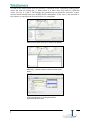
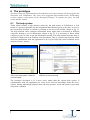
Tabs should not be clickable if no customer is chosen (fig. 1 and fig. 2). A simple clarification
which can avoid misunderstanding, a usability issue which all users would be benefited of.
Figure 1
Problem: Fields found in the tab panel can be
edited even though no customer is chosen.
Figure 2
Solution: Make fields unavailable if editing them
is pointless. With clear visual hinting,
misunderstandings can be avoided.
Support for construction of specialized tools and shortcuts would be good in order to fill
different users need. By avoiding a fixed toolbar less energy could be devoted into deciding
which tools it should contain and instead more on making a general toolbar suiting everyone.
Alphas toolbar is shown in fig. 3.
Figure 3
Offering the user possibilities to customize the toolbar would satisfy many.
Ellen Andersson
Marielle Bergström
15
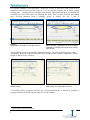
A push on the Enter button does not generate a consistent result. Sometimes pushing Enter
means the same as clicking the [..] button while it in other cases will result in a different
action. See fig. 4, 5 and 6. The naming and graphical layout should be consistent, a basic
demand which should have been fulfilled before distribution. If this issue is not attended to
the software is considered defect and will receive complaints.
Figure 4
When pushing Enter this pop-up window will appear.
Figure 5
When the [..] button received a click this view will be
shown
Figure 6
In this case pressing [..] and pressing Enter
generates the same view.
Ellen Andersson
Marielle Bergström
16
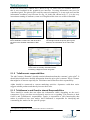
It is unclear whether a field possesses a value-list 1 or not, to find out a click on the field is
required. If one exist it is necessary type to a “%” to reach the complete list of values, simply
clicking the […] button will give an empty search form. This means that there is too much job
reaching for a tool which goal is to simplify the work. This is a basic function that should
have received attention from a usability group at Oracle. See fig. 7 and 8.
Figure 7
No indication of hidden functionality is given.
Figure 8
When the field, organisation, receives a click its
appearance changes and a symbol for a value
list is shown.
The possibility to resize all windows should be obvious. The lack of this function is rather
remarkable. When the window is maximized no changes in the window’s appearance can be
found, as shown in fig. 9 and 10.
Figure 9
Before scaling
Figure 10
After scaling, no visible effect is shown.
To facilitate quick navigation and the use of keyboard-shortcuts it should be possible to
navigate between all fields with the help of ALT-tab- buttons.
1
A list containing possible input values.
Ellen Andersson
Marielle Bergström
17
There are many occasions when the users need to save their work but this is rarely indicated
in the graphical user interface. Most dialogs misses a save button, users have to instead use
the save button in the shortcut toolbar as shown in fig. 11. This seems quite illogical. The
need for saving at all might be questioned. Saving is basically a shortcut method for not
having a backward button but many users are familiar with a save functionality and likes it. It
can therefore be justified to have. If a save functionality is used it should, however, be visible
to users and it should be clear when they are supposed to save. Having a save button in
appropriate places should be more suitable.
Figure 11
Save button found in the shortcut-toolbar
When working with the work queue the status of the service-commission must be changed
manually. This is to show that someone is currently working the case otherwise someone
might make conflicting changes. This could be done automatically. Today the cases position
in the work queue will change even if it is opened and closed without any changes. It will be
moved to the bottom of the queue even if it just was brought up by mistake. The position of
the service-commission in the queue should not be changed. A user must have the freedom to
look into cases without changing their positions in the queue.
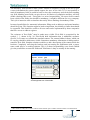
To improve visibility of system status, open windows should be made visible in the work
area. Today the opened windows are shown only under the window drop-down menu. No
indication of which windows opened exists. The windows lie on top of each other covering
their existence. Implementing a start bar, similar to the one found in Windows, will prevent
this (fig. 12).
Figure 12
All windows opened are made visible, making it easy to toggle between them.
A complete list of customers addresses can be found under the tab named
”addresser/telefonnummer” (fig.13 and 14). This list will easily be long and it can be
necessary to have a function which can filter some of them, for example it could be an option
to hide all inactive addresses. It should also be possible to create addresses when needed.
Ellen Andersson
Marielle Bergström
18
Today the user is forced to abandon their tasks and return to the window where addresses are
created.
Figure 13
A long list of addesses can be hard to search.
Figure 14
A filtering option can decrease the list and
make the search easier.
It is not clearly visible if a message has or do not have an appendix enclosed. The only
indication, see fig. 15 and 16, is a small icon shown in the menu bar and only when a selected
message is chosen, this is easy to miss.
Figure 15
A massage without attachment
Figure 16
A message with attachment
Ellen Andersson
Marielle Bergström
19
In the tab current info (“aktuell info”) shown in fig. 19, some rows are clickable. However,
this is not visualized in the graphical user interface. Covering information can never be
considered good. The priority pile could be removed completely, it is not used at all and the
information it radiates is not relevant. See fig. 18. In this tab, shown in fig. 17, it is also very
inconsistent naming of attributes; some are in English while some are written in Swedish.
Figure 17
Some attributes is written N/Y and other NEJ/
JA which is the Swedish translation of NO/
YES.
Figure 18
The thought behind the priority pile is good,
however, the information is too inaccurate.
Figure 19
These rows are actually clickable buttons,
something a beginner never can guess.
5.1.2 TeliaSonera’s responsibilities
The tab Contract (“Kontrakt”) should contain information about the customer’s price-plan2 . It
should also include more detailed information about the price-plan’s content. This is a feature
that might be of interest especially for TeliaSonera and is therefore their responsibility.
Alpha should be connected to current marketing activities. Operators could then easier
suggest suitable products and thereby increase their sales.
5.1.3 TeliaSonera’s and Oracle’s shared Responsibilities
There should be modes that can adjust the information visible depending on the user’s
competence. Every user does not necessarily need to see everything. This function is both
Oracle’s and TeliaSonera’s responsibility. Oracle is responsible to offer functionality that
makes it possible to have user modes, and TeliaSonera is responsible for classifying and
customizing the modes for the specific groups.
.
2
Price-plan is an agreement of which prices the customer is entitled to.
Ellen Andersson
Marielle Bergström
20
All mandatory fields should be made visible. Instead of completely relying on the user to give
correct information the system should support the user in his work. If it is not possible to
mark all mandatory fields it would be better to keep the consistency and refrain from marking
any field. Marking some fields can give the user an illusion of completion and they will skip
double checking their work. Fixing this is a mixed responsibility. Of course Oracle cannot
know which of the fields who should be mandatory, it might be different for every company.
Their job is instead to offer an interface that easily allows marking of mandatory fields.
Increased possibilities for automatic information filling such as addresses and postal numbers
should be given. This function might be hard to implement, but initially a feature that should
be supported. This should be useful to all users and can be implemented by those companies
that have access to address registers.
The existence of flexi-fields 3 must be made more visible. Flexi-field is recognized by the
symbol, [ ], shown in fig. 20. Flexi-fields hold information that is additional, customer
specific, or in some way outside the standard content. The content hidden in them, which can
be varying, should be made more visible. Sometimes mandatory information is hiding under a
nameless flexi-field. Simplest solution would be to add a description of the content inside the
brackets. Completely removing the brackets and just naming the field/button with a proper
name could also be a working solution. This is a shared responsibility were Oracle should
give the possibilities to name the fields and TeliaSonera’s duty to actually do the naming.
Figure 20
Visual appearances of flexi-fields.
3
A flexi field is actually like a button and will when clicked open a window which contains extra information.
Ellen Andersson
Marielle Bergström
21
6 The prototype
The help system was evaluated due to the indication of its shortcomings which emerged in the
discussion with TeliaSonera. Our survey also suggested improvement needs. Forthcoming
sections contain a description of the developed prototype. It contains two parts, the help
system and the wizard.
6.1
The help system
Today Alpha includes a help function written by the lead trainers at TeliaSonera. A lead
trainer is a person responsible for the information and education given to the users. Access to
the current help function is reached by clicking on an icon in the toolbar, shown in fig. 21.
The help function offers complete information about Alpha and is structured in different
categories forming a tree of information, shown in fig. 22. It is necessary to know which
category to pick in order to get the information needed. The help content describes how to
navigate in Alpha as well as complete work procedures. This is a passive help function which
does not communicate with the application at all. It gives help only when consulted and is
unaware of users’ actions.
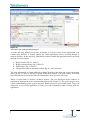
Figure 21
The current help system is reached
from the toolbar.
Figure 22
Overview of the current help
The prototype developed is of a more active nature than the current help system. It
communicates with the application on some levels and has knowledge about the user’s
actions. Among other things it knows where the user operates. As the old system it gives help
only when consulted.
Ellen Andersson
Marielle Bergström
22
Figure 23
Overview of the developed help prototype
To make the help function even more accessible it is moved closer to the application. The
current help function is located outside the main application and is accessed through a
separate window. In the new help, information is shown within the application and is accessed
through several locations;
•
•
•
•
Region names (fig. 23, label 1),
Region question mark (fig 23 label 2),
Field names (fig. 23 label 3)
The question mark in the main toolbar (fig 21), same as before.
The help information is found within the window located on the right side of the application
shown in fig. 23 label 4. All help is found within that window. The help window is divided
into different tabs to easily find relevant information, more about the tabs later.
When a region name is clicked a window appears. The text displayed in the windows is
explanatory information of the corresponding region (fig. 24 label 1). The goal is to give users
a basic understanding of the regions purpose. Windows can be moved and closed. They will
always lie on top of the application to easily view the information while working with the
application.
Ellen Andersson
Marielle Bergström
23
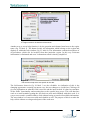
Figure 24
If a region names is clicked this will be shown
Another way to access help function is by the question mark button found next to the region
name (fig. 25 label 2). The button locates all information which belongs to the region and
displays it within the help window (fig. 23 label 4). The information contains descriptions of
all procedures which can be invoked from that particular region. In this way irrelevant
information is eliminated and users’ information-search is thereby simplified.
Figure 25
The access to help which are specific for this tab.
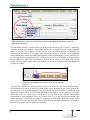
The field names shown in fig. 26 label 3 are also clickable. An indication of this is the
changing appearance occurring on mouse-over; the text changes to a bold font. Clicking will
give an explanation on what the field is used for and the input needed. It is hard to remember
all the fields’ functionality and meaning due to the systems large scope. This will therefore
work as a small reminder getting the user back on track and confident with their work. It is
easy to access and is reached within a click without having to search all available information.
The text-window is of course movable and closable as well. The purpose of this is to make the
help visible without covering needed parts of the work-area.
Ellen Andersson
Marielle Bergström
24
Figure 26
When pointing the mouse over the field name it gets a bold appearance and when clicked an
information box appear.
The main help-window is divided into five different tabs shown in fig. 27 label 4. All help is
available through this window. Today information can be found in several places and that
makes it hard to know where to look. In this way information-search is facilitated by
gathering all information in one place. The user knows where to look and can be confident
about finding help within the limited time that he possess. Information is in one place but can
be searched with several different tools. Offering several ways of searching for help broadens
the possibilities to find correct information. Sometimes the topic is very vague and a broad
search must be made, other times the subject is specified and browsing information by
categories is faster.
Figure 27
Overview of the different tabs found in the bottom of the helpwindow.
The first tab contains the search function. Users can search by keywords without further
specification of the topic or select to search within topics connected only to the opened tab.
Specification of a certain department can also narrow the search. When a search has been
made, the result is shown in a list within the help-window. To view the content of a specific
search the user can click on the search hit as it is a link to the detailed information.
Information is then displayed below the search field. If it is the desired information and
further guidance is needed it is possible to activate a wizard. More about the wizard in the
next section. Previous search results will be replaced by the detailed information. To return to
the search result the user can push the back button.
Ellen Andersson
Marielle Bergström
25
The user can find old search hits under the History tab (Historik). Often users look for the
same things and repeating the same search is common. It is therefore possible for the user to
save the search hit. This hit is saved in the History tab and thereby enables an easy way to go
back and review old search results. The purpose is to give the user the possibility to make a
personalized “clipboard” which can be filled with whatever information the user feels
necessary.
Routine (Rutin) is a tab that contains all the routines. It is similar to the current help and is
structured like a tree. Sometimes this is the superior way to find information. For example
when the category is known and the user needs all information under that category. Detailed
information can on the other hand be hard to find. Even if it is there it can be lost in the
massive information. Because of the similarity to the current help function this will ease the
transition making it as seamless as possible for those users who uses the current help function.
There is also an Index tab which contains information listed in alphabetical order. This
information, if desired, is not limited to the user’s area of expertise (department). Sometimes
the user needs to access information not needed on everyday basis. The user is able to choose
if he prefer to view all information or just the information connected to the specific
department.
Links to the latest information is displayed in the next tab called News. Under this tab the user
can find additional information that will directly affect their work. Today this kind of
information is spread by each key user through mail and it is up to the key user to decide the
content of this mail. This leads to inconsistency in the information-flow. Key users have
different priorities which may result in different interpretations of the procedures. In worst
case this will lead to inconsistent information to the customers. An example of this kind of
news is updates on the installation time of broadband. Another is updates of procedures for
placing a specific order. In this way both users and key users can be guaranteed information
which is correct and updated.
The above suggestion of the help functions visual presentation will hopefully make the
transitions between help function and application transparent. It is useful to have a help
function close to the application making the user feel that the help function is a part of the
application. This will also avoid switching between windows to access the help function. The
help area is of course scalable if the user wishes to view more text.
Ellen Andersson
Marielle Bergström
26
6.2
The wizard
To evolve the idea with a help function which helps users in an efficient way it was decided to
develop a suggestion for a wizard. The wizard is supposed to operate transparently above
Alpha and should be easily activated through a button in the help function. It is possible to
activate the wizard whenever the user feels insecure about performing a task. The wizard
would then help the user with the task making sure all the mandatory fields are filled
correctly. It also shows the user if a certain order of procedures is necessary. To activate a
wizard for a specific task, users first have to search for the “manual” describing the desired
task and then activate it through pushing the button in the help function. A sequence of
pictures of the wizard is shown below. They explain how the wizard is supposed to work.
Figure 28
When a search for a routine is made the results will be shown as above. This view will be visible when
a desired manual is found and chosen.
Figure 29
The wizard is activated by clicking on the button named ”Activate wizard”. The wizard will then take the
user through the procedure step by step as shown in the figures below (figure 30-32).
Ellen Andersson
Marielle Bergström
27
Figure 30
Figure 31
Figure 32
This wizard can be of service to the user in many ways. When the user is a beginner they can
use the wizard to learn Alpha. This will make sure that all the beginners will receive the same
information no matter which office they are located in. By this the problems with consistency
in TeliaSonera education will be solved. The wizard can also be switched on when an
advanced user has to perform a new or seldom preformed task. A benefit from this is that the
users will not disturb their colleges, they will also feel more confident with their work as they
can manage on their own.
Ellen Andersson
Marielle Bergström
28
7 Result
Four interviews were performed in order to evaluate the prototype, these interviews can be
found in Appendix B. The result will be presented below. Three of these interviews were made
to validate the prototypes functionality. They were made with Eva Andersson (lead trainer),
Maria Stråmo (key user, private segment), Göran Ekersund and Daniel Behm (key users,
enterprise segment). Evaluation of the prototype was necessary in order to confirm the
prototypes validity and to obtain a successful help function. The fourth interview has a
different purpose. Its focus lies on the acceptance of Alpha. The interview was made with
Marie Lundquist and Magnus Lundqvist (members of Alphas acceptance group).
7.1
Results from the prototype evaluation
Daniel and Göran find the prototype appealing, especially the history tab. They think a history
function will lead to faster ways of finding help. We believe that users often get stuck on
particular things several times, Daniel and Göran confirm our suspicions. Users find it hard to
remember procedures that are seldom performed. Therefore they will only keep vague
memories of which help sections to look in and much time is spent on finding the desired
help. In those cases a history function would be really useful.
Eva liked the idea with putting the help closer to the application but she still wanted to keep
her old structure. A lot of work is put into the current help function and it would be a shame
to let it go to waist. However, most of the previous work could still be useful according to our
opinion and the only thing that should change would be the presentation of it, not the content.
Users ask their colleges all the time and do not look for answers in the help, this is a problem.
Eva agreed and says that she is trying to encourage the users to seek help on their own. She
preferred showing them how to find help instead of giving them exact answers. This is a good
start, but to motivate users to look for help they should be equipped with tools that support
them. A good search function would make it easier to find help. Eva agreed that a good search
function is needed and she has demanded one for a long time.
After observing the users work we could see that they had problems with the large amount of
fields. It seemed hard to remember what they meant. We therefore suggested some small help
text directly in the graphical user interface. However, we were unsure if this would be as big
help as we thought, and we were therefore glad when Eva agreed and thought it would be a
good idea. The short explaining text information was also well received by Daniel who said,
“Often the problem with using help is that it takes time to find particular details and you can’t
be sure to find it at all and you will therefore give up before even trying. It’s a big problem
just finding help for simple fields and tabs, so making short explanations would make it worth
reading the help instead of asking.” Göran continued and said “The navigation in today’s help
is not simple. It would also be good if everything were available in the help. The current
system is divided in different parts such as billing (“ta betalt”) and sell (“sälja”), words which
may seem obvious to the author but users don’t agree. Today the help is considered
intimidating and no one want to look or learn how to use it. The suggestion with the short
help text is good and will probably be sufficient to ease the understanding”.
We also asked what Daniel and Göran thought of a wizard, Göran said “It would be great in
the beginning. There are big problems with the education today, so sure, it would be very
helpful with a wizard. But it will also be great to help the different departments work in a
uniform manner. Today the lack of a uniform standard is a problem and a customer may
receive different answers depending on which city who answer the call”. Eva was skeptic
Ellen Andersson
Marielle Bergström
29
about the wizard idea. She doubted that it was technically possible to implement as many
tasks can be performed in different ways. Maria found the wizard function best suited for
beginners and those who do a procedure seldom. She also thought it would be suiting for
educational purposes. She thinks employing a wizard will make the education more
consistent, not letting different routines be interpreted differently. She points out a very
important problem and its solution; consistent education would solve the problems with
departments on different locations giving conflicting information. Maria also had an
interesting alternative to our suggested help function; she said “A system that is built on
questions and answers would solve the problems with finding help, help wouldn’t be needed”.
Again we agree but as this is not possible to implement in Alpha it lies outside the range of
this report and we disregarded her idea. However, for future projects it would be good to keep
this solution in mind. It would be a safe way to navigate users through their task with them
focusing on the customers’ problems instead of a complex system.
Maria thought that a help system should offer everything, not just specific help about the
application but also prices and routines. She also thought that routines should be easy to
understand and search, they should follow a standard, and every routine should be alike. It
was also interesting to see that she had not heard the roomers about an unchangeable system.
She was free to demand anything without limiting her demands. As she is very involved with
education she also emphasized how important it is to have an education that teaches the user
how to search help. If the user knows how to learn he can always find solutions and ways to
solve these. If he instead learns a number of fixed procedures he will stand clueless as soon as
he has to do new things or when procedures changes. She said “There must be an attitude
change to make people stop asking questions and search for help themselves” and emphasized
that a supporting environment that encouraged this kind of thinking was important. Göran
confirmed the problems with the attitude towards the help function when he said “The
education of the help isn’t made thoroughly. The help system is mentioned in some short
sentences, not more. Only a couple of questions are dedicated to the help system in the
training material”.
Another important goal of our help function was to make it useful under limited time frames,
the success of this goal was supported of Daniel who said that he thought that it was an easy
way to find help even with a customer waiting. But Göran objected to this and said “it should
only work if the system is updated continuously and the information is easy to read and
relevant”.
The suggestion to have a window bar at the bottom of the screen was not of interest for Eva,
she said, “It should clutter the interface” We do not agree with this opinion. The windows are
placed on top of each other and it is very easy to miss an underlying window. Of course
opened windows can be viewed in the window curtain menu, but this demands an active
action, and according to us it is hard to make anything too visible. Daniel on the other hand
agreed with us and said “Having opened windows always visible makes it easier to change
between them even though the education emphasized using the window menu. However, new
users have problems switching windows”
Eva has been a good source to us and she has given us a lot of valuable tips. When we asked
if she had any other opinions she pointed out that it was not possible to scroll in the windows
with the mouse. This is really remarkable. Daniel pointed out another flaw when he said
“Switching between windows within Alpha is a problem. No simple way exists, such as alttab which is used when switching between different programs. It would also be good to have
an automatic formatting of the windows for example resizing windows so that four windows
Ellen Andersson
Marielle Bergström
30
would be visible at the same time without doing the frustrating work of resizing and moving
them manually”
7.2
Results from the Interview with the establishment team
From the interview with the acceptance team we can conclude that TeliaSonera has made a
very thorough job with their acceptance process. They had a team which focused on getting
Alpha accepted among the users. Marie explained Alphas purpose and said “Alpha is a suit
that we can grow in.” By that she means that Alpha makes way for easier development of
future products. This was hard or even impossible to do in the old systems. The old systems
did not easily communicate with each other and it was therefore hard to supply combined
services derived from different systems. Marie continued “Alpha is an important step that we
have to take no matter what. It might not be the best system for the users, it will not make
their work easier, and it might even make it harder. But we have to stay focused on the big
picture. Alpha is a standard system and we have to adjust to it. We have to rethink our way of
working because otherwise the organization cannot evolve.” Alpha might be good for the
management but users who fight with this program in their daily work might easily forget this
picture as the program makes their job too hard. Marie said “We understand that getting a
new system will probably make the users feel uncomfortable. The whole structure of the
workplace will suddenly change. One user that was good at the old system might be bad at the
new one resulting in change of balance making users feel negative towards the system.” They
tried to solve this in many ways such as introducing key users, FAQ services and so on, but
the question is, is that enough? It is important to have a thorough acceptance process, but it
can not compensate for every flaw in the system. The users might accept some small flaws in
order to see the big picture but he will not forget things that bug him every day. Marie pointed
out that they tried to remind the user of the big goals every time users received new education.
Repeating the message is good to gain acceptance.
Marie also talked about some positive events for the future “Alpha is adjusting towards
increased usability. We have recently made some changes to make Alpha more suitable for
customer service”. What we can see some improvements are indeed made, but it might be
hard to regain acceptance.
Ellen Andersson
Marielle Bergström
31
8 Discussion
This chapter is divided in four parts and will discuss the standard system Alpha. It will talk
about Alphas difficulties and how they can be handled. User evaluation is an important step
towards solving these problems. It also discusses the prototype development and which
benefit it gives Alpha.
8.1
TeliaSonera’s standard system, Alpha
There are a lot to consider when implementing a standard system. There are many obvious
advantages, but unfortunately many drawbacks as well. Standard systems bring advantages
such as saving money by cutting development-costs. This is the idea behind a standard
system. It is a general solution allowing a wide range of use. However, the downside of a
general system is that it might be too general and will not suit any of the companies
completely. An “untouched” standard system like this will probably not be that usable. To
make a standard system a bit more usable the company has to customize the system. They
have to hire someone to implement the customizations if such are needed. Extra functionality
besides those supplied is expensive, not everything is possible making either. This is the
tradeoff; usability verses money. To achieve a more usable standard system the company has
to customize the application to suit their special needs and that means that the standard
system’s cost increases. However, the whole point with a standard system is to save money
and if they customize the system completely the cost will probably be too high and they
would be better off developing a system from scratch.
A conclusion is then; a standard system cannot be as usable as a tailored system. When
implementing a standard system you are bound to make usability tradeoffs. However, this
might be righteous. If the company has a flexible organization it is possible to adjust their
work procedures to better adapt to the systems behavior. Small changes in the organization
might be good, but if the system requires several fundamental changes it can be a problem.
As stated before, customer service operators at TeliaSonera are under high stress and are
required to answer questions fast and proper to achieve their high goals. In this case asking
the operators to adjust their work to a system will be displeasing. In the competition with the
competitors is it really worth to sacrifice the operators thus sacrificing the biggest asset, the
customers, in this way?
But the question is; is it really necessary? Is the only way, when dealing with a standard
system, either to invest a lot of money or to get dissatisfied users? Is it really necessary to
make this tradeoff? We actually think that this problem should not exist. The system
developer should not be allowed to deliver an incomplete system. We believe it is possible to
make a usable standard system. The simple flaws found during this project should be fixed
even though the purchasing companies do not particularly demand it. The customers should
not accept it and therefore not buy it. For example the ability to scroll and resize is something
which all companies will find useful. The image we received at TeliaSonera was that Oracles
products are somewhat unchangeable.
Alpha is a good system and is necessary for TeliaSonera in many ways. For example Alpha
possesses an easier way to develop new products and services. TeliaSonera needs to stay on
top since the competition gets tighter, to manage that they have to create ways to develop new
interesting products to introduce on the fast changing market. So for now, Alpha does not
Ellen Andersson
Marielle Bergström
32
match the procedures that TeliaSonera uses, but it will in the future be a powerful weapon
against their competition.
An advantage with Alpha is that it is suppose to work as one system with the complete
customer information collected. The question about whether Alpha possesses an overview of
the customer was asked in the survey. The users gave only average grades and claims that
important information is still missing from Alpha. Today they use other systems as a
complement. Worth remembering is that the implementation of Alpha is not yet complete and
this can be a reason for the missing information. However, this opinion cannot be disregarded
since this is an important argument to why TeliaSonera has employed Alpha.
Even if Alpha was introduced three years ago users still have access to the older systems that
Alpha is supposed to replace. In the survey users state a long list of complementary systems
used. Users often do their tasks in the old systems instead of Alpha since they feel that Alpha
is unreliable and hard to use. They do not trust the system. Especially when there have been
many occasions when orders 4 that were placed fell through and users had to place them all
over again. Worth mentioning is that the reason for this in many cases are administration
errors. The interesting part is why they were done wrong. Is it lack of knowledge or can it be
a lacking system? Probably it is a little bit of both. The system is complicated. As said before
the image given is that usability is less prioritized. But a lot of times the system is not the
problem. In this case we believe that the problem is the users’ lack of knowledge. They can
still operate in the old systems so whenever they bump into a problem they return to the old
systems which means that they never have to learn the new system. This theory is supported
by the fact that a new user, that does not know the old systems, accepts Alpha better. Another
fact that underlines the “cheating” is something we saw during the passive observations. The
users run Alpha all day but they did not do much in it, instead they use other systems. Our
concern is then; would Alpha be better accepted if there were fewer chances to cheat with the
old programs forcing them to learn and trust the new?
As said before Alpha was developed to replace many of the systems used. However, today it
seems like the list of systems is still increasing. This speaks against the main idea and
therefore contributes to the systems bad reputation. It is already bad enough as the response
times of the software is rather slow. The survey showed that most users prefer doing tasks
while the customer waits on the phone. The problem with the response time disables this work
procedure. Slow response times increases the pressure and stress and it is catastrophic, having
a fast and trustworthy application is of highest priority. Slow response time in combination
with the enormous amount of old system that, after all, still work better and faster, makes the
overall impression of Alpha low. Thus, the user has problems fully accepting the software.
Simply removing old systems might improve Alpha’s reputation even without improvements
of Alpha. However, usability issues in Alpha must still be attended to in order to get a fully
usable application.
As the users were encouraged to give improvement suggestions of the application, long lists
of wishes were expected. No such were found. One explanation was the users’ lack of
knowledge of what to improve. They are not aware of the possibilities and are therefore in a
doubtful position to give suggestions. However, that might not be the explanation. The
participants did not get any dedicated time assigned to finish the questioner, and therefore
gave it low priority. When they were asked to hand them in, they filled them out in a rush not
4
An order is one or a list of bookings. These bookings can consist of many things for example a leas or moving
of a leas, or a reservation for a technician.
Ellen Andersson
Marielle Bergström
33
to fall behind with their regular tasks. Lack of time to complete the questionnaire might
therefore be a likeable cause. The few who answered mentioned the clearest visible issues, the
slow response time and the inconsistent naming of fields.
8.2
Acceptance of Alpha
During the work on this project something occurred to us; to really cover the usability issue
one cannot neglect the attitude towards the system in question. We realized that when making
a system usable there is more than the systems feature that has to change. Acceptance of the
system is also important.
There are a lot to consider when working with the acceptance of a standard system.
Acceptance is very important since the standard system is not a perfect fit for the
organization. It is unfortunately very easy to start of on the wrong foot with the users.
Therefore it is important to involve the users in an early stage of the acceptance process.
So, have TeliaSonera fulfilled the acceptance factors? Well you can certainly say that they
have. They have actually been very thorough. We can conclude that information has been
given to the users, a lot and in a very early stage. The strategy they have used is a Pushstrategy. The information has been pushed on to the users. This seems to be the right thing to
do hence the size of the organization.
Something which TeliaSonera have been particular good at is to put the system in its context.
They have been very clear about why they need to implement a system like Alpha and what it
will do for the company. The system is thought of as a suit that they are supposed to grow in.
By this they mean that it might not fit at once, but it will eventually. From what we can tell,
the users seem to understand the message they try to send. However, users tend to forget it
once in a while.
It is important that the buyer and the supplier make a reasonable presentation of the
application, preventing the user from getting too high expectations. In TeliaSonera’s case they
had to market the system well among the users. It is not a system that will facilitate the users
work at once. It will not even help them in the same way as the other systems. This was
realized when we talked to some members of the establishment-team. They claim that the
system has a higher purpose; it is a great system to reach TeliaSonera’s goal to stay
competitive. The users were a small sacrifice that they were willing to make in order to focus
on the big picture. This is astonishing and we strongly question this tradeoff. However, some
customizations are made to compensate the users.
Education is important. It is where the user receives understanding of the system. Education is
a suitable channel for the company to once more preach the goals and purpose of the system.
This opportunity has TeliaSonera taken advantage of. They repeat the purpose every time the
user performs a new phase of the education. Even though the user might not pay much
attention to the information about the purpose the user will still unconsciously understand and
will slowly grasp and accept the message that TeliaSonera tries to send to them.
It is important to see the user as an asset in the acceptance process. This is something that we
feel TeliaSonera have succeeded at. They have realized in an early stage that they need to get
the user onboard otherwise the company will not prevail. There are a lot of facts that supports
this theory. For example, the establishment-team focused on spreading the message and made
sure that the user received the information. They had an FAQ which they constantly updated
to fit the users needs. The group also conducted follow-ups on how well the message was
Ellen Andersson
Marielle Bergström
34
received. Unfortunately we never got a clear picture of what they revealed but the concluding
impression was negative. Surprisingly they seemed to disregard these results.
Something which is very important when being in the acceptance process is to create a sense
of the system’s indispensability in order for the organization to work. This will motivate
usage of the system. TeliaSonera motivates their users; the constantly flowing information
makes it impossible to think this system is unnecessary. However, since TeliaSonera is unable
to shut down the corresponding systems users thinks that the system is dispensable, the
organization will work even without Alpha. So they are actually undermining themselves,
ironically. When Alpha is implemented in the private segment it will be easier to shut down
some of the systems and then the users really have to rely on Alpha. Hopefully the effect of
this will be the users finally accepting the system and then the acceptance process will be
complete. However, usability issues will still remain. The goal must always be to develop an
application with good usability. Forcing users to accept the system does not solve the
usability problems only the acceptance.
8.3
Alpha; considering the graphical user interface
Alpha, as it is today, is far from perfect. Usability seems to lack priority, at least for the
moment. But what exactly is wrong? Has Alpha a good user interface? But first; what makes
a good interface? A good interface is where balance between technology and the user needs
exist. In Alphas case it is clear that the technology is a priority. There are several examples
where the user needs has been neglected. In the section below we can view these.
8.3.1 Usability heuristics
Ten usability heuristics have been mentioned in the theory section. Now Alpha will be
discussed considering these heuristics.
The first heuristic is “visibility of system status”. This is about keeping the user informed
what is happening. Alpha does not fully support this according to our observations. There is a
status bar, on the bottom of the application, which indicates actions such as saving and
deleting. This is hardly visible. The information that is given is also quite irrelevant. It can tell
when something is done wrong or when something is missing but often it cannot tell what it
is. So unfortunately this heuristic is not fulfilled.
“Match between system and the real world” is the second heuristic which means that the
system has to speak the user’s language and not use unfamiliar terms. One of TeliaSonera’s
whishes was that Alpha had to be in Swedish. We feel that the problem with the unfamiliar
terms derives from this decision. The English words in Alpha which include unfamiliar
system terms are translated directly to Swedish. Weird words are unavoidable by this method.
However, since the users working in customer service uses the system frequently they reach
an intermediate level quite fast and simple things as recalling words will be a problem mostly
for beginners.
“User control and freedom” is another important heuristic. It argues that the user has to be
able to easily escape and go back from unexpected places and situations. This heuristic is a
very important to fulfill in a system that is in use in a customer service. Customers usually
change their minds and are not always sure what they want. According to our opinion Alpha
sometimes supports this heuristic. It is possible to minimize windows which enable escaping
without saving the changes. However, there are times when Alpha is unable to move further
and the user is forced to give an input in order to continue.
Ellen Andersson
Marielle Bergström
35
The forth heuristics is “consistency and standards” which means that the words and phrases
used in the system has to be consistent; not letting the user wonder if the different words
mean the same thing. Alpha lacks this concept. It is a large system which is developed by
many programmers. With this in mind it is easy to understand Alphas consistency problem.
The words employed are not consistent, for example the fields prompting for customers’
telephone-number is named at least four different things (“anläggning”, “extern referens”,
“identitet”, “nummer”) depending on which view currently visible. This problem should not
be difficult to correct and definitely not cost anything for TeliaSonera since it stand to reason
that Oracle should deliver a complete system. And it is not complete with such a vital defect.
“Help users recognize, diagnose, and recover from errors” is the fifth heuristic. A pop-up
window appears whenever an error occurs in Alpha, which is good. Unfortunately the text
written in some of the pop-ups is text coming from debugging sessions. This is of course
completely useless to a user. In some parts of the pop-ups there are readable text, this text can
in most cases point out the errors character. It should exist more of these messages in Alpha,
it should be a requirement.
“Error prevention” is the next heuristic. This heuristic is not met either. There are no
indications to the user that he is going in the wrong direction. It is easy to make mistakes in
Alpha; the only thing that possibly prevents the user from making those is the “value list”,
where a proper parameter can be chosen from a list. Although there is nothing that tells the
user what parameter to choose.
“Recognition rather than recall” is a heuristic that applies to the former example. As said
before some fields in Alpha provides a “value list” that allows the user to choose a value. This
is a classic example of recognition. A user recognizes a value easier than recalling it.
Suggestions for evolving this concept are found in the help prototype. One suggestion is
similar to the existing “value list”. Every field should contain an explanation to the meaning
and purpose of the field. More about this can be found in the previous chapter, 6.1.
The eighth heuristics are “flexibility and efficiency of use”. This heuristic is about providing
tools for advanced users, making their work more efficient, and at the same time they should
be functional for beginners. These accelerators can be found in Alpha and appears in the form
of short commands. However, sometimes different functions can apply to same short
command and this is confusing. Other tools that count as accelerators are a few shortcuts to
functions which can be found on top of the application. These are also visible to beginners but
that is, as we see it, a benefit.
“An esthetic and minimalist design” means that irrelevant information should be hidden. This
is particularly hard to consider when talking about a standard system; since it is a general
solution that many companies employ it is almost impossible not to show irrelevant
information. It gets even more impossible to consider in TeliaSonera because there are a lot of
different departments in customer service, all dependent on slightly different information. The
users are therefore bound to view irrelevant information. However, this issue can be avoided
if you tie the displayed information to the different departments. Since the user-ids are tied to
a specific department users will only view relevant information. This concept has also been
covered in the improvement suggestion chapter, 5.
The last heuristic is “help and documentation”. It means that help should be provided to the
user when needed, something that actually is provided in Alpha. However, it is not used by
the users, at least not frequently. It does not matter how good or how well written the help is
Ellen Andersson
Marielle Bergström
36
or even how big effort it took making, if it is not used, it is useless either way. We decided to
revise the help and develop a new way of providing it. More about this in chapter 6.1, The
help system.
8.3.2 Navigating Alpha
Few opinions were given on the menu and toolbar questions, but the classical two camp
groups are represented. Half prefers the menu and half the toolbar. However, the toolbar can
be improved. The user could be given possibilities to customize the toolbar-interface to suit
personal workflows. One can also make studies to see which tools “efficient users” uses and
help new users work more efficient by guiding them to known efficient ways of making
procedures, instead of letting every user struggle to find their own. Of course there must be
space for personalized customization but learning good procedures from the start can be a
good guide too.
8.3.3 Beginners and experts in Alpha
The people working in TeliaSonera’s customer service use the systems available quite
frequently. They answer several calls a day and Alpha is used in some of those calls. Previous
paragraphs have discussed Alpha and its lack of usability. But how do the users get by
everyday using a lacking system. Well the answer is simple, they develop their own way of
dealing with the systems defects learning how to disregard things and adjust their behavior.
They do not pay attention to the “extra” information displayed and they know the functions of
the buttons even though they have bad names and weird symbols. Because of the extensive
use of these buttons users learn the consequences. The survey showed that users find
frequently preformed tasks logical and tasks seldom preformed not logical. From that one can
conclude that it may in many cases be people’s knowledge or attitude and not the system that
is problematic. Just because the procedure is preformed often and therefore accepted by the
user it does not mean that it is good or effective. The tasks can simply be familiar to users and
therefore accepted even though they might take long time or be hard to find. Users accept
them better because they know how to handle them. But when dealing with customer service
it is of great importance to strive for effective procedures. However, when a new user starts
using the system or when an old one has to do a task that they seldom perform, the lack of
usability becomes an obvious problem. Is it possible to design a tool that can be of help to
both a beginner and an expert without disturbing everyday tasks?
8.4
Help system
Help systems are easily neglected when making software. They are usually constructed as a
TV-manual and who uses them?
The current help is constructed like a passive book, the only navigation help is “chapter”
headlines. The image we received at TeliaSonera was that the current help is not used much.
Users think it is hard to find answers in and the attitude towards the help is therefore bad.
They rather ask their colleges. This was not clearly illustrated in the survey, however, it was
something that we observed during the passive observation and during our stay at
TeliaSonera. The new help function that was developed during this project works more like
an active help system. It is not completely active but at least a bit more than the current help
function. It has some knowledge about the user’s actions.
During the interviews with the key users we found an answer to the low usage of the current
help function. The education material does not pay much attention to the help function, and
Ellen Andersson
Marielle Bergström
37
therefore the users do not know how to use it. During the education it is preferable to establish
acceptance, something that at least is worth considering.
TeliaSonera has a problem with Alpha and the fact that it is a standard system. But what if
there was a possibility to work around the issues with a standard system? We argue that there
are ways. If a more active help system is constructed for the application it would be possible
to bypass some of the issues with a standard system. If communication between the
application and the help exists it renders possibilities for the help system to be aware of users’
current actions. The help system is then able to guide the user in a way which gives the user a
sense of personalized help. Thus, the user will feel that the system is friendly and the usability
issues are bypassed. This kind of help system will also compensate for the people that lack
some knowledge. Since the help system also will educate the user during their work the user
will eventually learn.
Thus, the question from previous section, “Is it possible to design a tool that can be of help to
both a beginner and experts without disturbing everyday tasks?” is answered yes; if
implementing our partly active help system the goals will hopefully be reached.
8.4.1 Prototype development
It was quite clear what to change to make a better help function. Better ways to sort the
information is necessary to both increase the acceptance and making the system more usable.
As previous solutions have been to simply introduce new systems, it was important not to
rewrite history this time. Yet another system would only be annoying. Therefore we decided
to evolve the already existing help and move it closer to the application, making the transition
between help and application seamless.
8.4.2 Prototype evaluation
It was quite interesting to make the interviews which aimed at evaluating the help systemprototype. Overall the results were positive. All participants whished for the idea to be
realized, just asking when they could have this kind of help system. Even though the feedback
was positive there are reasons for doubts. First of all, the participants were presented with
only one new suggestion, and their old alternative was in another type of league. Maybe our
solution is much better than the old versions, but still there might be other solution more
suitable. There is also an issue regarding the cost. An implementation of this gratitude will
probably be expensive. However, it might just be what TeliaSonera needs. The question is; is
the benefit larger then the cost of implementation? This question is important to consider.
Of course, we feel that the benefits are sufficient and that TeliaSonera would be better off
with a solution like this, the interviewees obviously agree. The result of the cost calculations
will have to decide whether it is remunerative or not. However, making this calculation is
beyond this report.
The conclusion of the evaluation established that the help function possesses following
benefits:
•
•
•
•
Increased confidence among users
Reduced distractions
Increased usability
Decreased phone-time
We believe that the result of this will be an efficient and satisfying user environment.
Ellen Andersson
Marielle Bergström
38
9 Conclusions
It is a lot to consider when implementing a standard system like Alpha. On one hand you have
a really good system which saves a lot of money on development and maintenance, and on the
other you have the usability issue which is a great concern for the users. If usability is lacking
it will become hard to motivate users to use the presumed good and moneysaving system, we
have a tradeoff.
In TeliaSonera’s case we think it is possible to achieve a good usability by implementation of
our proposed solution. First of all, we think Oracle should be able to deliver a system with a
higher degree of functionality. They should also deliver a system that is carefully tested. For
example, scrollable and scalable windows are a must in these types of applications. This
should be a requirement from all customers and not too hard to implement. There is also a
great need to have standard platforms which are easy to, if needed, customize. Anyhow this
might just be a dream which never comes true. So we cannot rely on Oracle in order to solve
TeliaSonera’s problem. We have to work with the system as it is today.
The help function is one step towards the goal and another is implementing the list with the
small improvements. We believe that with a good help function one can bypass the whole
usability-issue of a standard system and still keep the benefit of saving money. This help
system will be a replacement to some of the usability customizations made just for
TeliaSonera without decreasing the users confidence. The user will still feel that the system is
usable. As long as the user has a good chance of learning the procedures they can get used to
anything. Since the users, working in customer service, are frequent users they will become
good quite fast. And things rarely performed will have reminders instructing them what to do.
Acceptance of a new system is connected to a number of things. We think there are three
main areas which are very important:
•
•
•
Usability/quality of the new system
A carefully performed acceptance process
Seamless transition from the old systems to the new
If these areas are neglected it will have negative impact on how fast the new system will be
accepted and thereby used. In worst case it may jeopardize the full implementation.
Our recommendation in general, based on what we have seen, is to:
•
•
•
Demand consistency and usability from the developer.
Achieve a fast and reliable system which operates independent, allowing
determination of obsolete systems in order to avoid double work for the users.
Secure that a positive spirit imbues the entire project.
Ellen Andersson
Marielle Bergström
39
9.1
Propositions for further studies
For further studies we propose deeper evaluation of Alpha. As our focus lied on customer
service for enterprise segment, there are several parts of the system that has not been
considered. For example there is a large invoice module which might need some attention.
The help system which has been made is also in need of further development. It is also
important to make an estimation of the cost to be able to decide whether it is remunerative or
not. If it is profitable a technical solution behind the functionality has to be constructed and
carefully evaluated. However, this lies outside the range of this report and is a suiting area for
further studies.
Ellen Andersson
Marielle Bergström
40
10 References
[1] Bertil Carlsson, (1991) Kvalitativa forskningsmetoder, Liber AB,
ISBN 91-47-04816-6
[2] Bertil Carlsson (1990) grundläggande forskningsmetodik, Norstedts förlag AB,
Stockholm, ISBN 91-20-09045-5
[3] Dix Finlay, Russell Beale. 1998, Human computer interaction, second edition,
ISBN 0-13-239864-8, Prentice hall Europe 1998, Great Britain.
[4] Rogers, Sharp (2002), Interaction Design by Preece, Wiley, ISBN 0-471-49278-7
[5] Alan cooper (1995), About face, the essentials of user interface design,
ISBN 1-56884-322-4, IDG Books Worldwide, Foster city CA USA.
[6] Claes Magnusson, Björn Törngren (2006),Standardsystem – genväg eller senväg? En
undersökning med fokus på anpassingsproblematik, INF06-013
Available at: http://biblioteket.ehl.lu.se/olle/papers/0001655.pdf (2006-08)
[7] G.Fisher, A. Lernke, T.Schwab, “Knowledge-Based Help Systems”. In Proceedings of
Human Factors in Computing Systems (CHI-85), pp 161-168, April, 1985 through,
Graeme Knight, Danny Kilis, Perry C. Cheng, “An architecture for an integrated active help
system”
Available at: http://delivery.acm.org/10.1145/340000/331710/p58knight.pdf?key1=331710&key2=6764915511&coll=ACM&dl=ACM&CFID=15151515&CF
TOKEN=6184618 (2006-08)
[8] Stein Adelheit (1998), “Active help and user guidance in multimodal information system:
a usability study”
Available at: http://www.ipsi.fraunhofer.de/~stein/publications/Stein98.pdf (2006-08)
[9] C.Tattersall, “A new architecture for intelligent help systems.” In proceedings for
intelligent tutoring systems. Second international conference.ITS ´92, Montreal, Canada, pp
302 – 316 (1992). Through,
Graeme Knight, Danny Kilis, Perry C. Cheng, “An architecture for an integrated active help
system”
Available at: http://delivery.acm.org/10.1145/340000/331710/p58knight.pdf?key1=331710&key2=6764915511&coll=ACM&dl=ACM&CFID=15151515&CF
TOKEN=6184618 (2006-08)
[10 ] L. Friman, L. Göransson (1999). Factors for successful anchorage. ISSN 1400-1942
Aviable at: http://w3.msi.vxu.se/exarb/lflg_ex.pdf 2006-08
Ellen Andersson
Marielle Bergström
41
APPENDIX A
Result of the usability survey
User experience and use of the software
Alpha is used 3-4/h a day by two users, four users uses it the most of the day while two uses it
just an hour a day. One user adds, that he has alpha running the whole day but that he only
uses it for every third customer
Five users have used the software for 2 years (nr 2, 3, 4, 5, 6), two 1 year (nr 1 and 7) and
participant nr 8, 3 years.
Education and user level
The users estimated their education period to 1-2 weeks. Participant nr 3 says that it is hard to
estimate the length of the education and says that “education is constantly ongoing”.
Participant nr 5 says “5 days with a teacher, but ongoing self education.” further comments
follows, “about a week but an hour now and then when something new comes up” (participant
nr 6) “About 2 weeks totally, a day now and then when nothing coherent” (participant nr 7).
1, 2, 5, 7 mark their level with a 3. 3, 4, 6, 8 grade their level with a 4.
Work procedures and thoughts about the overall judgment of the applications logic
Participant nr 2 finds it illogical, and grades it 1. Four users (3, 4, 6, and 8) give it a 3. 7 and
five gives it a 2. User nr 1 gives it a 4.
Participant nr 7 says “you have to learn how to do procedures, there is no logical order”
When talking about the clearness of the workflow in Alpha there is 2 camps; one that think it
is clear and one think it is very unclear. Four people gives it a 2 (nr 2, 4, 5, 7) nr 3 grades it 5,
(nr 6, 1) gives the grade 4 and nr 8, 3. Comment given by nr 6 says “you’ll learn with time”.
Does the workflow fit the natural conversation order?
1, 2, 5, 7 say yes, 7 with the reservation “in general”. 3, 6, 8 gives more developed answers
and yields respectively “You must do everything in correct order, for example it isn’t possible
to register a contact person while making a tender”. Nr 6 says “it sometimes feels a little bit
too long having the customer waiting while doing the work because there is a lot of waiting”
Nr 8 states “No, the pictures usually don’t come in the same order as the customer speaks”.
Judgment of the information Are you getting a clear picture of the customer and the
information about them.
All but nr 7 have given the grade 3, nr 7 gives a 2 and says” You can se that a customer has a
permanent and a cellular subscription but you can’t se what type of subscription they have.
Can you find all information/functionality, if not what is missing?
Nr 2, “it should be easier to gain access to service cases”, nr 3 “It is many things missing in
Alpha. All customers’ subscriptions aren’t converted to Alphas database, so we must check in
different systems to gain an overall view of the customers. Nr 5, “I don’t know all functions
so I can’t tell what’s missing. Nr 6, all information isn’t updated, for example if they have
“TFA-contracts, small-company-package solutions etc. Nr 7 “Everything is available but hard
to check”.
Ellen Andersson
Marielle Bergström
42
How does the help function support you?
Answerer given were nr 3 says “helps me fast”. Nr 1, 4 says, it takes time but I’ll find the help
I want. Nr 1 state that he gets his help by online and colleges, nr 4 also gets help from
colleges and helpwindow.5, 7 doesn’t find help. Nr 2 can’t find enough detailed help. 6, 7 8
doesn’t use the help. Nr 6 also state that he doesn’t use the help and says “I ask my colleges
it’s complicated to search the help”, nr 8 also agrees and says “by talking to each other”
What do you think about the short commands?
2, 3, 4, 5, 6, uses short commands while 1, 7, 8 don’t. All persons using them feel that short
commands make their work easier.
Do the short commands feel natural and easy to remember?
2, 4 and 5 thinks so. While 3, 8 say no.
Short commands seem to be used by some of the users. That user who uses them seems to
think that they are very helpful and somewhat easy to remember.
Does the program support you in your conversation with the customer?
Nr 1, 3 grades is 3. 2, 4, 5, 7 and 8 gives the grade 2. Nr 7 says “sort of, but you must still use
another system to gain an overall view. Nr 1 “Not yet, but maybe after gaining more
experience “
What systems besides alpha do you use?
Nr 1, ism, front office, kb, tad ims. Nr 2, frontoffice, facit, tupp, webbmera, x-pris, koda,
krita, sinn, arkinet, betty. Nr 3 ism, tad, kundbild, frontoffice, nr 4, ”many”, nr 5, front office,
kunbild, tad, ism, facit, lokus, gsm, ahs. Nr 6. tad, kundbild, frontoffice, ism, vertygslådan.
Nr 8, kundbild, frontoffice, tad. (The one with most experience uses fewest systems).
Do you think the response time is to long?
Nr 1, 3, 5, 6, 7, 8 gives the grade 1 (it’s a big problem). Nr 2, 3 gives the grade 2. Nr 1 says
“It’s slow”. Nr 7, it’s slow normally, but sometimes even slower”
Is it your opinion that the response time in contrast to the conversation time is to long
Nr 1: 4. Nr 2, 3, 4, 5 and 6 give the grade 2. And nr 7, 8 grade 1.
Nr 7, “Alpha is so slow that the conversation takes twice as much time as before”
Nr 1, “short conversation-time and long process-time”. Long conversation time and short
process time is liked by the rest. Nr 5 “both short conversation-time a short process-time.”
In the survey there were questions asked about the different tabs in the Alpha system, how
often they use these and what they think about them.
-
“Overview” (Översikt): Isn’t used that often. The users did not have that much to say
about this tab.
“Current info” (Aktuell info): Isn’t used that often either. They think that the visual
appearance is ok.
“Organization” (Organisation): Some of the users use this tab. The thing that is missed
in this tab is “ca” (it tells the user about which department the customer belongs to)
according to 3, 5 and 10. “If the customer is handled by the leas customer service”
says 2.
Ellen Andersson
Marielle Bergström
43
-
-
-
-
-
“Address / telephone number” (Adresser/telefonnummer): Isn’t used that often, only
sometimes. Nr 10 says “It could be clearer which address is applied. It is confusing
with all the addresses”.
“Relation” (Relation): Isn’t used that much. On the question “is there information that
is less important to you?” nr 10 says “it is easier to click on the first names and then
you will get the contact person as well”.
“Lead” (Lead): Is sometimes used depending on what the user area of expertise is. The
users who use this tab think that the visual appearance appeal to them. On the question
“are you satisfied with the tabs visual appearance?” Nr 1 and 4 say “everything is
needed”. Users that don’t use the tab say: “haven’t used much lead since this latest
version”. Nr 2 says “too many unnecessary fields that we are not using”.
“Tender” (Offert): Is used a lot. No opinions were stated. The grades on the visual
appearance lie between 3 and 4.
“Order” (Order): Is used a lot. The users didn’t have much to say about this tab either.
The grades on the visual appearance are 5, 3, 3, 4, and 4.
“Message” (Meddelande): Isn’t used at all.
“Service commission” (Serviceärende): Is used a lot. The survey showed that the users
like this tab. Although they think that some of the fields are quite useless. Nr 2 says
“same problems with too many fields without function”.
“Contract” (Kontrakt): The user level on this tab is 5, 2, 4, 1, 2, and 3. The users think
that this tab is ok but it doesn’t contain enough information.
“Installed bace” (IB): The user-level is given this numbers; 1, 4, 5, 4, 3, 1, 4. On the
question about visual appearance this tab received 3, 3, 2, 4.
“Accounts” (Konton): Is used quite often (3, 4, 4, 3, 4, 2, 4). The users didn’t have that
many opinions about this tab. The visual appearance got the grades 3, 3, 2, 4.
The survey also contained questions about menus and toolbars. The users seem to be quite
satisfied with the visual appearance of the menus and toolbars. The grades given were: 5, 3, 4,
3, 3, 4, and 4.
On the question “Is it good to have general functions gathered this way?” the users
answered 5, 4, 4, 3, 4, 5, and 4. There were some request though about having the possibility
to create own functions and shortcuts. The survey also showed that about half of the users use
the toolbar and the other half prefers the dropdown menu.
“Do you use the tool field or do you prefer the curtain menu?” Four preferred tool fields
and three preferred curtain menu.
“Is it natural to use the tool field or do you have the need to have them in the field?” Nr
4 says “you get used to anything”. Nr 6 says “in tabs”. Nr 7 says “uses only curtain menu”.
In the survey the users were asked the question; “if you were given the opportunity to
change Alpha, what would you like to change?” There were not many of the users who had
answered this question. But those who did answered that they wanted the program to be a lot
faster. Some also thought that the names of the fields in the system are a bit unclear and
doesn’t apply to the function that it stands for.
Ellen Andersson
Marielle Bergström
44
APPENDIX B
1 Interviews
1.1
Prototype evaluation interviews
The complete questions asked in the following three interviews can be found in Appendix C.
Because of the informal form of this interview the answers are not completely concordant
with the asked questions. Some answers were digressions from the subject and some questions
did not receive any exact answers and will therefore be skipped in the following compilation.
1.1.1 Prototype evaluation interview 1
The interview was made with Eva Andersson. She works as a lead trainer for the billing
department. Her job is to write the help sections available in Alpha, lead educations, and
evaluate the system. In the evaluation of the help system with Eva Andersson following
opinions regarding the suggested changes of the help were noted.
Would you consider using any help system?
“Yes, I think it’s necessary to use help, I also encourage my colleagues to look in the help
instead of asking me. When they ask me I prefer to help them finding help instead of giving
them answers”
Compared to the old help system, do you think you would use this one more?
Would you prefer this one?
“One of the most requested features within the help system is the search function, a feature
which today is insufficient. Search will be a really big improvement. A good search function
based on keywords has been demanded for a long time.”
The prototype also suggested a function for keeping a history of all searches. That idea was
well received and was expanded further by Eva who suggested a “scrap book”. This meant
that not only the last searches should be possible to save but also own “links”. This makes it
possible to bookmark information that is of special interest.
Would the short explaining text information visible when clicking “tab headlines” and
“fieldnames” be helpful?
She thought it was a good idea, ”It would most certainly be of value for the users, at least it
won’t be worse”. Her concerns were regarding the information quantity “Who is going to
write all texts?”, “Must every field have an explanation?” Her idea was to select and assign
explaining text to only some fields.
Do you consider this help more available?
Do you think that the functionality of the help function shown in the prototype would be
of use to you?
The overall impression of moving help information closer to the user was: “Sure it can be of
help, at least it wouldn’t be worse”. But she still wanted to keep the possibility to open the
help without running Alpha. The possibility to use shortcuts to every command was also of
great importance.
In a customer conversation would this help system support you?
“Sure it can be helpful, it will at least not be worse”
Ellen Andersson
Marielle Bergström
45
Do you think the affinity between the help system and the application increased?
She both wanted to move the help closer to the user but still wanted to keep the main structure
of the old help system.
Do you think it would help to have a status bar that shows which windows are opened?
Having a window bar at the bottom of the screen was not of interest, she said, “It should
clutter the interface. The status field on the other hand is not visible enough and it should be
given a more eye-catching appearance. Today the user will miss all information in the status
filed if Alpha is not run in a maximized view”.
What do you think about a wizard system, a forcing dialog sequence, do you think it
would be good in educational purpose?
She was skeptic about the wizard idea; the concerns were “many tasks can be performed in
different ways, should a wizard really work in those cases which don’t have a straight flow.”
Her suggestion was “use the method of questions and answers” (questions and answers is an
interaction model that prompts the user for questions that they have to answer. Based on the
answers different operation is performed). That method is on the other hand very similar to
the wizard system and fills the same functionality.
Other opinions
Another concern which arose was about the system in general, “Why isn’t it possible to scroll
in windows with the mouse?”
1.1.2 Prototype evaluation interview 2
Maria Stråmo, interviewee number two, has no experience working with Alpha, but is a key
user for the private segment. She has experience with user education and is responsible for
spreading new information and work routines to her colleagues. A prototype of the help
system was shown to her; thoughts and opinions were then collected. Because of her
uncolored opinion of Alpha she might be able to give an impartial view.
Would you consider using any help system?
“In a help system everything should be available not just specific help about the application
but also prices and routines. To make routines easy to understand and search they should
follow a standard, every routine should be alike. They should also be short and in bullet
form.”
“In general there are problems with help information that is spread over many places. For
example there is the “Product guide” 5 , procedure descriptions 6 and even more links in the
web based toolbox 7 but also information spread through email, TeliaSonera’s website and
each applications help system. It’s hard to know were to look and it takes time to actually find
the help.”
5
Product guide (produktguiden) is a webpage within TeliaSonera’s intranet that describes the products in detail.
It also links to the information that can be sent to customers for example a contract or product information.
6
Procedure description (rutinbeskrivningar) is links within TeliaSonera's intranet. These links contains
information on how orders with different products are placed.
7
The toolbox is another webpage within TeliaSonera’s intranet. The toolbox is a help-tool for the user. It
contains links to all kinds of useful information, for example it links to Product guide and procedure description.
It also contains links to the systems used by customer service, for example Alpha.
Ellen Andersson
Marielle Bergström
46
Would you prefer this one?
“A system that is built on questions and answers would solve the problems with finding help,
help wouldn’t be needed. But if the system should work as it does today and the help
information would be the supporting factor, it’s of great importance for the trainer to
emphasize the need and functionality of the help while educating users. Many problems today
originate from the attitude towards help systems and not against the specific help. If an
educator says, ‘the help is bad and you’ll never find anything’, most certainly the user won’t
use it. But if instead the help’s importance is mentioned and the focus lies on learning how to
search help it will most likely be more used”
In a customer conversation would this help system support you?
“Yes, it must be ok to take time for searching help while speaking with a customer”, ”having
a good help will make searching possible. There must be an attitude change to make people
stop asking questions and search for help themselves”.
Would the short explaining text information visible when clicking “tab headlines” and
“fieldnames” be helpful?
“It’s often the small things that are hard to remember and takes time to find. If it is faster to
find the help by your self instead of this kind of help will prevent many questions”
Do you think the affinity between the help system and the application increased?
“It’s good with just one system”
What do you think about a wizard system, a forcing dialog sequence, do you think it
would be good in educational purpose?
“Maybe a good solution for beginners who actually know how to do stuff but still want to
check with someone, making sure they aren’t making a mistake. It can also be of help for
those who make a procedure seldom. But average users will probably not need it. What it
would be great for, on the other hand, is education. Today the educations consistency is not
good; having a uniform education will make people do their work in a proper manner not
making room for local interpretation of routines. Today many procedures are interpreted
differently depending on who reads them. This should not be possible.”
1.1.3 Prototype evaluation interview 3
Göran Ekersund and Daniel Behm are currently key users for Alpha. They have extensive
experience with education of colleagues. Their work is also to act as a helping hand in their
colleagues’ daily work. The prototype was shown to them and the following opinions were
given.
Do you think that the functionality of the help function shown in the prototype would be
of use to you?
“History should make it simpler and faster to find help, often you get stuck on a particular
thing several times“ says Göran.
“It is of great importance to help the user sort out the relevant help information. It get’s easier
the more the material is sorted“ says Göran.
In a customer conversation would this help system support you?
“It feels like an easier way even with the customer waiting” says Daniel.
Ellen Andersson
Marielle Bergström
47
“Of course it would only work if the system is updated continuously and the information is
easy to read and relevant” says Göran.
Would the short explaining text information visible when clicking “tab headlines” and
“fieldnames” be helpful?
“Having a short helping text would be great, often the problem with using help is that it takes
time to find particular details and you can’t be sure to find it at all and you will therefore give
up before even trying. It’s a big problem just finding help for simple fields and tabs, so
making short explanations would make it worth reading the help instead of asking. This
would probably be useful even to expert/intermediate users” says Daniel.
“The navigation in today’s help is not simple. It would also be good if everything were
available in the help. The current system is divided in different parts such as billing (“ta
betalt”) and sell (“sälja”), words which may seem obvious to the author but users don’t agree.
Today the help is considered intimidating and no one want to look or learn how to use it. The
suggestion with the short help text is good and will probably be sufficient to ease the
understanding” says Göran.
Do you think it would help to have a status bar that shows which windows are opened?
“Having opened windows always visible makes it easier to change between them even
though the education emphasized using the window menu. However, new users have
problems handling windows” says Daniel.
What do you think about a wizard system, a forcing dialog sequence, do you think it
would be good in educational purpose?
“It would be great in the beginning. There are big problems with the education today, so sure,
it would be very helpful with a wizard. But it will also be great to help the different
departments work in a uniform manner. Today the lack of a uniform standard is a problem
and a customer may receive different answers depending on which city who answer the call”
says Göran.
“The education of the help isn’t made thoroughly. The help system is mentioned in some
short sentences, not more. Only a couple of questions are dedicated to the help system in the
training material” says Göran
Other opinions
“Switching between windows within Alpha is a problem. No simple way exists, such as alttab which is used when switching between different programs. It would also be good to have
an automatic formatting of the windows for example resizing windows so that four windows
would be visible at the same time without doing the frustrating work of resizing and moving
them manually” says Daniel.
1.2
Interview with the establishment team
An interview with Marie Lundquist and Magnus Lundqvist was made. They are part of the
establishment team that TeliaSonera created to increase the acceptance for Alpha.
The interview started by asking the question; what have been made to make the users
understand Alpha’s purpose? The answer to this question was very extensive. Marie started
by explaining how they worked and how they spread information to the users.
Ellen Andersson
Marielle Bergström
48
“During the acceptance process we worked very closely with the development-group. We
could then frequently adjust the information and also give feedback. We started by informing
the directors, then we moved on to the next level and worked our way trough the organization
until we reached the users. It was very important to get the people high up in the organization
to understand the message. Making users believe in the systems purpose made it easier for
them to spread the message further.”
Marie also talked about the message which they spread: “Alpha is a suit that we can grow in.
It is an important step that we have to take no matter what. It might not be the best system for
the users, it will not make their work easier, and it might even make it harder. But we have to
stay focused on the big picture. Alpha is a standard system and we have to adjust to it. We
have to rethink our way of working because otherwise the organization cannot evolve.”
“We understand that getting a new system will probably make the users feel uncomfortable.
The whole structure of the workplace will suddenly change. One user that was good at the old
system might be bad at the new one resulting in change of balance making, this user feels
negative towards the system.” This problem is something that they had to deal with. Magnus
and Marie mean that this information would make the inferior user feel more satisfied with
the system.
“We also instated key users that had meetings every third week, giving and receiving
information”, Marie said. She means that these users would then go on educating the other
users and giving them a positive view of the system. These users would be used to give
feedback to the establishment team. It tells what questions were asked among the users and
therefore what answers were requested in the FAQ 8 .
“When a user receives his education about the Alpha he will obtain information about Alpha’s
purpose and why it is good for TeliaSonera. Every time he will go trough a new part of
education he will get the same information over and over again.” Marie means that they used
the education as an opportunity to talk about why Alpha is so good.
Later on in the process the team gave more presentations to follow-up, not letting the users
forget the message. They had regular meetings with the leaders and newsletters about Alphas
were constantly flowing.
Magnus talked about some setbacks that they had during the process, “In the middle of
implementing Alpha TeliaSonera made some organization changes. There were some
assignments that changed for the operators. We were facing a decision; either we continue the
education like before or adjust the education at once. If the education had continued like
before users would have learned routines which would be obsolete a few weeks later. We
chose to adjust the education to the new assignments at once”
The team also made follow-ups to study how well the message was received. Magnus said:
“We made evaluations on two occasions.” But what exactly these evaluations resulted in was
unclear to us. Our impression was that they did not go so well.
The team also experienced some other problems. They were constantly fighting other issues
of Alpha for attention. There were a lot of technical issues which were prioritized and the
acceptance issues had to come second.
8
FAQ is short for Frequently Asked Questions. Used to as an information source for the user.
Ellen Andersson
Marielle Bergström
49
Magnus worked a bit more towards customer service and had therefore some interesting
things to say about the acceptance process at his department. “Not all customers are
converted to the system; this means that we cannot terminate the other systems until those
customers are transferred to Alpha. So until Alpha is implemented in the private sector the
users have to become accustomed to having a lot of systems. We realize that the total
acceptance cannot increase until the other systems are shut down.”
Marie talked about how things are today and how it is developing in the future. “Alpha is
adjusting towards increased usability. We have recently made some changes to make Alpha
more suitable for customer service.”
Ellen Andersson
Marielle Bergström
50
APPENDIX C
Questions from the prototype evaluation interviews
Would you consider using any help system?
Compared to the old help system, do you think you would use this one more?
Would you prefer this one?
Do you consider this help more available?
Would this kind of change of the help system be to use for you?
In a customer conversation would this help system support you?
Would the short explaining text information visible when “tab headlines” and “fieldnames” is
clicked be helpful?
Do you think the affinity between the help system and the application increased?
Do you think it would help to have a status bar which makes it visible which windows are
opened?
What do you think about a wizard system, a forcing dialog sequence, do you think it would be
good in educational purpose?
Ellen Andersson
Marielle Bergström
51