1
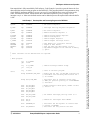
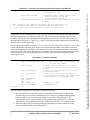
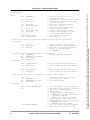
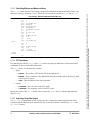
5.3.3.3 Calculating Minimum and Maximum Values
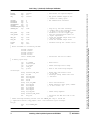
Code Listing 5. Minimum / Maximum Routine (Min_max)
Min_max
clr
nop
move
move
move
move
do
clr
move
clr
move
cmp
jle
move
A
A0,X:MAX_VAL
#$FF,A0
A0,X:MIN_VAL
#BUFFER,R0
#BUFFLEN,_minmax
A
X:(R0)+,A0
B
X:MAX_VAL,B0
B,A
_lower
A0,X:MAX_VAL
_lower
clr
nop
move
cmp
jgt
move
B
X:MIN_VAL,B0
B,A
_higher
A0,X:MIN_VAL
_higher
_minmax
rts
5.3.3.4 FFT Calculations
The main program calls the fftr2a and bitrev macros developed by Motorola to perform fast Fourier
calculations for devices in the DSP56300 family.
The fftr2a macro uses the following variables:
•
Inputs:
— POINTS—The number of FFT points (512 in this application).
— BUFFER—The base address of the data buffers (normally ordered) used by the macro in both
X and Y memory spaces.
— COEF—The base address of the sine/cosine table.
•
Outputs:
— X:BUFFER—The real values of the FFT results.
— Y:BUFFER—The imaginary values of the FFT results.
Because the output of the fftr2a macro is bit-reversed, the bitrev macro is called to unscramble the
data in BUFFER.
5.3.3.5 Acquiring a Single Data Sample
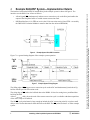
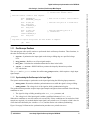
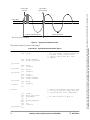
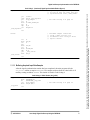
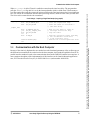
The Acq_sample routine listed in Code Listing 6 acquires a single input signal sample from the DAQ
system through the DSP56303 Port A peripheral. This second-level routine is called by the Syncro and
Acq_buffer routines.
22
Interfacing a Data Acquisition System to the DSP56303
Because of an order from the United States International Trade Commission, BGA-packaged product lines and part numbers indicated here currently are not
available from Freescale for import or sale in the United States prior to September 2010: DSP56303
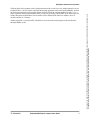
The Min_max routine listed in Code Listing 5 calculates the minimum and maximum sample values in the
data buffer starting at X address BUFFER. The results are stored in the variables MIN_VAL and MAX_VAL.