1
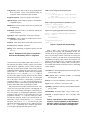
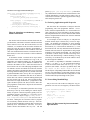
sm stringchecker {
state decl { java.lang.String } str;
{ public HashMap tracking = new HashMap(); }
init { tracking = new HashMap(); }
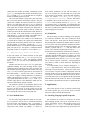
1. A system and language that make it easy to write a
broad set of checkers in a unified framework.
2. Showing that common sources of bugs can be expressed succinctly within this framework: most of our
checkers are less than a hundred lines of code.
start:
{ str = java.lang.String.anymethod(...) }
==> str.tracked, {
tracking.put(str.getDefinition(), ...);
};
3. Showing that the approach is effective by using it to
find dozens of bugs in more than six different systems.
str.tracked:
{ str } ==> {
// matches any use
tracking.remove(str.getDefinition());
};
final { bugs.addAll(tracking.values()); }
}
The rest of this paper is structured as follows: Section 2
explains the syntax and semantics of MJ using three small
examples. Section 3 describes the MJ language; Section 4
describes the system in detail. Section 5 reports on our experiences with uses of specific extensions. Section 6 discusses related work, and Section 7 concludes.
Figure 2. String checker: identifies locations
where (immutable) strings are discarded
2. Overview
This section gives two motivating examples for MJ. In
Java, objects of the built-in string class are immutable. A
common source of bugs is to assume that string operations such as replace(), concat(), or trim() affect the
string objects to which they are applied, when in fact a new
string object is returned. As an example, consider the code
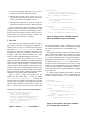
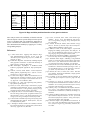
in Figure 1, which MJ found in Oceanstore [16], a large
software system for distributed global persistent data.
In this code snippet, the programmer tries to create a
unique message id by combining (concatenating) different
elements of a message and computing a SHA-1 hash on the
result. In reality, only the message src element is used to
compute the SHA-1 hash, making the message id not nearly
as unique (and secure) as the programmer intended. This
example demonstrates both that potentially serious logical
bugs can result from obvious violations of simple API rules
and that they can be readily detected automatically.
Figure 2 shows a simple MJ program that can
identify this and similar bugs.
It uses the pattern
java.lang.String.anymethod(...) to match code
locations where any method of the String class is invoked
with any number of parameters. Upon finding a match, the
analysis engine will bind the returned value to a state variable str, which will be tracked to all code locations that
the so-bound definition reaches. In addition, it will record
this match in a hashtable, which is accomplished by calling
out to the user-specified Java code embedded in the { ...
} clause.
Subsequently, the analysis engine will examine all locations reached by that definition to see whether they use the
returned value. This check is described using the simple
{str} pattern, which denotes any use other than simply assigning the returned value to one (or more) local variables.
It is guarded by the state str.tracked, which binds str
to only those values tracked from a previous call to a string
method. If a use is found along any path, the definition is
removed from the hashtable. After all paths have been explored, definitions that are left in the hashtable are flagged
as potential errors.
A second example illustrates MJ’s ability to perform
simple flow-sensitive analyses. In Java, a common idiom is
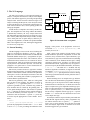
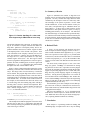
to check if an object reference is null, and then to derefersm nullchecker {
state decl anyobject o;
start:
{ o != null } ==> true = o.isnotnull,
false = o.isnull ;
o.isnull:
{ anyclass.anyfield = o } ==>
{ /* ignore this innocuous use */ }
// any use
| { o } ==> { err("use of null object"); } ;
o.isnotnull: { o.size() } ==>
{ /* possible size() pattern */ }
;
OceanStore ostore/tapestry/channel/ChannelRouteMsg.java:
public SecureHash generate_msg_id() {
String id = src.toString();
id.concat( dest.toString() );
id.concat( Integer.toString(channel_id) );
id.concat( Integer.toString(sequence) );
id.concat( Integer.toString(frg_index) );
msg_id = new SHA1Hash(id);
return msg_id;
}
}
Figure 3. Null checker: flags when variables
are accessed that could be null
Figure 1. Calls to id.concat do not affect id.
2