1
A CW treasure
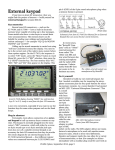
Keep your eyes open for one of these at a hamfest.
Self contained, can be powered by a “DC Wall Wart”.
Programable speeds from 1 to 100 wpm. Capacitive
touch, not mechanical and much more!
The SA-5010 µMatic Keyer is a compact unit with
modern design in
electronics and styling.
The Memory Keyer
uses a microprocessor
which keeps component count low and
reliability high.
Features of the
Memory Keyer include:
1. Up to ten
buffers for storing text
or commands. These
are variable length
buffers,which elimiAn oldie but goody — the
nate wasted memory
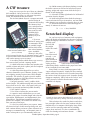
Heath SA-5010 µMatic Keyer
space. Available
[photo by WA2EWP]
memory is also effectively increased by the use of “command strings” and by
a repeat feature which which allows you to automatically send a message up to ten times.
2. An editing feature which allows easy recovery
from errors when you load a message buffer.
3. A built-in sidetone oscillator and speaker with
variable volume and pitch. A phone jack and earphone
is provided for private use.
4. A thin 22-position keypad lets you select
character formation, speed, character spacing, character weighting, message repeat count, buffer number
and mode. The sidetone is gated to provide audible
feedback to produce a click. Illegal entries and error
conditions produce a “warble.”
5. Integral capacitive “touch” paddles which
reduce fatigue. The paddles unplug and store inside the
keyer when not in use. Also, a rear panel jack is provided for an external mechanical paddle assembly.
6. Full “iambic” features.
7. Five LEDs to indicate the current mode.
8. A practice mode which allows you to send
random code groups of random length and selectable
types(alpha, alphanumeric, and alphanumeric plus
punctuation). 100 different repeatable random sequences are available, all of which are altered every
time you turn off the keyer.
9. A (PC) key which allows you to pause, manually insert text into a buffer message being sent, and
then continue.When you insert a pause character in a
message or command string , an automatic pause is
made at that point so you can manually insert text.
10. CMOS memory with battery backup to retain
the buffer contents as well as the last selected speed,
spacing, weight,and repeat count while the Keyer is
turned off and unplugged.
11. Selection of either right-handed or left-handed
operation from the keypad.
12. Built-in diagnostics that check the microprocessor each time the keyer is turned on, and test RAM
when batteries are re-placed or when the Keyer is reset.
13. Automatic shutoff after more than approximately 15 minutes of non-use.
73 — •• • Don, WA2EWP
Scratched display
Do you have a piece of amateur radio equipment
where the liquid crystal display has become scratched?
Maybe the display is difficult to read now — scratches
certainly spoil
the look and
they might
reduce the resale
value.
Here’s a
hint I discovered
recently — you
can take out
light scratches in
plastic faceplates
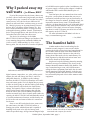
Cadie Products’ Krazy Kloth
with a product
called Krazy Kloth®, available in the paper towel aisle
of our Cortlandt Town Center A&P.
Krazy Kloth is a cotton cloth impregnated with
“super-activated chemicals”. Simply rub the scratched
surface with Krazy Kloth for a few seconds then polish
the surface clean with a paper towel. Scratches usually
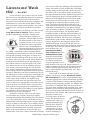
disappear completely. Take a look at the “before” and
“after” pictures of a Radio Shack scanner with a
scratched LCD display.
Scratch on plastic scanner dial indicated by arrow (left)
was largely removed by rubbing with Krazy Kloth (right).
This technique also works for plastic watch faces,
but you might want to be far more cautious with the
ultrathin face of a computer LCD display. Krazy Kloth
can be used for removing stains and for polishing
copper, brass and steel. It is also recommended by
Cadie for cleaning tools and auto chrome. — NM9J
PCARA Update, September 2002, page 2