1
stations, like positive and negative offsets of video
frequency, distinct characteristics of the station’s
vertical interval, or even hidden levels of closed
captioning, data, or other auxillary information. Learn
how to hear what piggybacks on TV signals: exact time
correction, SAP and
PRO audio, even stock
and sports information. FM signals have
similar attributes.
Especially interesting is the recent incorporation of the
BBC’s RDS radio data service system, which can provide you with an instant station ID if you are equipped
to decode it. You can also enjoy a variety of broadcasts
that are transmitted on FM stations’ subcarriers. Muzak
background music and services for the blind and select
ethnic groups are available if you know where and how
to look for them. There is a faction of the WTFDA that
DXes NOAA weather radio stations on 162 MHz. Don’t
laugh. These stations make wonderful propagation
beacons. For example, WWH26 on 162.425 MHz in
Newport, NC is an excellent indicator of long distance
tropo into the Carolinas. It is the only NOAA station on
162.425 along the Atlantic Coast. When it breaks your
squelch, head for 2 meters, 220 and 440 MHz for great
fun. Read all about it at http://www.anarc.org/wtfda/.
All of these clubs have frequent newsletters and
Internet reflectors to keep their membership up-to-the-minute. Each club
produces extensive guidebooks for each
of these band segments to help you
identify your catches and help you plot
your strategy. If you are looking for
new aspects to our hobby, this may be
your ticket. Listen carefully. You might
really like it!
— 73 de N2KZ Karl
Editor’s note
Your editor is not going to let Karl’s line about
“broadcast stations still operating on long wave in
Europe and beyond” go by without an explanation and
a comment.
Over on the other side of the pond in Europe and
in the ex-Soviet Union, long wave broadcasting is still
alive, stretching back in time almost as far as what is
called AM broadcasting on this side of the Atlantic.
Traditional European broadcast radios did not have an
“AM” button, instead they had two buttons marked
“MW” for medium wave and “LW” for long wave. If
your radio was likely to be used in a French speaking
country it might also be marked with “PO/GO”, which
has nothing to do with jumping sticks.
The advantage of long wave broadcasting is that
the coverage area is much greater than for medium
frequencies. In the UK, the BBC’s main long wave
transmitter at Droitwich in the English Midlands runs
500 kilowatts on 198 kHz and covers most of England,
day and night. For comparison, BBC Radio 5 Live uses
six main transmitters rated from 10 to 200 kilowatts,
to cover roughly the same area on two separate medium frequencies of 693 and 909 kHz.
The downside of long wave is that electrical noise
can be more disruptive — especially near TV sets or
industrial locations — and nowadays, with most radios
being manufactured in the Far East it is getting increasingly difficult to purchase an everyday set with a “long
wave” button. However, if you take a look at Radio
Shack’s DX-398 and DX-402 worldband radios, you will
find a “LW” button just waiting to be pressed.
— Malcolm, NM9J
Mobile mount
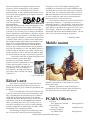
The photo shows PCARA member Charlie,
WA2WGJ, mounted on a camel while on vacation
during June 2002.
Charlie reports that he wore his DXCC pin
throughout the visit to Portugal, Spain and Morocco,
but did not run into any other radio amateurs.
PCARA Officers
President:
Greg Appleyard, KB2CQE
Vice President:
Bob Tarsio, N2CBH
Secretary/Treasurer:
Joe Ellman, KR2V
PCARA Update, September 2002, page 5
[email protected]
[email protected]
[email protected]