1
Setting the Release Time
Longer release times cause the analysis input signal transients to sustain for a longer
period, at the vocoder’s output. A long release time on percussive input signals, such as
a spoken word or hi-hat part, will translate into a less articulated vocoder effect. Use of
extremely short release times results in rough, grainy vocoder sounds. Release values of
around 8 to 10 ms are useful starting points.
Using Freeze
The frozen analysis signal can capture a particular characteristic of the source signal,
which is then imposed as a complex sustained filter shape on the Synthesis section. The
following are examples of when this could be useful:
If you are using a spoken word pattern as a source, the Freeze button could capture the
attack or tail phase of an individual word within the pattern—the vowel a, for example.
If you want to compensate for people’s inability to sustain sung notes for a long period,
without taking a breath, you can use the Freeze button: If the synthesis signal needs to
be sustained but the analysis source signal—a vocal part—is not sustained, use the Freeze
button to lock the current formant levels of a sung note, even during gaps in the vocal
part, between words in a vocal phrase. The Freeze parameter can be automated, which
may be useful in this situation.
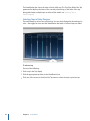
Setting the Number of Bands
The greater the number of bands, the more precisely the sound can be reshaped. As the
number of bands is reduced, the source signal’s frequency range is divided up into fewer
bands—and the resulting sound will be formed with less precision by the synthesis
engine. You may find that a good compromise between sonic precision—allowing
incoming signals (speech and vocals, in particular) to remain intelligible—and resource
usage is around 10 to 15 bands.
Tip: To ensure the best possible pitch tracking, it is essential to use a mono signal with
no overlapping pitches. Ideally, the signal should be unprocessed and free of background
noises. Using a signal processed with even a slight amount of reverb, for example, will
produce strange and probably undesirable results. Even stranger results will result when
a signal with no audible pitch, such as drum loop, is used. In some situations, however,
the resulting artifacts might be perfect for your project.
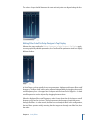
EVOC 20 TrackOscillator U/V Detection Parameters
Human speech consists of a series of voiced sounds—tonal sounds or formants—and
unvoiced sounds—the nonformant nasal continuants, fricatives, and plosives, mentioned
in A Short Primer on Formants. The main distinction between voiced and unvoiced sounds
is that voiced sounds are produced by an oscillation of the vocal cords, whereas unvoiced
sounds are produced by blocking and restricting the air flow with lips, tongue, palate,
throat, and larynx.
Chapter 6
Filter Effects
143