1
Testing for Optimal Results
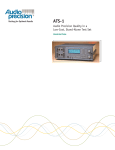
Portable One
Audio Precision Quality
in a Portable Test Set
Unmatched Portable Performance
Portable One: Unparalled Precision in a Portable Package
The Portable One family of audio test instruments—at home on
the bench or rugged in the field.
With thousands of units sold, you’ll find the Portable One family of audio analyzers in operation around the world in maintenance, engineering and production facilities. Whether in
broadcast, communications, bench or production use, Portable One offers a complete easyto-use audio test set housed in a rugged case ready for almost anything. With twelve different measurement functions selectable at the push of a button, Portable One is comprehensive while remaining user-friendly. Its popularity is no less due to its outstanding
performance specifications; yet Portable One is as affordable as lower-performing test sets.
Analog Only or full Dual Domain—Analog and Digital
The Portable One Plus
Portable One Plus Access includes comprehensive analog generation and measurement, with
two outputs and two inputs. Easy-to-set-up sweep capability produces graphs of frequency
response, distortion vs. frequency and even amplitude sweeps. Non-volatile storage of up to
30 tests allows easy one-button recall of your favorite test setup. Connect Portable One to a
compatible printer and produce reports incorporating high-resolution graphs. If you work
with digital audio, the Portable One Dual Domain® model adds AES3/SPDIF audio and in-
Unparalleled Precision
terface measurement capabilities to the comprehensive analog capabilities of the Portable
One family.
Low Distortion
Analog System THD+N 80 kHz BW –92 dB
Analog+Digital+AES3/SPDIF: the Portable One Dual Domain
Digital Distortion THD+N £–140 dB
Portable One Dual Domain® is a comprehensive audio test set for both analog and digital au-
High Analog Bandwidth
dio, as well as for generation and measurement of AES3/SPDIF digital interface characteris-
Signal Generation to 120 kHz
tics such as jitter. Like our 2700 Series family of instruments, Portable One Dual Domain
Low Noise
features true dual domain architecture. Digital signals are generated and measured purely in
22 Hz–22 kHz < –114 dBu
the digital domain, resulting in the extremely low distortion and noise residuals necessary
A-weighted < –118 dBu
for making useful digital audio measurements.
Wide Input Voltage Range
Input Range 80 mV–250 V in 10 dB steps
Flat Response
20 Hz–20 kHz ±0.05 dB
Low Crosstalk
Input < –120 dB
Output < –110 dB
Low Jitter
Generator < 0.8 ns
Analyzer < 1.6 ns
Performance, Measurement Power, and Ease-of-Use
Easy to Use
Analog Performance:
Measurement functions are simply selected
The low distortion transformer-coupled ana-
from the front panel. Just press a button
log generator supplies a full 30.17 dBu
and make the
for finer resolution. When
measurement. Se-
not otherwise used, the
lection of analog
setting knobs and buttons
and digital inputs
also provide a convenient
is clearly indi-
human interface for scroll-
cated on the front
ing display cursors and for
panel with LED
entry of other settings and
legends. Portable
data.
One makes graphs
of swept measurements in real time
on the high contrast back-lit LCD display,
including both frequency and amplitude
sweeps. Hard copy high-resolution graphs,
compact screen-sized graphs or tabular data
(40 W, 150 W or 600 W) source impedances. Extremely low analyzer noise and residual distortion support measurement of
high performance digital devices.
Analog Convenience Functions:
In addition to the above measurements, the
analog GEN LOAD function measures the in-
Stereo:
Portable One Dual
Domain is a true
two channel instrument. Both analog
and digital level
functions measure
both inputs simultaneously. Phase and
level ratio measure-
listings can be made from your Portable One
(+29.6 dBm into 600 W) at selectable
put resistance of your device at any frequency you choose and makes swept
impedance measurements (including loudspeakers).
AC MAINS CHECK measures the voltage, frequency and distortion of the power line
without hazardous direct connections.
BARGRAPH display in AC MAINS CHECK function provides a visible history of maximum
and minimum mains voltage excursions.
ments are also available.
to laser or ink jet printers at the touch of a
button. Bargraphs can display measurements ranging from AC mains power line
Full Range of Analog & Digital Testing
Facilities:
Portable One Dual Domain provides com-
The dBg unit (dB referred to the present an-
plete and parallel measurement capabilities
alog generator amplitude) is useful for com-
for both analog and digital audio signals.
pression threshold measurements or rapid
Measurements common to both domains in-
response sweeps at several different abso-
clude: Amplitude, Noise, Level (2 channels
lute levels, as well as for input to output
distortion to digital interface error rate
simultaneously), Frequency, Phase, THD+N,
gain/loss measurements.
…and nearly everything in between. Sepa-
SMPTE/DIN, IMD, Crosstalk and Level Ratio.
600 W Analog Input Terminations are indi-
rate buttons and knobs provide independent
Standard A-weighting, CCIR 468, and LP/HP
vidually switchable for each channel of the
control of frequency and amplitude. The
filters are included in both domains. RMS
analog analyzer.
buttons provide large and medium steps
and quasi-peak (CCIR 468) detectors are
(decade and 1/3 octave steps for frequency,
available in both domains.
10 dB and 1 dB for amplitude), with knobs
Turn on Portable One: Audio Testing to Meet Your Challenges
Comprehensive Analog and
Digital Functions
Digital Performance:
Portable One Dual Domain uses a true DSPimplemented analyzer for digital measurements, which results in –130 dB residual
THD+N, 0.01 dB flatness, and –140 dBFS re-
fect on THD+N, IMD, or noise. Competitive
for the jitter meter: a 700 Hz high-pass fil-
units can drive only one domain at a time
ter used for residual jitter measurements ac-
or use their analog generator to create the
cording to AES standards, and a 50 Hz high-
digital jitter, and thus can’t make this mea-
pass filter for jitter response measurements.
surement at all.
sidual noise. Other mixed-signal test sets in
Other Interface Signal Measurements:
Separate Digital Inputs & Outputs:
Portable One Dual Domain measures key digital I/O interface parameters in addition to
jitter, including sample rate, AES signal
voltage, frame delay through the device under test, and delay of the input signal rela-
the same price range have no digital ana-
tive to a house sync reference (frame or
lyzer, but use a D/A converter and an ana-
block).
log analyzer. These architectures “bottom
out” at –70 dB to –84 dB residual THD+N
Three I/O formats: XLR, BNC, and optical
(12–14 bit effective performance), and 0.1
(Toslink®). All are completely separate from
dB flatness. With today’s best A/D convert-
the analog audio XLR connectors, permit-
ers measuring
ting both digital and analog generators to
–108 dB to –112 dB
operate simultaneously. No cable changes
Flexible Interface Impairment Simulation:
THD+N, their real
required to go from A/D to D/A to D/D to
Flexible digital interface testing is vital for
performance is in-
A/A testing of a digital tape machine, for
troubleshooting and verifying performance
visible to these
example.
of digital audio at the systems level. Porta-
A competitive instrument lacking a
DSP analyzer produces false THD+N
mixed signal analyz- readings (red trace) from a popular A/D converter; but both the
ers …buried under Portable One Dual Domain and the
Audio Precision 2700 Series graph
true performance of the conthe analyzer’s noise the
verter (from 5 dB to 28 dB lower),
as shown by the blue trace.
and distortion floor.
ble One Dual Domain allows simulation of
Digital & Analog Monitors:
real world transmission and interface prob-
Listen to all measurements in the digital
lems.
and analog domains over the
Separate & Independent Analog & Digital
Generators:
internal loud-
Often necessary for dual domain testing.
pair of head-
You may, for example, drive the inputs of an
phones. In the analog domain, monitor sig-
A/D converter with the low-distortion ana-
nals or distortion. In the digital domain,
log sine while simultaneously driving the
the incoming signal, distortion, or jitter
converter’s digital reference (house sync)
can all be monitored.
speaker or a
input with the digital generator. Then, add
jitter or vary the sample rate to see the ef-
Jitter Meter:
Portable One Dual Domain includes jitter
measurement in nanoseconds or in Unit Intervals. Two filter selections are provided
Vary the digital output signal to test the acceptance range of your digital devices. Set
sample rate anywhere from 28.8 kHz to
99.9999 kHz, not just at the three standard
frequencies. Inject jitter amplitude from
0 UI to 2.5 UI (415 ns at 48 kHz) in
0.01 UI (1.6 ns) steps, or 0 UI to 25.5 UI
(4150 ns) in 0.1 UI (16 ns) steps.
Injected jitter frequency can be set from
10 Hz to 38.8 kHz, not just to a fixed frequency. Adjust output signal amplitude continuously from zero to 5.12 Volts in 5 mV
Dataü Error Testing Capability
for Digital Audio Signals:
increments, not just at a few steps. Only the
Stimulate the test device with random data
Portable One Dual Domain provides this
and display current or totaled error mea-
flexibility in a portable analyzer.
Dither amplitude is automatically set to the
surements on both channels. The signal and
proper value for the output word length
analysis techniques are compatible with the
and the selected probability function.
Independent Interface I/O Word Lengths:
BITTEST feature of our System products, so
Word length (resolution) of digital input
you can test a transmission link end-to-end
and output are independently set from 16
Sample & Frame Sync:
Synchronize Portable One Dual Domain sam-
to 24 bits. Output resolution is set to match
ple and frame sync to the digital reference
the device under test to assure proper
(house sync) input.
with a Portable One Dual Domain at one end
Digital Pass Mode:
and a System Two, Cascade or 2700 Series
Sends the input digital audio content to
dual domain instrument at the other.
the output while modifying status bytes,
validity bit, etc. Portable One Dual Domain
dither. Input resolution must be set to exclude signal in the AUX bits or other low-
Other Digital Convenience Functions:
can thus be used as a problem-solver be-
level bit activity meaningless to the desired
Digital Status bytes are displayed and set in
tween incompatible equipment.
measurement.
high-level English.
Signal Monitoring Outputs:
Independent Input & Output Sample Rates:
A digital signal appropriate for syncing an
Lets you test sample rate converters. Mea-
external oscilloscope may be derived from
surement of the incoming embedded audio
the input sample rate, output sample rate,
signal can be referred to the incoming sam-
input block rate, output block rate, digital
ple rate, status byte indication of rate, or
audio waveform, jitter signal, or the de-
the outgoing generator rate.
tected interface errors. A buffered version
of the balanced AES3 signal from the XLR
Error flag displays for confidence, lock, coding, parity errors and the validity bit are included.
Additional active bit and actual bit displays
on the panel help determine the word
length of the incoming signal and detect
stuck bits.
Digital Dither:
Portable One Dual Domain includes a full
complement of dither selections—triangular
and rectangular probability distribution
functions; white or shaped spectrum.
input is also available, which coupled with
the high input impedance of the XLR in
bridging mode allows non-intrusive digital
line measurements with conventional
ground-referenced oscilloscopes.
Save your test setups—with measured data and print reports
INTERNAL CLOCK/CALENDAR:
Save & Recall Tests:
An internal clock/calendar automatically
Save 30 instrument setups, including sweep
stamps the time and date on setups and
results data, time-stamped from the internal
data as they are saved.
clock calendar. Use for repeatable, easy
bench and production
testing or when in the
field, for storing test
data to be printed or an-
You can view or set the clock/calendar from
alyzed later. Each saved
the Setup panel.
test includes all settings
GPIB Control:
An IEEE-488 Interface is built in to allow
control of the instrument in an automatic
test environment. National Instruments
for the entire instrument, a default description or your own title for the test, the date
and time, and the last test sweep result
data.
Portable One prints graphs, panel setups
and measured data either to laser (PCL compatible) or inkjet printers. Front panel keys
LabWindows/CVI and LabVIEW drivers are
select two sizes of graph output (including
available. A LabWindows/CVI soft front
cursor data), tabular sweep data, bargraphs
panel program is provided with a Windows
and front panels for printing.
user interface for real-time instrument control through the GPIB interface. The
For a quick print, a compact graph provides
LabVIEW driver is provided with a Getting
a direct replication of the LCD screen. A
Started VI and sample VIs.
larger graph printout covering approximately half a page (360x280 pixels with
grid lines) allows finer detail to be shown.
Both graphs show key instrument setup parameters as well. Tabular data values for all
swept points may be printed in order to
preserve exact reading values.
The bargraph displays, with their useful
minimum/maximum indicators print just as
they are seen on the display, as do any desired instrument panels. Various printouts
may be combined on one page, to include
graphs, bargraphs and numeric data.
ANALOG SIGNAL OUTPUTS
Low Distortion Sine Wave
Frequency Range
Frequency Accuracy
Amplitude Range
Balanced
Unbalanced
10 Hz to 120 kHz
±0.5 %
(20 Hz to 30 kHz)
<0.25 mV to 26.25 Vrms [–70 dBu to
+30.6 dBu]
<0.25 mV to 13.12 Vrms [–70 dBu to
+24.6 dBu]
±0.2 dB [±2.3 %] at 1 kHz
0.01 dB
Amplitude Accuracy
Amplitude Resolution
Flatness (1 kHz ref)
10 Hz–20 kHz
±0.05 dB
Residual THD+N
25 Hz–20 kHz
£(0.0025% + 3 µV), 80 kHz BW [–92 dB]
Square Wave
Frequency Range
20 Hz–30 kHz
Amplitude Range
Balanced
0.71 mVpp to 34.73 Vpp
Unbalanced
0.71 mVpp to 17.36 Vpp
Amplitude Accuracy
±0.3 dB [±3.5 %] at 400 Hz
Rise/fall time
Typically 2.5–3.0 µs
SMPTE (or DIN) Test Signals with option “P1-IMD”
LF Tone
50, 60, 70, or 250; all ±1.0 %
HF Tone Range
7 kHz or 8 kHz (±1 %)
Mix Ratio
4:1 (LF:HF)
Residual IMD
0.0015 % [–96.5 dB], 60 Hz + 7 kHz
or 250 Hz + 8 kHz
OUTPUT CHARACTERISTICS
Source Configuration
Selectable balanced or unbalanced
Source Impedances
Balanced
40 W (±2 W), 150 W (±2 W), or
600 W (±6 W)
Unbalanced
40 W (±2 W)
Output Current Limit
75 mA peak
Max Output Power
Balanced
+30.0 dBm into 600 W (Rs = 40 W)
Unbalanced
+23.9 dBm into 600 W (Rs = 40 W)
Output Related Crosstalk
£–110 dB or 10 µV, whichever is
greater
(10 Hz–20 kHz)
ANALOG ANALYZER
ANALOG INPUT CHARACTERISTICS
Input Ranges
80 mV to 250 V in 10 dB steps
Maximum Rated Input
350 Vpk, 140 Vrms (dc to 20 kHz);
overload protected
Input Impedance
Balanced (each side)
Nominally 100 kW // 150–200 pF
Unbalanced
Nominally 100 kW // 150–200 pF
Terminations
Selectable 600 W ±1 %
CMRR 80 mV–2.5 V range
³70 dB, 50 Hz–20 kHz
Input Related Crosstalk
£–120 dB or 1 µV, whichever is
greater
10 Hz–20 kHz
Wideband Amplitude/Noise Function
Measurement Range
<1 µVrms to 140 Vrms [–118 dBu to
+45 dBu]
Accuracy (1 kHz)
±0.2 dB [±2.37 %] unweighted
Flatness (1 kHz ref)
±0.05 dB (20 Hz–20 kHz)
Bandwidth Limiting Filters
LF –3 dB
<10 Hz; 400 Hz ±5 % (3-pole)
HF –3 dB
22 kHz; 30 kHz; 80 kHz (3-pole), or
300 kHz
Weighting Filters
ANSI-IEC “A”; CCIR-QPK; CCIR-ARM;
CCIR-RMS
Optional Filters
Up to 2 (Aux 1 and Aux 2)
Detection
RMS (i=60 ms); AVG; QPK (CCIR
Rec 468)
Residual Noise
22 Hz–22 kHz BW
£1.5 µV [–114 dBu]
A-weighted
£1.0 µV [–118 dBu]
CCIR-QPK
£5.0 µV [–104 dBu]
Frequency Meter Related (both channels)
Measurement Range
10 Hz–200 kHz
Accuracy
±0.01 % [±100 PPM]
Resolution
5 digits
Phase Measurement Related
Measurement Ranges
±180, +90/–270, or –90/+270 deg
Accuracy 20 Hz–20 kHz
±2.0 deg
Resolution
0.1 deg
Level Meter Related (both channels)
Measurement Range
10 mV to 140 V for specified
accuracy and flatness, useable to
<100 µV [–38 dBu to + 45 dBu]
Accuracy (1 kHz)
±0.1 dB + 100 µV
Flatness (1 kHz ref)
(Vin >10 mV) ±0.05 dB
(20 Hz–20 kHz)
Bandpass Amplitude Function
20 Hz to 120 kHz
Tuning Range (fO)
Bandpass Response
Q=5 (2-pole)
Accuracy (at fo)
±0.3 dB, 20 Hz–120 kHz
THD+N / SINAD Function
Fundamental Range
10 Hz to 100 kHz, THD+N mode
Measurement Range
.001 %–100 %
SINAD Range
400 Hz–1 kHz
Accuracy
±1 dB, 20 Hz–120 kHz harmonics
Measurement Bandwidth
LF –3 dB
<10 or 400 Hz
HF –3 dB
22k, 30k, 80k, or 300 kHz
Residual THD+N
25 Hz–20 kHz
£(0.0025% + 3.0 µV), 80 kHz BW
[–92 dB]
Crosstalk Function
Frequency Range
10 Hz to 120 kHz
Measurement Range
–140 dB to 0 dB
Accuracy
±0.5 dB
SMPTE (DIN) IMD Function with option “P1-IMD”
Test Signal Compatibility
40–250 Hz and 3 kHz–20 kHz in
0:1 to 8:1 ratio
IMD Measured
Amplitude modulation products of
the HF tone.
Measurement Range
<0.0025 %–20 %
Accuracy
±1 dB per SMPTE RP-120-1983,
DIN 45403
Residual IMD
£0.0025% [–92 dB], 60 + 7 kHz or
250 + 8 kHz
Wow & Flutter Function
Test Signal Compatibility
2.80 kHz–3.35 kHz
Accuracy (4 Hz)
±(5 % of reading + 0.002 %)
Detection Modes
IEC/DIN; NAB; JIS
Residual W+F
£0.005% Weighted; £0.01%
Unweighted
DIGITAL SIGNAL GENERATOR
DIGITAL OUTPUT CHARACTERISTICS
Output Formats
AES/EBU (per AES3-1992); SPDIFEIAJ; Optical
Sample Rates
28.8 kHz–99.9999 kHz
Sample Rate Accuracy
±0.002% [±20 PPM] lockable to
external reference
Word Length
16 to 24 bits (even values)
Sine Wave
Frequency Range
10 Hz to 47 % of sample rate
(22.56 kHz at 48 ks/s)
Frequency Resolution
Sample Rate ¸ 223
(typically 0.006 Hz at 48 ks/sec)
Flatness
±0.001 dB
Residual Distortion
±0.00001 % [–140 dB]
Square Wave
Frequency Range
10 Hz to 1/6 sample rate
Frequencies available
fs ¸ 4096 to fs ¸ 6, in even integer
divisors
SMPTE/DIN IMD Waveform with option “P1-IMD”
Upper Tone Range
Choice of 7 kHz or 8 kHz
Lower Tone Range
Choice of 50 Hz, 60 Hz, 70 Hz, or 250 Hz
Amplitude Ratio
4:1 (LF:HF)
Residual Distortion
£0.00001 % [–140 dB] at 4:1 ratio
Random Generator Waveform
Waveform
Compatible with Audio Precision
BITTEST
Dither (all waveforms)
Probability Distribution
Triangular or rectangular;
independent for each channel
Spectral Distribution
Flat (white) or Shaped (+6 dB/oct,
triangular only)
Amplitude
Automatically tracks word length or off
AES/EBU INTERFACE GENERATION
Interface Signal
Amplitude Range
Balanced (XLR)
Unbalanced (BNC)
Channel Status Bits
Validity Flag
AES/EBU Impairments
Induced Jitter
Jitter Freq Range
Jitter Amplitude
0–5.11 Vpp, into 110 W in 5 mV steps
0–1.62 Vpp, into 75 W in 1.6 mV steps
English language decoded,
Professional/Consumer
Selectable, set or cleared
Sine wave
10 Hz to 38.8 kHz
0–1.28 UI (pk), in steps of 0.005 UI
or better
1.3–12.75 UI, in steps of 0.05 UI or
better
(total generator/analyzer) peak calibrated
£0.005 UI (700 Hz–30 kHz BW)
£0.015 UI (700 Hz–30 kHz BW)
Residual Jitter
RMS response
Peak response
Spurious Jitter Products
Jitter & Ref Delay Off
£0.0005 UI
Jitter On
£–30 dB below jitter signal
REFERENCE INPUT CHARACTERISTICS
Input Formats
AES/EBU (per AES3-1992)
Input Sample Rates
28.8 kHz–99.9999 kHz
Lock Range
±0.0025% [±25 PPM]
Narrow Band Amplitude
Frequency Range
Filter Shape
THD+N Measurements
Fundamental Range
0.04% to 40% of sample rate
(10 Hz–19.2 kHz at 48.0 ks/sec)
10-pole, Q=19 (BW = 5.3% of f0)
0.02% to 45% of sample rate
(10 Hz–22.0 kHz at 48.0 ks/sec
£–138 dBFS
22 Hz, 400 Hz 2-pole Butterworth
15 kHz, 20 kHz 6-pole elliptic lowpass
Weighting Filters
ANSI-IEC “A” weighting; CCIR QPK;
CCIR RMS
SMPTE (DIN) IMD Function with option “P1-IMD”
Test Signal Compatibility
40–250 Hz and 3 kHz–20 kHz in 1:1
to 4:1 ratio
IMD Measured
Amplitude modulation products of
the HF tone.
Measurement Range
<0.0001%–10%
Accuracy
±1 dB per SMPTE RP-120-1983,
DIN 45403
Residual IMD (0 dBFS)
£0.0001% [–120 dB], 60 + 7 kHz or
250 + 8 kHz
Frequency Measurements
Range
5 Hz to 47% of sample rate
Phase Measurement Related
Measurement Ranges
±180, +90/–270, or –90/+270 deg
Accuracy
±2.0 deg (20 Hz–20 kHz)
Resolution
0.1 deg
BITTEST Measurement
Measurement
Compatible with random mode of
Audio Precision BITTEST
Residual THD+N
High pass Filters
Low pass Filters
DIGITAL INTERFACE MEASUREMENTS
AES/EBU Impairments, Real Time Displays
Input Sample Rate
±0.002% [±20 PPM] internal ref,
±0.0001% [*1 PPM] external ref
Output to Input or Reference Measures status propagation from
the AES/EBU output to the input.
Input to Input Delay
Range is 0–192 (frames), resolution
±60 ns.
AES/EBU Input Voltage
Balanced
400 mV to 10.24 Vpp,
±(10% + 50 mV)
Unbalanced
100 mV to 2.56 Vpp,
±(10% + 30 mV)
Jitter Amplitude (500 Hz)
(peak-peak sine wave calibrated)
0–10 UI,
Jitter Flatness
±1.5 dB, 100 Hz–22 kHz (50 Hz HP
selection, RMS detection, 48 kHz
sample rate)
Residual Jitter, peak calibrated (analyzer only) (700 Hz–30 kHz
BW)£0.01 UI RMS; £0.03 UI Peak
Spurious Jitter Products
£0.002 UI (1.2 kHz) or 0 dB below
jitter signal
Channel Status Bits
English language decoded
(Professional/Consumer)
Validity Flag
Displayed for selected channel
Parity; Signal Confidence;
Displayed for total signal (both
channels combined)
Receiver Lock; Coding Error
AUXILIARY SIGNALS
Generator Analog Sync Output; Digital Sync Output; Analyzer Input
Monitor; Analyzer Reading
AUDIO MONITOR
Power Output
Typically 1 watt
GENERAL / ENVIRONMENTAL
Power Requirements
Temperature Range
DIGITAL ANALYZER
Humidity
DIGITAL INPUT CHARACTERISTICS
Input Formats
AES/EBU (per AES3-1992); SPDIFEIAJ; Optical
Sample Rates
28.8 kHz–99.9999 kHz
Word Length
16 to 24 bits
EMBEDDED AUDIO MEASUREMENTS
Wideband Level/Amplitude
Range
0 dBFS to –140 dBFS
Frequency Range
<10 Hz–22.0 kHz at 48 ks/sec
Accuracy
±0.01 dB, ³–90 dBFS
Flatness
±0.01 dB, 15 Hz–22 kHz
High pass Filters
22 Hz, 400 Hz, 2-pole Butterworth
Low pass Filters
15 kHz, 20 kHz 6-pole elliptic lowpass
Weighting Filters
ANSI-IEC “A” weighting; CCIR QPK;
CCIR RMS
Residual Noise
–140 dBFS unweighted; –142 dBFS
A-weighted
EMC
Dimensions
Weight
Safety
100/120/230/240 Vac (–10%/+6%),
50–60 Hz, 50 VA max
0° C to +40° C Operating; –20° C to
+60° C Storage
90% RH to at least +40° C (noncondensing)
Complies with 89/336/EEC, CISPR 22
(class B), and FCC 15 subpart J (class B)
16.5 x 6.0 x 13.6 inches [41.9 x 15.2
x 34.5 cm]
Approximately 20 lbs [9.1 kg]
Complies with 73/23/EEC,
93/68/EEC, EN61010, and IEC 1010
(including Amendments 1 and 2)
Complete Portable One specifications are downloadable from the Products area of the
Audio Precision Web site at audioprecision.com.
Portable One Dual Domain Block Diagram
WOW &
FLUTTER
DISCRIMINATOR
CHANNEL
A
SQUARE
WAVE
GENERATOR
MEASUREMENT
AMPLIFIER
BAND PASS
BAND REJECT
FILTER
INPUT
TERMINATION
ANALOG
INPUT
INPUT
PREAMP
and
ATTENUATOR
PRIMARY
READING
DETECTOR
WEIGHTING
FILTERS
SOURCE
IMPEDANCE
OUTPUT
ATTENUATOR
MAIN
OSCILLATOR
PHASE/FREQ
COMPARATORS
CHANNEL
B
OUTPUT
AMPLIFIER
SIGNAL
SUMMATION
SECONDARY
READING
DETECTOR
CHANNEL
A
ANALOG
OUTPUT
BALANCING
TRANSFORMER
CHANNEL
B
INPUT
TERMINATION
INTERMOD
DEMODULATOR
ANALOG
TRIGGER
OUTPUT
FUNCTION
MONITOR
IMD HF TONE
GENERATOR
INTERMODULATION DISTORTION OPTION
INPUT
MONITOR
SPEAKER/
HEADPHONE
MONITOR
MICROPROCESSOR
LCD DISPLAY
SPDIF
In
AC/DC
M
U
X
AES/EBU
Input
AES/EBU
RECEIVER
MONITOR
D to A
JITTER
DETECTOR
A to D
DSP
Generator Waveform Trigger
OPTICAL
RECEIVER
OPTICAL
Jitter Signal
Output Clock
DELAY
LOGIC
REFERENCE
IN
M
U
X
Input Clock
CLOCK
GENERATOR
SYNC
JITTER
GENERATOR
JITTER
MODULATOR
SPDIF
OUT
AES/EBU
TRANSMITTER
AES/EBU
Output
DRIVER
OPTICAL
DRIVER
BUYING A PORTABLE ANALYZER FOR
ANALOG AND DIGITAL AUDIO:
Ordering Information
P1PA
Portable One Plus Access Audio Test System with GPIB interface
P1DD
Portable One Dual Domain (digital and analog) Audio Test System
with GPIB interface
Options and Accessories for Portable One Instruments
P1-IMD
SMPTE/DIN intermodulation distortion measurement and generation
(analog and digital)
P-CAS
Protective soft carrying case with shoulder strap and
internal/external pockets
RAK-P1
Rack mount shelf for Portable One Plus Access or
Portable One Dual Domain
MAN-P1PA
Additional Portable One Plus Access operator’s manual (one included
with instrument)
MAN-P1DD
Additional Portable One Dual Domain operator’s manual (one
included with instrument)
MAN-ATS488
Additional GPIB manual for Portable One Plus Access or
Portable One Dual Domain (one included with instrument)
SVC-P1
Service manual for Portable One Plus Access or
Portable One Dual Domain
CAB-XMF
Set of four XLR male to XLR female cables
CAB-XBR
Set of four XLR male/female to RCA/BNC cables
CAB-AES
Set of two AES3 digital cables, 1 meter
CAB-AES2
Set of two AES3 digital cables, 2 meters
CAB-AES4
Set of two AES3 digital cables, 4 meters
Soft carrying case option
The padded interior protects your Portable One.
An extra pocket stores documentation and cables.
What to look for when evaluating competitive instruments
Digital Architecture and Features:
Not all analyzers that accept a digital
input signal are actually digital analyzers. Does the instrument have a
real (DSP-implemented) digital domain analyzer, or just a D/A converter
from the digital input connector to an
analog hardware analyzer? This latter
approach in a competitive unit yields
distortion performance in the 12–14
bit range (–70 to –85 dB THD+N, for
example). There’s just not that much
12-bit digital audio around to measure anymore. Portable One Dual Domain’s digital analyzer guarantees
–130 dB residual distortion (nearly 22
bit performance), far in excess of the
–108 to –112 dB actual linearity of
today’s best A/D converters.
Analog Performance: Does the instrument have an analog hardware
generator and an analog hardware analyzer? Some competitive units (at
twice the price of Portable One Dual
Domain) use DSP techniques for all
generation and analysis, so analog
DIGITAL
TRIGGER
OUTPUT
OPTICAL
signals pass through converters inside
the instrument. The result is THD+N
as high as –79 dB, flatness as poor as
–0.2 dB—inadequate for most modern
audio devices.
Interface Testing: Does the instrument have independent analog, digital, and jitter generators? If it can
only provide analog or digital output
at any one time, you can’t test a
house-synchronized A/D converter for
jitter rejection. Without independent,
flexible digital audio and jitter generators, you can’t measure jitter sensitivity of a D/A converter at various
audio and jitter frequency combinations.
True Dual Domain: True Dual Domain
hardware by definition guarantees a
full range of analysis capabilities in
both analog and digital domains. Everyone measures level and some measure THD+N (although implemented
with extremely limited performance,
as noted above). Be sure that other
useful measurements such as IMD
(Intermodulation Distortion), Phase,
and Crosstalk are available for both
analog and digital signals, not just
analog.
Testing for Optimal Results
5750 SW Arctic Drive
Beaverton, Oregon 97005
Tel 503-627-0832 Fax 503-641-8906
US Toll Free 1-800-231-7350
email: [email protected]
web: audioprecision.com
pn 0057.0003 rev 1
IV0930134245