1
10
In this method the preamplifier and main amplifier
are set up as they would be used normally, but
with a dummy capacitor (or no capacity) on the
Input connector of the 142AH, and with the ac
voltmeter connected to the main amplifier output.
The noise voltage indicated on the meter,
designated Erms, is read and noted. Then a test
pulse of known energy, Ein (in keV), is applied to
the Input and the amplitude of the resulting output
pulse, Eout is measured in volts with an
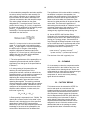
oscilloscope. The noise spread can then be
calculated from the formula
where Erms is output noise in volts on the 3400A
meter, Ein is input signal in keV particle energy,
and Eout is output signal in volts corresponding to
the above input. If the gain of the shaping
amplifier is adjusted so that the output pulse
height is 2.35 V for an input of 1 MeV equivalent
charge, then the rms meter will be calibrated
directly in energy (1 mV = 1 keV).
7. The noise performance of the preamplifier, as
measured by these methods, should not differ
significantly from that given in the specifications
in Section 2.
8. lf, during testing of the preamplifier and
detector, the noise performance of the
preamplifier has been verified as outlined in the
preceding section or is otherwise not suspected, a
detector may be tested to some extent by
duplicating the noise performance tests with the
detector connected in place and with normal
operating bias applied. The resulting combined
noise measurement, made either with an analyzer
or by the voltmeter method, indicates the sum in
quadrature of the separate noise sources of the
amplifier and the detector. In other words, the
total noise is given by
(Ntot)2 = (Ndet)2 + (Namp)2.
9. Each quantity is expressed in keV FWHM. The
quantity Ndet is known as the "noise width" of the
detector, and is included as one of the specified
parameters of each ORTEC semiconductor
detector. By use of the above equation and with a
knowledge of the noise of the preamplifier, the
noise width of the detector can be determined.
The significance of this noise width in evaluating
the detector is subject to interpretation, but
generally the actual resolution of the detector for
protons or electrons will be approximately the
same as the noise width; the resolution of the
detector for alpha particles will be poorer than the
noise width. The most useful application of
determining the noise width of a detector is in the
occasional monitoring of this quantity to verify
that the detector characteristics have not
undergone any significant change during use.
10. Use an ORTEC 419 Precision Pulse
Generator with a matched charge termination to
measure the rise time of the 142AH through the T
(timing) or E (energy) output. Connect the 419
output through the charge terminator to the Input
on the 142AH and use an oscilloscope with a fast
rise time (1 ns if possible). The rise time of the
preamplifier can then be computed by:
(Total rise time)2 = (Preamp rise time)2
+ (Pulser rise time)2 + (Oscilloscope rise time)2.
The rise time of the 419 is typically 3 ns.
5.2. CLEANING
If it is necessary to clean the components and/or
the printed circuit in the 142AH at any time, use
only methanol as a cleaning solvent. Do not use
compressed air or other source of pressurized gas
unless it is known to be clean and free of
compressor oil, and do not use any cleaning
agent other than methanol.
5.3. FACTORY REPAIR
This instrument can be returned to ORTEC for
service and repair at a nominal cost. Our
standard procedure for repair ensures the same
quality control and checkout that are used for a
new instrument. Always contact the Customer
Service Department at ORTEC, (865) 482-4411,
before sending in an instrument for repair to
obtain shipping instructions and so that the
required Return Authorization Number can be
assigned to the unit. Write this number on the
address label and on the package to ensure
prompt attention when it reaches the factory.