1
A 100-MHz Analog Oscilloscope for
Digital Measurements
A new general-purpose oscilloscope has features such
as dual-channel magnification and third-channel
trigger display that enhance its versatility, particularly
with respect to measurements in digital systems.
by Allan I. Best
DESPITE CONTINUING ADVANCES in circuit
speeds, a great amount of digital design work
continues to be carried on at clock rates below
100 MHz.
This is particularly true for digital designs involv
ing TTL and CMOS devices where clock rates
below 50 MHz predominate. Hence, the growing
need in digital test instrumentation is not so much for
the ability to work at the highest possible speed as it is
for means of coping with the complexity of digital
circuit operation, a need that is becoming more and
more acute as the applications of microprocessors
continue to expand.
In assessing the oscilloscope needs of digital
designers, it became clear that the requirements of
a large segment of users could be met by a generalpurpose, dual-channel scope that had a bandwidth
of 100 MHz, a wide range of vertical deflection fac
tors, a bright CRT capable of finely-drawn traces,
a precision time base, sensitive, stable triggering
and a delaying sweep with low inherent jitter that
would enable timing measurements with less than
1% error.
In particular, for the debugging and field mainte
nance of digital systems — especially those based on
microprocessors — it was expected that users would
want to team such a scope with a logic state analyzer,1
the logic state analyzer to locate problems in the data
domain and the oscilloscope to work in the time
domain finding the electrical malfunctions that cause
the data-domain problems (see box, page 5).
A Well Fitted Oscilloscope
It was with this background in mind that a new
oscilloscope was developed. The primary goal was to
provide lab-quality performance and versatility in an
easily-maintained instrument at an economical price.
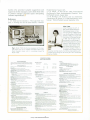
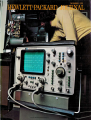
The result is shown in Fig. 1.
Although this instrument, the HP Model 1740A,
has the compactness, ruggedness, and ease of main
tenance required of an instrument for the field, it has
all the attributes of a high-quality, dual-channel,
100-MHz laboratory oscilloscope. It is well suited for
digital work with its bright CRT display, precision
time bases, stable triggering, and a third channel that
enables the timing of an external sweep trigger signal
I Cover: Display of wave
forms fulfills an important
function in the world of 1's
and O's just as it always has
in the world of analog sig
nals. The oscilloscope pic
tured here displays wave
forms in the traditional man
ner but it can also be adapted
to display 1's and O's in a data format, as ex
plained in the article beginning on this page.
In this Issue:
A 100-MHz Analog Oscilloscope for
Digital Measurements, by Allan I. Best page 2
An Oscilloscope Vertical-Channel
Amplifier that Combines Monolithic,
Thick-Film Hybrid, and Discrete
Technologies, by Joe K. Millard .... page 8
A Real-Time Operating System with
Multi-Terminal and Batch /Spool Capa
bilities, by George A. Anzinger and
A d e l e M . G a d o l
p a g e
1 2
Real-Time Executive System Manages
Large Memories, by Linda W. Averett page 18
c Hewlett-Packard Company. 1975
Printed in US. A.
© Copr. 1949-1998 Hewlett-Packard Co.