1
TM 11-6625-2759-14 & P
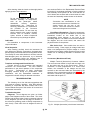
FRONT PANEL CONTROLS AND
CONNECTORS
DOT MKR
Used to horizontally position the
frequency dot.
The displayed
frequency
readout
characters
enumerate the actual frequency of the
dot. When the DOT MKR control is in
its detent position (fully ccw), the
frequency dot and the selected
frequency are on the vertical center
line of the graticule. The 7L5 can be
operated in a start sweep mode when
the frequency dot is positioned to the
left vertical graticule line. The DOT
MKR control is disabled when the
FREQUENCY SPAN/DIV switch is at
MAX.
REFERENCE
LEVEL
Sets the full screen signal amplitude
level (dBm, dBV) required at the
INPUT to the plug-in module. This
level is relevant to the input impedance
of the plug-in module. Reference level
is associated to the top graticule line of
the display area and signal level is
relative to this reference.
The
reference level range depends on the
plug-in module, however, in the 2
dB/Div mode it covers 149 dB, in the
10 dB/Div mode the range is 90 dB
and in the Lin mode 20 nV/div to 200
mV/div. The control has two speeds or
stepping increments; pulled out, each
increment is 10 dB, pushed in each
increment is 1 dB or in some cases
(dependent on the plug-in module) 2
dB.
VAR
The VAR (variable) control provides 8
dB
or
more
gain
adjustment
between each calibrated reference
level step. A<symbol is displayed on
the crt, preceding the reference level
readout, whenever the reference level
is not calibrated (VAR is not in its
detent position).
Pushing any front panel pushbutton switch
activates a bistable electronic circuit to change its output
state. When in the active state, the plastic pushbutton is
illuminated. Pressing the pushbutton a second time
changes the output of the circuit to the inactive state and
extinguishes the illuminated button.
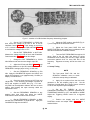
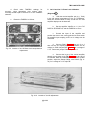
Front panel controls also include two special
photo-optic switch assemblies, the FREQUENCY
SPAN/’DIV-RESOLUTION switch and the TIME/DIV
switch. Designed especially for the 7L5, each assembly
is a mechanical/photo-electric, digital switch, that
provides a TTL compatible five-bit binary output. The
reliability of these switches has been demonstrated and
with normal use they should last the life of the
instrument. Dismantling or field repair of these switches
is discouraged since their proper operation requires
precision alignment of their internal components. If either
switch assembly is damaged or suspected of
malfunction, it should be replaced as an assembly.
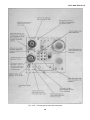
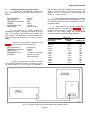
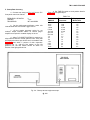
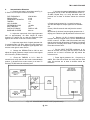
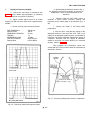
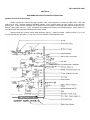
The following describes the function of the front
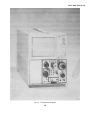
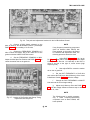
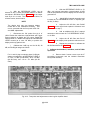
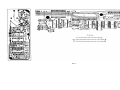
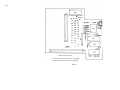
panel selectors for the 7L5. A layout of the front panel is
shown in Fig. 3-2.
DOT FREQUENCY
FINE TUNING
Changes
the
dot
(marker)
frequency in coarse (10 kHz) or
fine (250 Hz) steps over the input
frequency range of 0 Hz to 5 MHz.
The frequency of the dot marker is
displayed on the crt readout in the
upper right set of characters. Dot
frequency will not extend beyond
the 7L5 frequency range, even if
the control is rotated. When power
is applied, dot frequency starts at
0.000.
Selects
coarse
or
fine
incrementation for the DOT
FREQUENCY control. When the
FINE TUNING switch is activated
(illuminated), each rotational click
of the DOT FREQUENCY control
changes the dot frequency in
increments of 250 Hz. When the
FINE TUNING switch is inactive
(extinguished), each rotational
click of the DOT FREQUENCY
control changes the dot frequency
in increments of 10 kHz.
INPUT BUFFER The active (illuminated) state of this
pushbutton switch inserts 8 dB of
signal attenuation at the input of the
first mixer and adds 8 dB of vertical
gain (after the variable resolution
filters).
When used, it reduces
intermodulation distortion caused by
excessive input signal amplitude.
Because of its increased gain, the
noise figure is increased 8 dB when
this switch is activated.
3-3