1
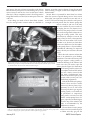
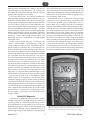
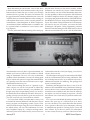
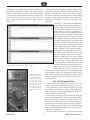
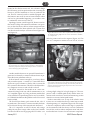
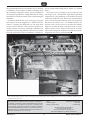
II, with its use of a variable speed electric compressor, is a different story. Compressor speed is an output of the hybrid ECU, and can be viewed as a scan tool PID (Figures 8, 9). Specs from DENSO indicate that the compressor can run up to 7500 rpm and use around 3.4 kW of electrical power (which comes out to around 17 amps if you use Watt’s Law). Wearing Class 0 gloves, safety glasses and using a CAT III 1000-volt meter, I’ve carefully peeled back the orange exible conduit from the 3 three phase cables leading to the electric compressor, and connected an inductive high voltage AC amp clamp around one of the cables. Measured current draw was 7 - 8 amps on a 70-degree F. day (Figure 10). By the way – please don’t even think about back probing or piercing ANY orange HV cables on a hybrid. The result will very likely be a no start condition. Since there is no 12-volt electric starter to crank the gas engine on a hybrid Toyota or Lexus, one of the HV motor generators cranks the engine at around 1000 rpm whenever it needs to start. In order for this to happen, the hybrid’s electronics must be happy with the state of various relays and controls, in addition to the condition of the HV wiring insulation. Just like a GFI in your house automatically pops a breaker to shut down a shorted circuit to prevent shock or electrical res, the safeguards on hybrid electric vehicles do the much the same. A tiny pinhole in a high voltage wire or around a connector could cause an arc and potential shock hazard, and induce a complete system shut down. Also, orange cables often have an inner conductor surrounded by insulaFigure 9: Gen II Prius HVAC PIDS graphed from the Toyota Techstream Lite. Note that the tion, then a braided ground shield (like an set temperature number drives the compressor speed. antenna coax) on top of that, and then more orange insulation on top of that. A “T” pin jammed into the center conductor will connect the braided ground shield to that center conductor. A direct short of high voltage to ground will be the result. Sure hope those Figure 10: Connecting a current probe to this electronic safeguards work and your gloves don’t have a Cat III/1000 volt mulpinhole in them! timeter and clamping the probe over one of the heavy high voltage AC lines going to the compressor will tell you the current draw of the compressor. The current probe outputs amps to mV. January 2011 2010 – 2011 Generation III Prius Starting with the 2010 model year, Toyota fans saw the launch of yet another Prius generation. Unless you work at a Toyota dealership, you’ll not likely see one in your shop for a while, but as a heads up, we’ll cover the highlights of what’s new. There are a lot of wildly high-tech and innovative new features to say the least. Look at the front of the gas engine and right off the bat you see something missing. There is no serpentine belt on this vehicle. There’s no alternator (hybrids all use a DCDC converter for that job), no power steering pump (a 12volt electric power steering system is used), and there is also no mechanical water pump, because the main pump to move coolant under all conditions is now an electrically-operated 12-volt pump. Next up for the Gen III Prius is an optional solar panel 6 MACS Service Reports