1
» Combustion chamber volume error results in more
than 111 0 point difference in compression between the
front & rear cylinders
» Squish area is reduced
» Wedge is removed, reduced, etc.
» Piston ring travel appears in the relief area
» Extreme roughness (waves, lumps, grinding
marks, etc.)
After the work has been completed to your satis
faction, it is probably advisable to lap the valves in
again, to "heal" any light scratches on the seating
surfaces and insure proper sealing.
Of course, the final step is a thorough cleaning
before re-assembly.
Note: the comments given here are believed to be
accurate and reliable, and based on well-proven, time
tested techniques and are safe & effective for all
motors (if careful applied). I feel that modem air-flow
research may be able to improve on this, but such
developmental work is beyond my financial means. In
all likelihood, other patterns & theories are effective
(to a greater or lesser degree), but the ideas given here
are taken from professionally-prepared motors, as
well as interpolations from factory racing department
drawings & instructions.
STROKING
Purpose
All Harley-Davidson 45 motors 1929-1973 (ex
cept XA) share the same stroke length: 3 131t6"
(3.8125"), the same as 1952-1953 K & KK Models,
1953-1969 KR, and all 1957-85 900cC & 1000cC iron,
and 1986-* 883 cc , l100cc & 1200cC Evo Sportsters®.
The bore-to-stroke ratio of the 45 motor is radically
"under-square" (the stroke is greater than the bore)
and obsolete by modem standards, but the only effec
tive method of increasing the displacement is to in
crease the stroke, using "stroker" flywheels. This
permits displacement increases of up to 59 In.3 or 970 cC
with std. bore pistons.
This is especially useful in motors equipped with
big-port WLDR, WR and K-Model cylinders, as the
increased vacuum, compression, and sharper rod angle
will greatly reduce the normally "soft" low-speed
response of these motors.
My subject here is some of the more basic work
involved in planning and installing these parts. I will
not cover engine assembly in general; consult your
service and parts manuals, as well as "How to Restore
Your Harley-Davidson" by Bruce Palmer III. I
strongly recommend that the breather timing modified
per "BT-HP" instructions, and that the cylinders be
relieved.
Please read this entire article thoroughly before
purchasing or modifying any components. Large
strokes and/or heavier rods will require extreme re
liefs to the cylinder mouth areas. Certain combina
tions ofrod & extreme stroke are not practical due to
severe interference with the crank-cases, case fasten
ers, and cylinder base flange. For reading conven
ience, I will refer to 1957-1985 iron-head Sportster®
parts as "XL".
Dimensions
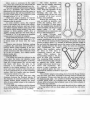
Each std. flywheel contains centered Va" (.875")
tapered holes to receive the sprocket & pinion shafts.
Rotation takes place around this shaft axis. The std.
Page 20 of40
1.00" crank-pin holes are off-set from these shaft
holes by 1.90625" (Y2 of the std. stroke of 3.8125"), so
that the crank-pin & rods follow a different path. The
amount of off-set determines the stroke length:
Stroke Length = 2 x Off-set Distance
This is the only dimension that affects the stroke.
Rod length (although otherwise important) does not
change the size of the motor.
In addition to the obvious change in displacement,
compression is also increased, and other functions are
also affected.
Selection of Components
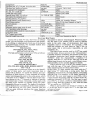
The total height of the assembled parts: 50% of
stroke + rod length between centers + piston com
pression distance with the new stroke must equal the
total height of the motor: crank-case deck height +
stroker plate (if used) + cylinder height + piston to
head clearance.
Changes in any dimensions must be compensated
for in the other components. If the stroke is increased
but the motor height remains stock, the rod and/or
piston must be shortened to compensate for the stroke
Increase.
Certain combinations of stroke length, piston, etc.
appear to offer the advantage of maximum size, when
compared to other choices. It's important to keep in
mind that re-designing the motor allows you to make
other improvements as well. The most important of
these is increasing the efficiency of the combustion
chamber.
Positive deck ("pop-up") pistons add power and
torque to any size motor, and are well worth the extra
trouble to calculate the measurements and do the
machine work.
No factory race or high-performance side-valve
motor (including Indians) was built without this fea
ture after 1948. Before making your final choices,
remember that pop-up is almost certainly worth more
power than an extra inch or two of displacement.
"45 Performance", by VICTORY LIBRARY
May 15, 2005