1
Wheel quick release
Front Wheel Secondary Retention Devices
IMPORTANT:
Riding with an improperly adjusted wheel quick release can allow the wheel to
wobble or disengage from the bicycle, causing serious injury or death to the rider.
Therefore, it is essential that you:
1. ask your dealer to help you make sure you know how to install and remove your
wheels safely.
2.understand and apply the correct technique for clamping your wheel in place with
a quick release
3.each time, before you ride the bike, check that the wheel is securely clamped.
The wheel quick release uses a cam action to clamp the bike’s wheel in place.
Because of its adjustable nature it is critical that you understand how it works, how
to use it properly and how much force you need to apply to secure the wheel.
IMPORTANT
The full force of the cam action is needed to clamp the wheel securely. Holding
the nut with one hand and turning the lever like a wing nut with the other hand
until everything is as tight as you can get it will not clamp the wheel safely in the
dropouts.
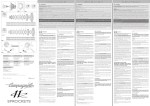
CLOSED
OPEN
Most bicycles have front forks which utilize a secondary wheel retention device to keep
the wheel from disengaging if the quick release is incorrectly adjusted. Secondary
retention devices are not a substitute for correct quick release adjustment.Secondary
retention devices fall into two basic categories:
1. The clip-on type is a part which the manufacturer adds to the front wheel hub or
front fork.
2.The integral type is molded, cast or machined into the outer faces of the front fork
dropouts.
Ask your dealer to explain the particular secondary retention device on your bike.
WARNING!
Do not remove or disable the secondary retention device. As its name implies, it serves
as a back-up for a critical adjustment. If the quick release is not adjusted correctly, the
secondary retention device can reduce the risk of the wheel disengaging from the fork.
Removing or disabling the secondary retention device may also void the warranty.
Secondary retention devices are not a substitute for correct quick release adjustment.
Failure to properly adjust the quick release mechanism can cause the wheel to wobble
or disengage, which could cause you to loose control and fall, resulting in serious injury
or death.
Removing a Quick Release Wheel
1. If your bike has rim brakes, disengage the brake’s quick-release mechanism to
open the clearance between the tire and the brake pads.
2.Move the wheel’s quick-release lever from the locked or CLOSED position to the
OPEN position.
3.If your front fork does not have a secondary retention device go to step (5).
-- Turning the tension adjusting nut clockwise while keeping the cam lever from
rotating increases clamping force;
GENERAL
The wheel hub is clamped in place by the force of the quick release cam pushing
against one dropout and pulling the tension adjusting nut, by way of the skewer,
against the other dropout. The amount of clamping force is controlled by the tension
adjusting nut.
5.Raise the front wheel a few inches off the ground and tap the top of the wheel
with the palm of your hand to knock the wheel out of the front fork.
ENGLISH
Adjusting the quick release mechanism
4.If your front fork has a clip-on type secondary retention device, disengage it and
go to step (5). If your front fork has an integral secondary retention device, loosen the
tension adjusting nut enough to allow removing the wheel; then go to the next step.
CLOSED position
-- Turning it counterclockwise while keeping the cam lever from rotating reduces
clamping force.
Less than half a turn of the tension adjusting nut can make the difference between
safe clamping force and unsafe clamping force.
OPEN position
14
BIKE OWNER’S MANUAL
scott-sports.com
15