1
Projet 30
Projet de développement S2 – 2011-2012
MODELES 3D D’UN CERVEAU HUMAIN A PARTIR D’IMAGES 2D
ISSUES DE RESONANCE MAGNETIQUE
ENCADRANT : Francesco P. Andriulli
MOTS CLÉS : imagerie cérébrale, résonance magnétique, brain-computer interfaces.
SUJET : Several cutting edge technologies rely on the detection, mapping, and interpretation of the electromagnetic activity of the human brain. In designing braincomputer interfaces, for example, one could detect the electric currents associated to
different brain conditions to obtain input streams for a brain-controlled computer. The
detection of brain currents relies on advanced electromagnetic inverse algorithms. In
order to increase the effectiveness of these algorithms, it is necessary to have high fidelity, ad hoc, 3D electromagnetic models of the human brain [1]. One approach to obtain such models is based on the processing of magnetic resonance (MR) images. In
this project, the students will develop a MATLAB software that, given a set of MR slices
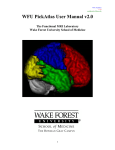
(see Fig. 1), will produce a 3D model of the human brain (see Fig. 3). This will be attained by gradual steps: (i) first a stacked set of MR images will be mapped on a 3D
cube and appropriately interpolated. This will provide a first, simple and nonsegmented, 3D model. Next, (ii) more sophisticated segmentation algorithms will be
interfaced (in a simple way) with the MATLAB software (segmentation tools, such as
iso2mesh [2], will be provided and don’t need to be developed by the students). This
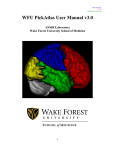
will provide 2D segmented data (see Fig. 2) and 3D segmented models (see Fig.3).
Finally, (iii) the newly developed MATLAB tool will be interfaced with visualization software commonly used in biomedical engineering and in the medical practice (e.g. [3]).
Figure 2: 2D segmentation.
Figure 1: magnetic resonance slices.
Figure 3: output of iso2mesh [2].
1/2
Projet 30
Projet de développement S2 – 2011-2012
RÉSULTATS ATTENDUS :
Etude des outils existants et de la bibliographie.
Développement des fonctionnalités spécifiées en (i).
Développement des fonctionnalités spécifiées en (ii).
Développement des fonctionnalités spécifiées en (iii).
Validation du logiciel.
Manuel d’utilisation.
OBJECTIFS PÉDAGOGIQUES :
Durant le projet, les élèves auront à développer les compétences suivantes:
•
Appliquer ses connaissances dans une situation nouvelle.
•
Définir les connaissances à acquérir dans la problématique d’un développement.
•
Tester, évaluer, valider des éléments de solutions.
•
Utiliser des technologies/outils adaptés au projet.
OUTILS UTILISÉS :
MATLAB®
CONTRAINTE DE FORMATION :
Aucune.
RÉFÉRENCES :
[1]. B. Aubert-Broche, A. C. Evans, L. Collins, A new improved version of the realistic
digital brain phantom, NeuroImage, Volume 32, Issue 1, 1 August 2006, Pages
138-145.
[2]. Iso2mesh: a 3D surface and volumetric mesh generator for MATLAB/Octave.
(http://iso2mesh.sourceforge.net).
[3]. 3DSlicer. A multi-platform, free and open source software package for visualization and medical image computing. (http://www.slicer.org/).
2/2