1
MIX 2.3
If the data give percents, mass, or anything other than counts over the grouping intervals, an
accuracy index of 1 or 0.1 may not be suitable and you may have to experiment to find a better
value, according to the relative magnitude of the “chi-square”.
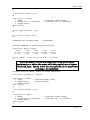
The final prompt of Option 5 asks if you want to abort; this is the only provision for escape if
you realize that your input is not appropriate. Response Y leads back to the prompt to choose an
Option, response N begins the direct search.
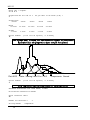
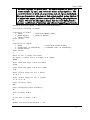
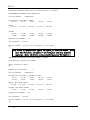
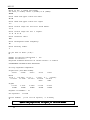
The output is self-explanatory. The choice of constraints is indicated by acronyms FIXED
(fixed), MEQ (means equal), EQSP (means equally spaced), GCRV (means on a growth curve),
FCOV (fixed coefficient of variation), CCOV (constant coefficient of variation) and SEQ (standard
deviations equal) under those parameters which, by reason of the constraints, are not being
estimated directly.
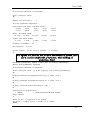
It may be that the initial values lie outside the region of admissible values defined by the upper
and lower limits on the means and standard deviations and the iterations never penetrate the
admissible region. This will be flagged by an error message and the final value of chi-square will be
.100000E+17. In extremely pathological cases, the means and standard deviations will lie within
the upper and lower bounds specified but are inadmissible for some other reason. For example,
they may specify a mixture that is nowhere near the observed histogram. This will be flagged by
an error message and the final value of chi-square will be .100000E+16.
Option 5 should not be used if the proportions do not sum to 1 or if there is a negative
proportion, as the likelihood-ratio chi-square being minimized will be meaningless; it may even be
negative. If necessary, use Option 3 to prepare the proportions before entering Option 5.
On the microcomputer versions of MIX, during the direct search, a counter displays the
number of function evaluations. When the iterations finish, a short beep indicates convergence, a
long beep indicates that the limit of function evaluations was reached, a double beep indicates that
the parameter values were inadmissible.
Option 6. Estimate proportions, means, sigmas with or without constraints.
Use efficient “scoring” iterations (Macdonald and Pitcher 1979) to estimate the parameters
under specific constraints. The variance-covariance matrix for the estimates is computed and
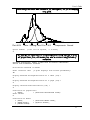
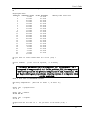
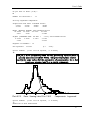
standard deviations are given for the estimates. The observed and expected counts for each interval
may be tabulated or graphed.
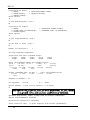
The final prompt asks if you want to abort; this is the only provision for escape if you realize
that your input is not appropriate. Response Y leads back to the prompt to choose an Option,
response N begins the iterations.
On the microcomputer versions of MIX, a counter displays the number of iterations. When
the iterations finish, a short beep indicates convergence, a long beep indicates that the limit of
iterations was reached, a double beep indicates that the iterations failed and the parameters have
been restored to their values from the previous step.
14