1
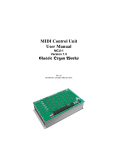
MIDI CONTROL UNIT MCU-1 INTRODUCTION _________________________________________________________________________________________________________ MIDI CONTROL UNIT MCU-1 1. INTRODUCTION Description Congratulations! You are now the proud owner of the MCU-1 (MIDI Control Unit, MCU). The MCU-1 is a MIDI interface that allows MIDI sound modules to be added to a pipe or electronic organ, or even to create a whole organ through the use of computer-driven virtual organ software such as Hauptwerk™ 1. Designed as a modular unit, it provides a ‘smart’ add-on interface so that organs can be provided with MIDI voices that can be controlled as though they were part of the organ. The MCU is designed for organists, organ enthusiasts, and MIDI users. In particular, organists may connect keyboards, stops, pistons, tuning devices, expression controls, crescendo controls, volume controls and a pedal board to the MCU. Organ enthusiasts with an Ahlborn Archive SeriesTM module2 may use the MCU to control divisions, channel, stops, couplers, combinations, pistons, tremulants, crescendo, expression, Sforzando (Tutti), cancel, set, and tuning. Up to four Archive modules may be controlled simultaneously. By purchasing the optional GM-MIDI module, MIDI users can control channel, voice variation, drumset variation, volume, expression and tuning using the MCU. Furthermore, a convenient MIDI merge feature allows simultaneous control of multiple MIDI devices. An additional 48 output pins are available on the MCU, but they are presently not implemented being reserved for future use. Key-switch information from keyboards, pedalboards, stops, pistons and other switches is converted into MIDI control data. The MCU can support as many as three 61-note keyboards and one 32-note pedalboard. 1 Hauptwerk is a registered trademark of Milan Digital Audio Inc., USA, formerly Crumhorn Laboratories Limited, England. 2 Archive Module Series is a registered Trademark of Ahlborn-Galanti Organs, a division of General Music Corporation, Italy. Keyboard and pedalboard switches are interpreted by the microprocessor in the MCU to generate MIDI messages describing key-switch actions. Thus, a MIDI message details whether a key was pressed or released, the MIDI channel that the information should be transmitted on, and the key number pressed or released. Up to 105 stop and piston switches can be wired to the MCU. The concept of a stop and piston used in the MCU differs somewhat from that used in organ terminology. MIDI was originally developed for electronic music use in synthesizers. It was only a few years ago that organ-builders began adding MIDI capabilities to pipe organs. However, MIDI was not designed for a complex musical instruments such as the organ. Thus, the application of the MIDI standard to the organ is subject to organ-builders’ preferences, and standards are still evolving. On the MCU, stop switches are connected to input pins. When switches such as drawknobs, rocker-tabs, and pushbuttons are activated, the microprocessor identifies the switch action and generates a MIDI message to indicate a switch-on or switch-off. Piston switches are also connected to the input pins. However, when piston switches are activated a MIDI message is sent to select a combination of stops. The piston and stop switches allow the MCU-1 to simultaneously drive up to four Ahlborn Archive Series™ modules that generate pipe-organ voices. In addition, any MIDI-controlled sound module or PCbased synthesizer software may be connected. Typical units would be Hauptwerk virtual organs or Viscount Accupipe CM-100 pipe voice modules. There is also provision for an optional internal plug-in General MIDI sound generator, Classic type GM 9773. Five analog input pins can be configured for volume, expression, tuning and crescendo. By adjusting the analog device, a voltage on the analog input pin is interpreted by the microprocessor. In the case of a volume adjustment, a MIDI message will detail to the _________________________________________________________________________________________________________ MCU-1 Manual (Version 1.5) Issue-3 2009-06-17 2009 CLASSIC ORGAN WORKS 7