1
1.
INTRODUCTION
1.0
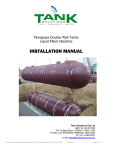
Proper installation is essential to the expected product life and performance of a Tank Solutions Glasteel II Underground
Storage Tank. This tank must be installed in accordance with these installation instructions, the latest AS4897-2008 and
APICSA recommended practices and authorities who have jurisdiction over underground tank installations and codes.
1.1
Failure to follow these instructions will void the tank warranty and may cause tank failure, serious personal injury or
property damage. Since Tank Solutions does not control the parameters of any installation, our sole responsibility in any
installation is that presented in our warranty.
2.
TANK HANDLING
2.0
Caution shall be used when handling the tank. Do not roll or drop the tank.
2.1
Equipment to lift and lower the tank shall be of sufficient capacity to do so without dragging or dropping the tank.
2.2
The tank shall be lifted and lowered using the lifting lugs provided. Cables or chains used shall be of adequate length. No
circumstances warrant the use of chains or slings around the tank shell.
3.
TANK STORAGE
3.0
If the tank is stored on site prior to installation, a secure area shall be chosen. Special attention shall be placed in
selecting the storage location to ensure the absence of rocks and foreign objects that might cause damage to the tanks
outer jacket.
4.
INPSECTION
4.0
Visually inspect the tank exterior for damage. Serious gouging or abrasion should be carefully reviewed and appropriate
action taken. Refer to Tank Solutions if there is any doubt as to the remedial action required.
4.1
Remove thread protectors and shipping plugs from all openings (except vacuum gauge location). Using compatible, non
hardening pipe sealant, install permanent metal plugs in all unused openings.
5.
PRE INSTALLATION CHECKS
5.0
Tank Solutions tanks are tested prior to shipment, but the tank must be checked at the site prior to installation. The
Installer is responsible for verifying vacuum gauge reading on the annular space by opening the needle valve. If a
minimum of 17kPa of vacuum is maintained for one hour, the interstitial space may be considered properly tested.
CAUTION: Do NOT Pressure Test the Interstitial Space.
6.
EXCAVATION AND BEDDING
6.0
The installing contractor must take all precautions necessary to protect employees working in or near a tank excavation.
These precautions should include, but are not limited to:
•
Location and protection of any utility installations near the excavation before opening the excavation;
•
Means of securing the walls of the excavation;
•
Means of preventing exposure of employees to hazardous fumes from the excavation;
•
Protection of employees from hazards associated with water accumulation in the excavation;
•
Barricades, etc. to prevent unauthorised vehicle or pedestrian traffic;
•
Inspection of the excavation and surrounding area at least daily.
6.1
Glasteel II underground storage tanks are designed to withstand a maximum burial depth of 2.1 metres. If a greater burial
depth is required, contact the manufacturer immediately.
6.2
The bottom of the excavation shall be suitably graded and levelled. The foundation for the tank shall be suitably graded
and have a minimum of 300mm of approved backfill (refer to Section 8). The tank shall be encompassed by approved
backfill, free from foreign matter which could cause damage to the tank exterior.
6.3
Soil Conditions
Stable Soil Conditions – Where shoring is not required to maintain a vertical wall from top to bottom of the excavation,
there shall be a minimum of 450mm (600mm for 3.5m tanks) from the outside edge of the tank to the inside edge of the
excavation. This distance shall remain true for the entire perimeter surrounding the tank.
Unstable Soil Conditions – Where soil will not maintain a vertical wall, the excavation must allow a minimum space equal
to ½ the diameter of the tank between the side and end cap of the tank and the excavation wall. Spacing between
adjacent tanks to be a minimum of 450mm.
NOTE: These are minimum spacings and must be increased as needed to accommodate anchors or anchor slabs. Always
allow sufficient clearance to allow the anchors to be set outside of the tank shadow. The relevant Australian Standard
(AS1940) specifies the minimum tank separation distances.
Form: F 940
Revision D
Page 2 of 4