1
INDOOR UNIT
●
●
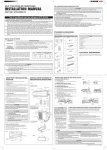
CUTTING THE HOLE IN THE WALL FOR THE CONNECTING PIPING
Fig. 5
●
Lower
Lower
65 mm hole
Fasten with
vinyl tape
10 mm or
over
65 mm hole
Fig. 8
Wall hook bracket
Connection piping
Alignment marks
[Installing the indoor unit]
●
●
5~10 mm
(1) Cut a 65 mm diameter hole in the wall at the position shown in
(Fig. 5).
(2) When cutting the wall hole at the inside of the wall hook bracket, cut
the hole within the range of the left and right center marks 40 mm
below the wall hook bracket.
When cutting the wall hole at the outside of the wall hook bracket, cut
the hole at least 10 mm below over.
(3) Cut the hole so that the outside end is lower (5 to 10 mm) than the
inside end.
(4) Always align the center of the wall hole. If misaligned, water leakage
will occur.
(5) Cut the wall pipe to match the wall thickness, stick it into the wall cap,
fasten the cap with vinyl tape, and stick the pipe through the hole.
(The connection pipe is supplied in the installation set.) (Fig. 5)
(6) For left piping and right piping, cut the hole a little lower so that drain
water will flow freely. (Fig. 5)
Centering marks
Wall hook bracket
For left piping and left rear piping, align the marks on the wall hook
bracket and shape the connection pipe.
Bend the connection piping at the bend radius of 70 mm or more and
install no more than 35 mm from the wall.
After passing the indoor piping and drain hose through the wall hole,
hang the indoor unit on the hooks at the top and bottom of the wall
hook bracket.
Small piping
Hang the indoor unit from the hooks at the top of the wall hook bracket.
Insert the spacer, etc. between the indoor unit and the wall hook
bracket and separate the bottom of the indoor unit from the wall.
Large piping
Upper hooks
(Spacer)
Wall hook bracket
Indoor unit
(Wall pipe)
(Wall cap)
(Inside)
Wall
Indoor unit
(Outside)
Lower slots
(Lower projections)
After hooking the indoor unit to the top hook, hook the fittings of the indoor unit
to the two bottom hooks while lowering the unit and pushing it against the wall.
INSTALLING THE WALL HOOK BRACKET
Fig. 6
Install the indoor unit piping in the direction of the wall hole and bind
the drain hose and pipe together with vinyl tape. (Fig. 7)
Install the piping so that the drain hose is at the bottom.
Wrap the pipes of the indoor unit that are visible from the outside
with decorative tape.
Fig. 9
Right outlet
[For Left rear piping, Left piping]
Bottom outlet
Interchange the drain cap and the drain hose.
(5) Prevent drain water frozen under low temperature environment.
When installing indoor unit's drain hose outdoors, necessary
measure for frost protection should be taken to prevent drain
water frozen.
• Under low temperature environment (when outdoor temperature under 0 °C), after cooling operation is executed, water
in the drain hose could be frozen.
Once drain water is frozen, the drain hose will be blocked
and water leakage may be resulted for indoor unit.
Be sure to install around the drain hose connector.
As the screw is inside, be sure to use screwdriver treated with
magnet.
Set the unit on a strong stand, such as one made of concrete blocks
to minimize shock and vibration.
Do not set the unit directly on the ground because it will cause trouble.
Connector cover removal
●
Connection pipe
To prevent gas leakage, coat the flare
surface with refrigerator oil.
Removal method of
drain hose
Installation method of
drain hose
●
●
Remove the screw at the left
of drain hose and pull out
drain hose.
Screw
Drain hose
(1) Fasten a flare nut with a torque wrench as instructed in this
manual. If fastened too tight, the flare nut may be broken after
a long period of time and cause a leakage of refrigerant.
(2) During installation, make sure that the refrigerant pipe is attached firmly before you run the compressor. Do not operate
the compressor under the condition of refrigerant piping not
attached properly with 2-way or 3-way valve open. This may
cause abnormal pressure in the refrigeration cycle that leads to
breakage and even injury.
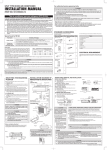
Open the open panel.
Remove the top cover.
Remove the cord clamp.
Route the connection cord from behind the indoor unit.
(5) Connect the end of the connection cord securely to the terminal block.
(6) Secure the connection cord with the cord clamp.
(7) Install the top cover with the screw.
(8) Close the open panel.
Fig. 10
Open panel
Top cover
Cord clamp
Vertically insert the drain hose
till the drain furniture aligns
with the screw hole of drain
cock. After inserting and before replacing, please reinstall
and fix the removed screws.
Screw
Screw
Cord clamp
Connection cord
Screw
Connection
cord
CAUTION
(1) Match the terminal block numbers and connection (3) Always fasten the outside covering of the connection cord with the cord clamp. (If the insulator is
cord colors with those of the outdoor unit.
chafed, electric leakage may occur.)
Erroneous wiring may cause burning of the electric parts.
(4) Securely earth the power cord plug.
(2) Connect the connection cords firmly to the terminal (5) Do not use the earth screw for an external connecblock. Imperfect installation may cause a fire.
tor. Only use for interconnection between two units.
Screw hole
Drain cock
Drain furniture
Drain furniture
Drain hose
(1) After inserting the two front hooks, then insert the rear hook.
(2) Tighten the tapping screws.
(1)
(2)
(3)
(4)
(5)
Fig. 11
Fig. 13
Installing the connector cover
Remove the outdoor unit connector cover.
Bend the end of the cord as shown in the figure.
Connect the end of the connection cord fully into the terminal block.
Fasten the sheath with a cord clamp.
Install the connector cover.
5mm
OUTDOOR UNIT WIRING
OUTDOOR UNIT INSTALLATION
●
Flare nut
Open panel
OUTDOOR UNIT
●
Pipe
INDOOR UNIT WIRING
(1)
(2)
(3)
(4)
Screw
●
●
CAUTION
A
Earth screw
12mm
(4)
Drain hose
1.5 to 2.0
1.5 to 2.0
30mm
(3)
Wing nut type
1.0 to 1.5
1.0 to 1.5
5mm
(2)
Remove the drain
cap by pulling at
Drain cap the projection at
the end of the cap
with pliers, etc.
Indoor unit pipe
Clutch type
0 to 0.5
0 to 0.5
12mm
(1)
CAUTION
In order to align the drain hose and drain cap, be
sure to insert securely and vertically. Incline insertion will cause water leakage.
When inserting, be sure not to attach any material
besides water. If any other material is attached, it
will cause deterioration and water leakage.
After removing drain hose, be sure not to forget
mounting drain cap.
Be sure to fix the drain hose with tape to the bottom
of piping.
Torque wrench
A (mm)
Conventional (R22) flare tool
Flash tool for
R410A, clutch type
Die
Wrench (fixed)
Rear outlet
Drain hose (on bottom)
Bind with vinyl tape
For left outlet
piping, cut off the
piping outlet
cutting groove
with a hacksaw.
Arm strength
Pipe outside diameter
ø 6.35 mm (1/4”)
ø 12.7 mm (1/2”)
Tighten with
two wrenches.
Piping (on top)
Wrist strength
25mm
●
●
Table 3
Pipe outside
diameter
Insert the flare nut (always use the flare nut
attached to the indoor and outdoor units respectively) onto the pipe and perform the flare
processing with a flare tool.
Use the special R410A flare tool, or the conventional (for R22) flare tool.
When using the conventional flare tool, always
use an allowance adjustment gauge and secure the A dimension shown in table 3.
Fig. 7
15.7 to 17.6 N•m
(160 to 180 kgf•cm)
49.0 to 53.9 N•m
(500 to 550 kgf•cm)
5 mm
12 mm
●
CAUTION
Install the wall hook bracket horizontally and perpendicularly.
6.35 mm dia.
12.7 mm dia.
Check if [L] is flared uniformly
and is not cracked or scratched.
(1) Cut the connection pipe to the necessary
length with a pipe cutter.
(2) Hold the pipe downward so that cuttings
will not enter the pipe and remove the burrs.
(3) Insert the flare nut onto the pipe and flare
the pipe with a flaring tool.
Tightening torque standard
(using a 20 cm wrench)
Tightening torque
5 mm
[Rear piping, Right piping, Bottom piping]
String
Flare nut tightening torque
Flare nut
FLARING
12 mm
FORMING THE DRAIN HOSE AND PIPE
(1) Install the outdoor unit wall cap (supplied with the optional installation set
or procured at the site) to the wall pipe.
(2) Connect the outdoor unit and indoor unit piping.
(3) After matching the center of the flare surface and tightening the nut hand tight,
tighten the nut to the specified tightening torque with a torque wrench.(Table 2)
Tapping screw
(size: large; quantity: 8)
Weight
Table 2
CONNECTION
Hang weight
from here.
Wall hook
bracket
CONNECTING THE PIPING
35 mm
WARNING
If the wall pipe is not used, the cord interconnecting
the indoor and outdoor units may touch metal and
cause electric leakage.
Leveling method
40 mm
Wall hook bracket
(1) Install the wall hook bracket so that it is correctly positioned horizontally and vertically. If the wall hook bracket is tiled, water will drip to
the floor.
(2) Install the wall hook bracket so that it is strong enough to withstand
the weight of an adult.
● Fasten the wall hook bracket to the wall with 8 or more screws through
the holes near the outer edge of the bracket.
● Check that there is no rattle at the wall hook bracket.
Control box
Remove the tapping screws.
WARNING
(1) Install the unit where it will not be tilted by more
than 5°.
(2) When installing the outdoor unit where it may exposed to strong wind, fasten it securely.
Tapping screw
Sheath
Cord clamp
Front hooks
Earth screw
Indoor unit terminal block
Rear hooks
Earth screw
Outdoor unit terminal block
Connection cord
Connector cover
Cord clamp
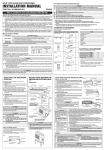
AIR PURGE
Connection cord
Always use a vacuum pump to purge the air.
Refrigerant for purging the air is not charged in the outdoor unit at the factory.
Fig. 14
Close the high pressure side valve of the gauge manifold fully and do not operate it during the following work.
1. Check if the piping connections are secure.
Connection cord wiring
CAUTION
2. Check that the stems of 2-way valve and 3-way valve are closed fully.
3. Connect the gauge manifold charge hose to the charging port of the
3-way valve (side with the projection for pushing in the valve core).
(1) Refrigerant must not be discharged into atmosphere.
(2) After connecting the piping , check the joints for
gas leakage with gas leak detector.
Fig. 12
4. Open the low pressure side valve of the gauge manifold fully.
3-way valve
Gauge manifold
Compound pressure gauge
Pressure gauge
-0.1 MPa
2-way valve
(-76 cmHg
-1 bar)
Flare nut
LO
HI
5. Operate the vacuum pump and start pump down.
Low pressure
side valve
6. Slowly loosen the flare nut of the 3-way valve and check if air
enters, then retighten the flare nut.
(When the flare nut is loosened the operating sound of the
vacuum pump changes and the reading of the compound
pressure gauge goes from minus to zero.)
7. Pump down the system for at least 15 minutes, then check if the
compound pressure gauge reads -0.1 MPa (-76 cmHg, -1 bar).
8. At the end of pump down, close the low pressure side gauge of
the gauge manifold fully and stop the vacuum pump.
9. Slowly loosen the valve stem of the 3-way valve. When the
compound pressure gauge reading reaches 0.1-0.2 MPa,
retighten the valve stem and disconnect the charge hose from
the 3-way valve charging port.
(If the stem of the 3-way valve is opened fully before the
charge hose is disconnected, it may be difficult to disconnect
the charge hose.)
10. Fully open the valve stems of the 2-way valve and 3-way valve
using a hexagon wrench. (After the valve stem begins to turn,
turn it with a torque of less than 2.9 N•m (30 kgf•cm) until it
stops turning.)
11. Firmly tighten the 2-way valve and 3-way valve blank cap and
the charging port cap.
High
pressure
side valve
(closed)
Run the connection cord to the rear of the outdoor unit within the A
range of the arrows shown in the figure.
(The connector cover becomes difficult to install.)
Connection cord
CAUTION
(1) Match the terminal block numbers and connection (3) Always fasten the outside covering of the connection cord with the cord clamp. (If the insulator is
cord colors with those of the indoor unit.
chafed, electric leakage may occur.)
Erroneous wiring may cause burning of the electric parts.
(4) Securely earth the power cord plug.
(2) Connect the connection cords firmly to the terminal (5) Do not use the earth screw for an external connecblock. Imperfect installation may cause a fire.
tor. Only use for interconnection between two units.
Valve stem
Charge hose
Blank cap Charge
hose
Charging port
Charging port cap
Vacuum pump
Table 4
Tightening torque
Blank cap (2-way valve)
19.6 to 24.5 N•m (200 to 250 kgf•cm)
Blank cap (3-way valve)
27.4 to 31.4 N•m (280 to 320 kgf•cm)
Charging port cap
12.3 to 15.7 N•m (125 to 160 kgf•cm)
CAUTION
During installation, make sure that the refrigerant
pipe is attached firmly before you run the compressor. Do not operate the compressor under the condition of refrigerant piping not attached properly with
2-way or 3-way valve open. This may cause abnormal pressure in the refrigeration cycle that leads to
breakage and even injury.
FINISHING
Overlap the insulation
Fig. 15
(1) Insulate between pipes.
● For rear, right, and bottom piping, overlap the connection pipe heat insulation and indoor unit pipe heat insulation and bind them with vinyl tape so
that there is no gap.
● For left and left rear piping, butt the connection pipe heat insulation and
indoor unit pipe heat insulation together and bind them with and vinyl tape
so that there is no gap.
● For left and left rear piping, wrap the area which accommodates the rear
piping housing section with cloth tape.
● For left and left rear piping, bind the connection cord to the top of the pipe
with vinyl tape.
● For left and left rear piping, bundle the piping and drain hose together by
wrapping them with cloth tape over the range within which they fit into the
rear piping housing section.
(2) Temporarily fasten the connection cord along the connection pipe with vinyl tape. (Wrap to about 1/3 the width of the tape from the bottom of the
pipe so that water does not enter.)
(3) Fasten the connection pipe to the outside wall with saddles, etc.
(4) Fill the gap between the outside wall pipe hole and the pipe with sealer so
that rain water and wind cannot blow in.
(5) Fasten the drain hose to the outside wall, etc.
Connection pipe
(heat insulation)
Seal A
Pipe
Wrap with cloth tape
Drain hose
Left piping
Refrigerant suitable for a piping length of 15 m is charged in the outdoor
unit at the factory.
When the piping is longer than 15 m, additional charging is necessary.
For the additional amount, see the table below.
Table 5
Pipe length
15 m
20 m
Additional refrigerant
None
100 g
CAUTION
(1) When adding refrigerant, add the refrigerant from the
charging port at the completion of work.
(2) The maximum length of the piping is 20 m. If the
units are further apart than this, correct operation
can not be guaranteed.
Between 15 m and 20 m, when using a connection pipe other than that
in the table, charge additional refrigerant with 20g/1 m as the criteria.
Cloth tape
For connection from the left rear
TEST RUNNING
Connection
piping
Drain hose
Connection piping
Drain hose
BAD
BAD
BAD
Drain hose
Holder
(Included with the piping
set sold separately or
obtained locally)
Fig. 16
Lifted up
Bent
Immersed in water
(Outside wall cap)
(Sealer putty)
(Saddle)
Wall
● Perform test operation and check items 1 and 2 below.
● For the test operation method, refer to the operating manual.
● The outdoor unit, may not operate, depending on the room temperature. In
this case, press the test run button on the remote control unit while the air
conditioner is running, (Point the transmitter section of the remote control
unit toward the air conditioner and press the test run button with the tip of a
ball-point pen, etc.)
● To end test operation, press the remote control unit START/STOP button.
(When the air conditioner is run by pressing the test run button, the OPERATION indicator lamp andTIMER indicator lamp will simultaneously flash slowly.)
(Wall pipe)
Connection
cord
Connection cord
Pipe
Additional charge
Butt connection pipe
(heat insulation) against
the indoor unit pipe
Indoor unit pipe (heat insulation) and
(heat insullation) wrap with seal A so that
there is no gap.
Vinyl tape
(Outdoors)
1. INDOOR UNIT
(1)
(2)
(3)
(4)
Is operation of each button on the remote control unit normal?
Does each lamp light normally?
Fig. 17
Do the air flow-direction louver operate normally?
Is the drain normal?
2. OUTDOOR UNIT
Test run button
(1) Is there any abnormal noise and vibration during operation?
(2) Will noise, wind, or drain water from the unit disturb the
neighbors?
(3) Is there any gas leakage?
9314963018-02
05L314_9314963018-02
2
2005.12.12, 10:37