1
VTT CREATES BUSINESS FROM TECHNOLOGY
Technology and market foresight • Strategic research • Product and service development • IPR and licensing
• Assessments, testing, inspection, certification • Technology and innovation management • Technology partnership
• • • VTT WORKING PAPERS 119 Fire Dynamics Simulator with Evacuation: FDS+Evac. Technical Reference and User’s...
ISBN 978-951-38-7180-2 (URL: http://www.vtt.fi/publications/index.jsp)
ISSN 1459-7683 (URL: http://www.vtt.fi/publications/index.jsp)
VTT WORKING PAPERS 119
Timo Korhonen & Simo Hostikka
Fire Dynamics Simulator with
Evacuation: FDS+Evac
Technical Reference and User’s Guide
ISBN 978-951-38-7180-2 (URL: http://www.vtt.fi/publications/index.jsp)
ISSN 1459-7683 (URL: http://www.vtt.fi/publications/index.jsp)
Copyright © VTT 2009
JULKAISIJA – UTGIVARE – PUBLISHER
VTT, Vuorimiehentie 3, PL 1000, 02044 VTT
puh. vaihde 020 722 111, faksi 020 722 4374
VTT, Bergsmansvägen 3, PB 1000, 02044 VTT
tel. växel 020 722 111, fax 020 722 4374
VTT Technical Research Centre of Finland, Vuorimiehentie 5, P.O. Box 1000, FI-02044 VTT, Finland
phone internat. +358 20 722 111, fax +358 20 722 4374
Series title, number and
report code of publication
VTT Working Papers 119
VTT-WORK-119
Author(s)
Timo Korhonen & Simo Hostikka
Title
Fire Dynamics Simulator with Evacuation: FDS+Evac
Technical Reference and User’s Guide
Abstract
This document describes how to simulate human egress using the evacuation
module, FDS+Evac, which is fully embedded in Fire Dynamics Simulator
(FDS). This manual applies to the FDS+Evac version is 2.1.1, which is
embedded in the current FDS version 5.3.0. The most up to date version of
this manual can be obtained from the FDS+Evac home page at
http://www.vtt.fi/fdsevac/.
The FDS+Evac Technical Reference and User’s Guide does not contain
information on how to operate FDS nor Smokeview, the companion
visualisation programme for FDS. Their full capabilities are described in their
documentation, which can be obtained from the FDS-SMV home page
http://fire.nist.gov/fds/.
ISBN
978-951-38-7180-2 (URL: http://www.vtt.fi/publications/index.jsp)
Series title and ISSN
Project number
VTT Working Papers
1459-7683 (URL: http://www.vtt.fi/publications/index.jsp)
12015
Date
Language
Pages
April 2009
English
91 p.
Name of project
Commissioned by
SA-PUSSURA
Keywords
Publisher
fire dynamics simulator, evacuation, crowd
movement, escape modelling, fire modelling
VTT Technical Research Centre of Finland
P.O. Box 1000, FI-02044 VTT, Finland
Phone internat. +358 20 722 4520
Fax +358 20 722 4374
Preface
This document describes how to simulate human egress using the evacuation module,
FDS+Evac, developed at VTT Technical Research Centre of Finland, which is fully embedded in Fire Dynamics Simulator (FDS). This manual applies to the FDS+Evac version
is 2.1.1, which is embedded in the current FDS version 5.3.0. The most up to date version
of this manual can be obtained from the FDS+Evac web page at http://www.vtt.fi/
fdsevac/.
The FDS+Evac Technical Reference and User’s Guide does not contain information on
how to operate FDS nor Smokeview, the companion visualisation programme for FDS.
Their full capabilities are described in the “Fire Dynamics Simulator (Version 5) User’s
Guide” [2] and the “User’s Guide for Smokeview Version 5” [12].
Certain commercial entities, equipment, or materials may be identified in this document
in order to describe an experimental procedure or concept adequately. Such identification
is not intended to imply recommendation or endorsement by VTT Technical Research
Centre of Finland, nor is it intended to imply that the entities, materials, or equipment are
necessarily the best available for the purpose.
4
Disclaimer
VTT Technical Research Centre of Finland makes no warranty, expressed or implied,
to users of FDS+Evac, and accepts no responsibility for its use. Users of FDS+Evac
assume sole responsibility for determining the appropriateness of its use in any particular
application; for any conclusions drawn from the results of its use; and for any actions
taken or not taken as a result of analyses performed using these tools.
Users are warned that FDS+Evac is intended for use only by those competent in the
fields of fire and evacuation simulation, and is intended only to supplement the informed
judgement of the qualified user. The software package is a computer model that may or
may not have predictive capability when applied to a specific set of factual circumstances.
Lack of accurate predictions by the model could lead to erroneous conclusions with regard
to life safety. All results should be evaluated by an informed user.
5
Contents
Preface
4
Disclaimer
5
1
Introduction
1.1
1.2
1.3
1.4
2
.
.
.
.
.
.
.
.
.
.
.
.
.
.
.
.
.
.
.
.
.
.
.
.
.
.
.
.
.
.
.
.
.
.
.
.
.
.
.
.
.
.
.
.
.
.
.
.
.
.
.
.
.
.
.
.
.
.
.
.
.
.
.
.
.
.
.
.
.
.
.
.
.
.
.
.
.
.
.
.
.
.
.
.
.
.
.
.
.
.
.
.
.
.
.
.
.
.
.
.
.
.
.
.
.
.
.
.
.
.
.
.
.
.
.
.
.
.
.
.
.
.
.
.
Name and Development Environment .
Type of the Model . . . . . . . . . . . .
Model Developers . . . . . . . . . . . .
Relevant Publications . . . . . . . . . .
Input Data Required to Run the Model
Model Results . . . . . . . . . . . . . .
Uses and Limitations . . . . . . . . . .
.
.
.
.
.
.
.
.
.
.
.
.
.
.
.
.
.
.
.
.
.
.
.
.
.
.
.
.
.
.
.
.
.
.
.
.
.
.
.
.
.
.
.
.
.
.
.
.
.
.
.
.
.
.
.
.
.
.
.
.
.
.
.
.
.
.
.
.
.
.
.
.
.
.
.
.
.
.
.
.
.
.
.
.
.
.
.
.
.
.
.
.
.
.
.
.
.
.
.
.
.
.
.
.
.
.
.
.
.
.
.
.
.
.
.
.
.
.
.
.
.
.
.
.
.
.
.
.
.
.
.
.
.
.
.
.
.
.
.
.
.
.
.
.
.
.
.
.
.
.
.
.
.
.
.
.
.
.
.
.
.
.
.
.
.
.
.
.
.
.
.
.
.
.
.
.
.
.
.
.
.
.
.
.
.
.
.
.
.
.
.
.
.
.
.
.
.
.
.
.
.
.
.
.
.
.
.
.
.
.
Introduction . . . . . . . . .
Agent Movement Model . .
Fire and Human Interaction
Exit Selection . . . . . . . .
Groups . . . . . . . . . . . .
Numerical Method . . . . .
Introduction . . . . . .
Component Testing . .
Functional Verification
Qualitative Verification
Numerical Tests . . . .
9
9
11
12
13
13
13
14
14
14
15
15
17
.
.
.
.
.
.
.
.
.
.
.
.
.
.
.
.
.
.
.
.
.
.
.
.
.
.
.
.
.
.
.
.
.
.
.
.
.
.
.
.
.
.
.
.
.
.
.
.
.
.
.
.
.
.
.
.
.
.
.
.
.
.
.
.
.
.
.
.
.
.
.
.
.
.
.
.
.
.
.
.
.
.
.
.
.
.
.
.
.
.
.
.
.
.
.
.
.
.
.
.
.
.
.
.
.
.
.
.
.
.
.
.
.
.
.
.
.
.
.
.
.
.
.
.
.
.
.
.
.
.
.
.
.
.
.
.
.
.
.
.
.
.
.
.
.
.
.
.
.
.
.
.
.
.
.
.
.
.
.
.
.
.
.
.
.
.
.
.
.
.
.
.
.
.
.
.
.
.
.
.
.
.
.
.
.
.
.
.
.
.
.
.
.
.
.
.
.
.
.
.
.
.
.
.
.
.
.
.
.
.
.
.
.
.
.
.
.
.
.
.
.
.
.
.
.
.
.
.
.
.
.
.
.
.
.
.
.
.
.
.
.
.
.
.
.
.
.
.
.
.
.
.
.
.
.
.
.
.
.
.
.
.
.
.
.
.
.
.
.
.
.
.
.
.
.
.
.
.
.
.
.
.
.
.
.
.
.
.
.
.
.
.
.
.
.
.
.
.
.
.
.
.
.
.
.
.
.
.
.
.
.
.
.
.
.
.
.
.
.
.
.
.
.
.
.
.
.
.
.
.
.
.
.
.
.
.
.
.
.
.
.
.
.
.
.
.
.
.
.
.
.
.
.
.
.
.
.
.
.
.
.
.
.
.
.
.
.
.
.
.
.
.
.
.
.
.
.
.
.
.
.
.
.
.
.
.
.
.
.
.
.
.
.
.
.
.
Testing and Verification
4.1
4.2
4.3
4.4
4.5
5
.
.
.
.
Theoretical Basis for the Evacuation Model
3.1
3.2
3.3
3.4
3.5
3.6
4
.
.
.
.
Model Documentation
2.1
2.2
2.3
2.4
2.5
2.6
2.7
3
8
Getting Started . . . . . . . . . .
Features of Limited Functionality
Most recent changes . . . . . . .
Intended Use of FDS+Evac . . .
17
18
22
24
25
26
27
.
.
.
.
.
.
.
.
.
.
.
.
.
.
.
Model Sensitivity
27
28
30
30
33
34
5.1 Introduction . . . . . . . . . . . . . . . . . . . . . . . . . . . . . . . . . . . . . . . . . . . . .
6
34
Contents
5.2 Numerical Mesh Sensitivity . . . . . . . . . . . . . . . . . . . . . . . . . . . . . . . . . . . . .
5.3 Human Parameter Sensitivity . . . . . . . . . . . . . . . . . . . . . . . . . . . . . . . . . . .
5.4 Summary . . . . . . . . . . . . . . . . . . . . . . . . . . . . . . . . . . . . . . . . . . . . . .
6
Model Validation
38
6.1 Introduction . . . . . . . . . . . . . . . . . . . . . . . . . . . . . . . . . . . . . . . . . . . . .
6.2 Comparisons with Test Data . . . . . . . . . . . . . . . . . . . . . . . . . . . . . . . . . . . .
6.3 Comparisons with Other Evacuation Models . . . . . . . . . . . . . . . . . . . . . . . . . . .
7
Running FDS+Evac
Setting up the Input File for FDS+Evac
8.1
8.2
8.3
8.4
8.5
8.6
8.7
8.8
8.9
8.10
8.11
8.12
8.13
8.14
8.15
9
The MESH Namelist Group
The TIME Namelist Group
The SURF Namelist Group
The MISC Namelist Group
The VENT Namelist Group
The OBST Namelist Group
The HOLE Namelist Group
The PERS Namelist Group
The EVAC Namelist Group
The EVHO Namelist Group
The EXIT Namelist Group
The ENTR Namelist Group
The DOOR Namelist Group
The CORR Namelist Group
The EVSS Namelist Group
38
38
42
48
7.1 Starting a FDS+Evac Calculation . . . . . . . . . . . . . . . . . . . . . . . . . . . . . . . . .
7.2 Updating an Existing FDS Input File to a FDS+Evac Input File . . . . . . . . . . . . . . . . .
7.3 Getting Help, Error Statements, Bug Reports . . . . . . . . . . . . . . . . . . . . . . . . . . .
8
34
35
37
.
.
.
.
.
.
.
.
.
.
.
.
.
.
.
.
.
.
.
.
.
.
.
.
.
.
.
.
.
.
.
.
.
.
.
.
.
.
.
.
.
.
.
.
.
.
.
.
.
.
.
.
.
.
.
.
.
.
.
.
.
.
.
.
.
.
.
.
.
.
.
.
.
.
.
.
.
.
.
.
.
.
.
.
.
.
.
.
.
.
.
.
.
.
.
.
.
.
.
.
.
.
.
.
.
.
.
.
.
.
.
.
.
.
.
.
.
.
.
.
48
49
52
53
.
.
.
.
.
.
.
.
.
.
.
.
.
.
.
.
.
.
.
.
.
.
.
.
.
.
.
.
.
.
.
.
.
.
.
.
.
.
.
.
.
.
.
.
.
.
.
.
.
.
.
.
.
.
.
.
.
.
.
.
.
.
.
.
.
.
.
.
.
.
.
.
.
.
.
.
.
.
.
.
.
.
.
.
.
.
.
.
.
.
.
.
.
.
.
.
.
.
.
.
.
.
.
.
.
.
.
.
.
.
.
.
.
.
.
.
.
.
.
.
.
.
.
.
.
.
.
.
.
.
.
.
.
.
.
.
.
.
.
.
.
.
.
.
.
.
.
.
.
.
.
.
.
.
.
.
.
.
.
.
.
.
.
.
.
.
.
.
.
.
.
.
.
.
.
.
.
.
.
.
.
.
.
.
.
.
.
.
.
.
.
.
.
.
.
.
.
.
.
.
.
.
.
.
.
.
.
.
.
.
.
.
.
.
.
.
.
.
.
.
.
.
.
.
.
.
.
.
.
.
.
.
.
.
.
.
.
.
.
.
.
.
.
.
.
.
.
.
.
.
.
.
.
.
.
.
.
.
.
.
.
.
.
.
.
.
.
.
.
.
.
.
.
.
.
.
.
.
.
.
.
.
.
.
.
.
.
.
.
.
.
.
.
.
.
.
.
.
.
.
.
.
.
.
.
.
.
.
.
.
.
.
.
.
.
.
.
.
.
.
.
.
.
.
.
.
.
.
.
.
.
.
.
.
.
.
.
.
.
.
.
.
.
.
.
.
.
.
.
.
.
.
.
.
.
.
.
.
.
.
.
.
.
.
.
.
.
.
.
.
.
.
.
.
.
.
.
.
.
.
.
.
.
.
.
.
.
.
.
.
.
.
.
.
.
.
.
.
.
.
.
.
.
.
.
.
.
.
.
.
.
.
.
.
.
.
.
.
.
.
.
.
.
.
.
.
.
.
.
.
.
.
.
.
.
Miscellaneous Information
54
56
56
57
57
58
58
58
63
64
64
65
66
68
68
70
9.1 Controlling the Start Time of the Egress Movement . . . . . . . . . . . . . . . . . . . . . . .
9.2 Additional FDS+Evac Input Files . . . . . . . . . . . . . . . . . . . . . . . . . . . . . . . . . .
9.3 FDS+Evac: Output Files . . . . . . . . . . . . . . . . . . . . . . . . . . . . . . . . . . . . . .
70
70
71
10 Sample Input Files
73
11 Conclusion
86
Acknowledgements
88
References
89
7
1. Introduction
This document describes how to simulate human egress using the Fire Dynamics Simulator (FDS) [1, 2, 3, 4], and in particular, the evacuation module [5, 6, 7, 8, 9]. This
combined fire and evacuation simulation program is called FDS+Evac in this document.
FDS+Evac allows simultaneous simulation of the fire and evacuation processes. It can
also be used to simulate only the human egress process without any fire effects, e.g., a fire
drill.
FDS+Evac treats each evacuee as a separate entity, or an ’agent’, which has its own
personal properties and escape strategies. The movement of the agents is simulated using
two-dimensional planes representing the floors of buildings. The basic algorithm behind
the egress movement solves an equation of motion for each agent in a continuous 2D
space and time, i.e., FDS+Evac is doing some kind of an artificial molecular dynamics
for the agents. The forces acting on the agents consist of both physical forces, such as
contact forces and gravity, and psychological forces exerted by the environment and other
agents. The model behind the movement algorithm is the social force model introduced
by Helbing’s group [13, 14, 15, 16]. A modification of the model to describe better the
shape of the human body was introduced by Langston et al. [17].
This chapter contains some general information on FDS+Evac. In Chapter 2, the model
documentation is summarised. Chapter 3 presents the theoretical model behind the agent
movement algorithm and details on the implementation. Chapter 4 is dedicated to various verification tests of the programme and Chapter 5 deals with the sensitivity of the
model to the model parameters. In Chapter 6, FDS+Evac is validated by comparing to
other evacuation calculation methods and experimental results. Chapters 7–11 contain the
user’s guide, where the inputs of FDS+Evac are explained.
The user of FDS+Evac should read carefully every chapter of this manual before starting to use the programme. The knowledge on the theoretical method is needed in order
to build up the model correctly. It also helps making the judgement on the applicability
and reliability of the programme in the application in question. Because the evacuation
calculation is implemented as a module of FDS, the reader is recommended to read first
the User’s Guide of FDS and learn how to do fire simulations. Even if the user wants to
run the programme without fire, she/he should be acquainted with the FDS in order to
build up the simulation geometry and running the FDS simulations.
8
1. Introduction
1.1
Getting Started
The evacuation module is embedded inside the FDS. Thus, the running of FDS+Evac
evacuation simulation is done similarly as an ordinary FDS fire simulation. See the
FDS User’s Guide [2] for details. FDS+Evac results can be visualised using the Smokeview [12] programme. Also, the computer hardware requirements are similar with FDS.
The FDS fire calculation can be run parallel by using the MPI version of FDS, but the
evacuation part is always calculated as a single thread.
The evacuation module, FDS+Evac, is embedded in the FDS 5.3, which can be obtained
from the URL
http://fire.nist.gov/fds/
Download the latest version of FDS-Smokeview installation package and install it. Check
if there exists more recent maintenance releases of the executables. The resulting FDS
executables are also the executables of the evacuation calculation module. The source
codes can also be obtained via the FDS-SMV web pages.
The home page of FDS+Evac is
http://www.vtt.fi/fdsevac/
This page contains the most recent version of this combined Technical Reference and
User’s Guide of FDS+Evac and some examples on the use of FDS+Evac. This web site is
also used to store the validation and verification test cases including the input files. This
(printed) manual refers to FDS 5.3.0 + Evac 2.1.1.
1.2
Features of Limited Functionality
All the intended features of FDS+Evac are not yet fully functional. For now, FDS+Evac
is best suited for doing calculations in buildings, whose floors are mainly horizontal.
Sports halls with spectator stands or concert halls can also be modelled if their geometry
is not too complicated, but the user should note that simulations in inclined geometries
have not yet been validated. It is also assumed that the different levels of the building
are separated from each other, i.e., they are connected to each other by stairs, escalators,
doors, and similar objects. Note, that FDS+Evac does not support the use of elevators
during evacuation process. Wide stairs or inclines can also be used to connect different
floors, but this is not as straightforward as to use the default staircase model. There are
no merging flows allowed in the default staircase model, so FDS+Evac is not yet easy to
use for tall buildings. The default staircase algorithm is still very simple and it should not
be trusted too much if the stairs get crowded. At this point this is not a major problem,
because there are no merging flows in the staircase model, i.e., the exit door restricts
the flow to the staircase quite efficiently. If merging flows in staircases are needed then
the detailed geometry of the staircase should be modelled, but this is not usually very
practical way of doing things. See the example case “Stairs.fds” on the FDS+Evac
web pages.
9
1. Introduction
The evacuation calculation needs, in addition to the fire calculation meshes, its own 2D
evacuation meshes. If no fire related data is needed in the evacuation calculation then there
are no need for fire meshes and FDS+Evac can be run in a “fire drill” mode. Evacuation
meshes should not be too fine, because then one might face problems with the evacuation
flow fields, which are used to guide the agents towards the exits. This difficulty can be
addressed by an experience user, but an easier way is always to use evacuation meshes,
which are not too fine. Usually mesh cell sizes 0.25 m or larger can be used without any
problems. For example, if you have 1.2 m wide doors you could use 0.3 m, 0.6 m, or
1.2 m cell spacing depending on how detailed geometry is needed. Note, that Smokeview
does not yet fully support the evacuation calculation, e.g., the positions of doors, stairs and
other evacuation objects are not shown by Smokeview. Note also that the spaces, where
agents are allowed to move, should be at least about 0.7 m wide, because FDS+Evac
is not able to move agents in narrower exit paths correctly. The user should check the
evacuation geometry by using the Smokeview programme and make sure that the “holes”
in the evacuation geometry are not too narrow. The best way of seeing the evacuation
geometry is to do a calculation without any fire mesh definitions. Then the Smokeview
shows just the evacuation geometry. It is a good practice to construct first the FDS fire
calculation input file and do a short test run. After this one can add the evacuation meshes
to the calculation and deactivate the fire meshes, i.e., try to simulate (and see) just the
evacuation part of the calculation. When the evacuation part of the input file seems to be
working as it should then a full fire + evacuation calculation could be done.
Note that while the FDS fire simulations can use time dependent geometry elements,
such as obstacles and holes, which are created and removed by special control devices,
the evacuation geometry does not support the time dependent geometries. For evacuation,
the initial geometry is always used for the whole duration of the simulation, but the user
can give time dependent information on the usability of the doors for the door selection
algorithm.
For now, the number of agents placed in the same main evacuation mesh is limited.
The programme stops and writes out an error message if more than 10 000 agents are
tried to place on the same evacuation mesh. Usually, one main evacuation mesh extends
over a whole floor of the building. Several main evacuation meshes may coexist, e.g.,
the different floors of the building, and the total number of agents is not restricted by the
programme. The available computer memory is the only factor limiting the total number
of agents. However, the calculation is going to be very CPU expensive if there are more
than a few thousands agents in the same evacuation mesh.
The initial density of agents cannot be much larger than 4 persons per square metre. In
cases of high human density, the simulation may require a couple of initialisation trials,
because the initial positions of agents are generated randomly. If FDS+Evac cannot place
agents on their initial positions, an error message “ERROR: FDS improperly set
up.” is printed on the standard error channel and more information is printed on the
diagnostic output file of the evacuation calculation.
FDS+Evac enables coupled fire and evacuation simulations. The smoke and gas concentrations from the fire calculation affect the movement and decision making of the
evacuating humans. In principle, the coupling could also be made to the other direction,
10
1. Introduction
i.e., humans could influence the fire calculation, e.g., by opening doors, but this feature
is not yet implemented in FDS+Evac. Gas phase concentrations of O2 , CO2 , and CO
are used to calculate Purser’s Fractional Effective Dose (FED) index [24], indicating the
human incapacitation. Smoke density is used both to slow down the walking speeds of
the agents and to affect the exit selection algorithm of the agents. Smoke density can also
be used to speed up the detection the fire, but it should be kept in mind that human nose
is a very delicate instrument and the levels of smoke concentration needed for a smoke
sensing may be below the accuracy of the current FDS predictions. Note that the effects
of radiation and gas temperature on agents are not yet implemented in the programme,
so agents do not try to avoid a fire if the user does not explicitly define the evacuation
geometry to take this in to account.
The evacuation part of the FDS+Evac is stochastic, i.e., it uses random numbers to
generate the initial positions and properties of the agents. In addition, there is a small
random force on each agent’s equation of motion. Thus, same results are not obtained for
a given input file if multiple simulations are done. For this reason, one should always do a
dozen or so egress simulations to see the variation of the results. To speed up this process,
several egress calculation can be done per one fire simulation and the calculation of the
evacuation flow fields used to guide agent movement need to be calculated only once to
each given geometry.
The present version of FDS+Evac does not use computer memory optimally and does
not fully support parallel CPU calculations for the evacuation part. In later versions of the
programme, the memory usage will be optimised. Currently, an efficient use of the computer memory requires that the evacuation meshes are made as small as possible and as
few obstacles as possible are placed in the calculation. For now, if FDS+Evac calculation
takes too much memory, the user must increase the amount of available memory. This
may require switching from a 32 bit to a 64 bit operating system, because the evacuation
meshes can not be distributed over many different processors/computers unlike the FDS
fire meshes using the MPI version of the FDS executable.
1.3
Most recent changes
Below is a short description of the changes made to the different versions of FDS+Evac.
For a full change log, the reader is asked to consult the Readme.txt file, which is on
the FDS+Evac web page.
1.3.1
Most recent changes, version 2.1.1 vs 2.1.0
The namelist objects EXIT, DOOR, and ENTR have their XB fitted to the underlying grid
just like the ordinary geometric objects in FDS fire calculation meshes, e.g., OBST and
VENT namelists. Note, that the EVAC, EVHO, and EVSS namelists are not (yet) fitted to
the grid.
11
1. Introduction
Human − Wall
Forces
1111
0000
0000
1111
0000
1111
0000
1111
0000
1111
0000
1111
0000
1111
000
111
0000
1111
000
111
0000
1111
000
111
0000
1111
000
111
0000
1111
000
111
0000
1111
000
111
0000
1111
000
111
0000
1111
000
111
0000
1111
0000
1111
0000
1111
0000
1111
0000
1111
0000
1111
Outflow
VENT
Evacuation
HOLE
EXIT
or
DOOR
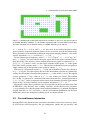
Figure 1. How to make an exit or a door.
1.3.2
Most recent changes, version 2.1.0 vs 2.0.0
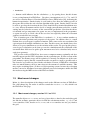
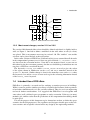
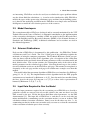
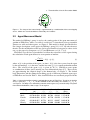
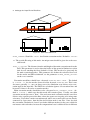
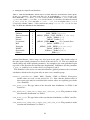
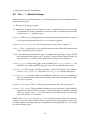
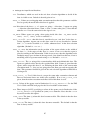
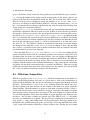
The version 2.0.0 demanded that a door should be defined such that it is slightly inside a
wall, see Figure 1. One had to define a small hole in the wall, where an exit (or a door)
was placed. This is not anymore necessary in version 2.1.0. The “outflow” vent and the
exit door can be placed directly at the wall surface.
In the earlier versions of FDS+Evac (2.0.0 and earlier) it was assumed that all obstacles
in the computational geometry were at least one grid cell thick, i.e., THICKEN=.TRUE.
was forced on the evacuation meshes. Now this is not anymore forced, so one can use
thin obstacles for the evacuation geometry, but the user should keep in mind that one can
not place a VENT on a zero thick obstacle.
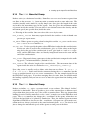
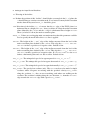
The keywords AVATAR_RGB and/or AVATAR_COLOR are used to give the colour
of the agents shown in Smokeview on the EVAC and ENTR namelists instead of the
QUANTITY keyword. Similar change is done for the namelists DOOR and EXIT, where
the keywords RGB and/or COLOR are now used to give the colouring information instead
of the COLOR_INDEX keyword.
1.4
Intended Use of FDS+Evac
FDS+Evac is primarily a research tool for studying evacuation processes in buildings.
While it seems to produce similar egress flows as found in the literature (both experimental and other simulation tools) it is not yet fully validated. Thus, its use as an engineering
tool needs further considerations. It is suggested that FDS+Evac is used together with
some other (well) validated egress programme to study evacuation. If the two (or more)
methods give similar results then the predictions of the computational modelling should
be quite good.
It is not the purpose of this document to give instructions on how to define the egress
scenarios for the design purposes. Fire regulators and designers should agree on the relevant scenarios and acceptance criteria before any design by the engineering methods.
12
2. Model Documentation
This chapter provides a short description of the evacuation module of the Fire Dynamics
Simulator (FDS). Detailed information about FDS can be found in its documentation [1,
2, 3, 4] and more detailed information about the evacuation algorithm and its features can
be found in the next chapters. Smokeview, the companion programme of FDS, is used to
visualise the results of FDS and FDS+Evac calculations and information on its properties
and how to use it can be found on its documentation [12].
2.1
Name and Development Environment
The underlying fire simulation programme, Fire Dynamics Simulator (FDS), is a computational fluid dynamics (CFD) model of fire-driven fluid flow. FDS is written using
Fortran 90 programming language. The companion programme Smokeview, written in
C/OpenGL programming languages, is used for graphical presentation of the simulation
results. The evacuation calculation module developed at VTT Technical Research Centre
of Finland (VTT) is implemented as subroutines of FDS and these subroutines together
with the FDS are called as FDS+Evac. Since the version 5 of FDS, the program development and maintenance has utilised a version control system (SVN). The source code is
maintained at a public domain server.1 Changes in the version numbers correspond to major changes in the physical models or input parameters. For minor changes and bug fixes,
incremental versions are released, referenced according to fractions of the integer version
numbers. In addition, day-to-day bug fixes made in response to user feedback are referenced by a compilation date and a SVN revision number that are printed at the top of the
diagnostic output file. The latest official release version of FDS is obtainable on the web
site http://fire.nist.gov/fds/. The latest documentation on the evacuation
part of FDS+Evac can be found on the web page http://www.vtt.fi/fdsevac/.
2.2
Type of the Model
FDS+Evac is a combined agent-based egress calculation model and a Computational
Fluid Dynamics (CFD) model of fire-driven fluid flow, where the fire and egress parts
1
The server is hosted by Google Code (http://code.google.com/p/fds-smv/)
13
2. Model Documentation
are interacting. FDS+Evac can also be used just to calculate the egress problem without
any fire-driven fluid flow calculation, e.g., it can be used to simulate fire drills. FDS+Evac
models the egress of the agents using continuous space and time, but the building geometry is fitted to the underlying rectilinear mesh. FDS+Evac uses simple rules and artificial
intelligence to model the exit selection processes of the evacuees.
2.3
Model Developers
The evacuation module of FDS was developed and its currently maintained by the VTT
Technical Research Centre of Finland. A substantial contribution to the implementation
of the evacuation calculation as a module of FDS was made by the Fire Research Division in the Building and Fire Research Laboratory (BFRL) at the National Institute of
Standards and Technology (NIST). Additional contributors and co-workers are cited in
the Acknowledgements.
2.4
Relevant Publications
Each version of FDS+Evac is documented by this publication – the FDS+Evac Technical Reference and User’s Guide. The User’s Guide part of the publication explains the
mechanics of using the computer programme. The Technical Reference Guide part provides the theory and the details of the algorithms, plus a description of the verification
and validation studies and details about the many parameters of the evacuation model and
their default values. This section contains also a throughout study of the effects of the
model parameters on the calculated egress flows. Note that the most up to date verification and validation results are on the FDS+Evac web page. This manual is not updated as
frequently as the web page and the web page will contain more example cases than this
manual.
The model behind the movement algorithm of FDS+Evac was introduced by Helbing’s
group [13, 14, 15, 16]. The implementation of this algorithm inside the FDS program
environment was introduced by Korhonen et al. [5]. Later the model was modified along
the lines given in the paper by Langston et al. [17] to a three circle representation of
humans by Korhonen et al. [6, 7, 8, 9].
2.5
Input Data Required to Run the Model
All of the input parameters required by the evacuation part of FDS+Evac to describe a
particular scenario are conveyed via one text file, which is the same one that is used for
FDS, created by the user. For the fire-driven fluid flow related parameters, see the FDS
documentation [2]. The input file of FDS+Evac is such that it can be used with just
minor modifications (commenting out the evacuation meshes) to run an ordinary FDS
calculation without evacuation calculation. Same is true for the other way also, i.e., by
commenting out the fire meshes one can make easily test runs to see that the construction
of the evacuation calculation part is done correctly.
14
2. Model Documentation
A complete description of the input parameters required by the evacuation module of
FDS can be found in the User’s Guide part of this document.
2.6
Model Results
FDS+Evac computes the position, the velocity, and the dose of toxic gases of each agent
inside the computational domain at each discrete time step. The movement of agents can
be visualised using the Smokeview programme [12]. The number of agents gone through
different parts of the evacuation scenario as well as the number of agents in different
evacuation nodes are saved in simple, comma-delimited text file, that can be plotted using
a spreadsheet programme. Some additional, quite detailed, information are written to the
diagnostic evacuation text file including the initial positions and properties of the agents.
2.7
Uses and Limitations
Although FDS+Evac can address many egress scenarios, there are limitations in all of its
algorithms. The most prominent limitations are listed below.
Geometry: The efficiency of FDS is due to the simplicity of its rectilinear numerical
mesh. This can be a limitation in some situations, where certain geometric features do
not conform to the rectangular mesh. The numerical meshes used by the agent movement
algorithm of FDS+Evac are two-dimensional cut-offs of the FDS fire meshes, thus the
same limitations apply to the evacuation part of the code. The present version of the
evacuation module can also treat inclines, like wide stairs and spectator stands, which
are along the x or y direction of the underlying rectangular mesh. The grid cell size
determines the finest details of the building geometry, which can be modelled by the
programme, e.g., the widths of the doors are integral multiples of the grid cell sizes.
Reduced Visibility: The smoke concentration calculated by the FDS is used to slow
down the walking speeds of the agents using the results of the experiment by Frantzich
and Nilsson [25], where larger smoke concentrations were used than in the experiments
by Jin [26]. The scatter of the experimental results is wide and new experimental results
would be more than welcome. Note also that in reality there are differences between
individuals in this respect, but the present version of the programme uses average values
for each agent. The default model for stairs does not include the option for agents to turn
back when the smoke concentration becomes too high.
Incapacitation: The incapacitation model is the FED concept introduced by Purser [24],
but the large scatter between different humans is not taken into account in the current
version of the programme. Whereas FDS is doing well for the smoke transport and the
prediction of O2 levels, it does much worse on the prediction of the CO concentration.
In the standard mixture fraction model of FDS, the amount of CO produced is mainly
decided by the user inputs. Note also, that the effect of HCN is not modelled and that the
toxic effects of CO2 are not modelled; only its hyperventilation factor is included.
Exit Route Selection: The exit door selection algorithm is still a relatively simple one. It
does not include any kind of social interactions, like herding behaviour. The user has more
or less full control on the doors which different agents will be using. In some applications
15
2. Model Documentation
this can be listed as a benefit of the model, but the requirements for user’s responsibility
and expertise should be recognised.
Detection and Reaction Times: The pre-movement time of the evacuating humans is
decided by the user input by giving distributions for the detection and reaction times. In
addition to the detection time given user input, the local smoke concentration can be used
to trigger the detection of a fire. Currently, the fire detection by agents can not be connected to the control logic of FDS, e.g. the smoke/heat detectors in FDS fire calculation
can not be used to trigger the movement of the agents.
Applications: There is no model for elevators in the current version of the FDS+Evac.
Nor there is any specific objects relevant to maritime applications. Concert halls and
sport facilities may be difficult to model due to the limitations dictated by the rectangular
computational mesh. There is limitation on the number of humans per evacuation mesh
(usually one mesh per one floor). In the present version one floor can contain at most
10 000 humans. The present version of FDS+Evac supports parallel calculation only for
the fire meshes, the evacuation meshes are always treated as a single thread. Thus, it is
not possible to divide the evacuation calculation to different processors using the parallel
version of FDS5. This sets the upper limit on the complexity of geometry, which can be
modelled due to the available computer RAM memory. Changing to a 64 bit operating
system and downloading the 64 bit versions of the FDS executables the memory problems
may be avoided.
16
3. Theoretical Basis for the Evacuation Model
3.1
Introduction
FDS+Evac treats each escaping person as an individual agent, whose movement is treated
by an equation of motion. This approach allows each agent to have its own personal
properties and escape strategies. Agents experience contact forces and moments as well
as psychological and motive forces and moments. The resulting equations of motions
for the translational and rotational degrees of freedom are solved using the methods of
dissipative particle dynamics. Thus, the model uses continuous time and space to track
the trajectories of the agents. FDS+Evac allows the modelling of high crowd density
situations and the interaction between evacuation simulations and fire simulations. Some
social interactions among the agents are introduced in the model. A reaction function
model is used to select the exit routes.
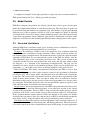
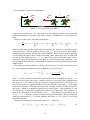
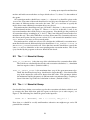
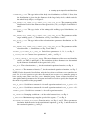
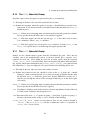
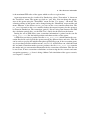
Humans are modelled as agents, which are moving in a 2D geometries representing the
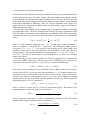
floors of buildings. The size of each agent is represented by three circles approximating
the shape of the human body, see Figure 2, just like in the Simulex programme [19, 21, 22,
23], in the MASSEgress programme [20], and in the CrowdDMX model [17, 18]. The
body dimensions and the unimpeded moving speeds of the default population types in
FDS+Evac are shown in Table 1. The body diameters and walking speeds are by default
drawn randomly for each generated agent from uniform distributions, whose widths are
also given in the table. The body diameter and moving speed distributions are taken to be
same as in the Simulex programme for the Male, Female, Child, and Elderly categories.
The category Adult is just a simple superposition of the Male and Female categories.
The existing fire simulation environment of FDS is used to minimise the programming effort to write an egress programme. For visualisation, the existing Smokeview
programme [12] developed at NIST is used. Additional benefit of using FDS as the platform of an egress model is the direct and easy access to the fire related properties, like gas
temperatures, smoke and gas densities, and radiation levels at each point in the computational grid. These quantities can be used to model the behaviour of evacuating humans.
The integration of the evacuation calculation in to the fire calculation would easily allow
the evacuation calculation to change the flow of the fire calculation, e.g., by allowing the
evacuees to open or close doors and windows, but this is not yet possible with the present
version of the FDS+Evac programme.
17
3. Theoretical Basis for the Evacuation Model
Rt
Rd
Rs
Figure 2. The shape of the human body is approximated by a combination of three overlapping
circles. Shown are also the definitions of the body size variables.
3.2
Agent Movement Model
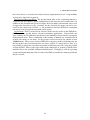
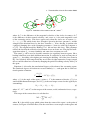
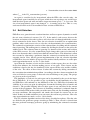
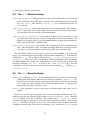
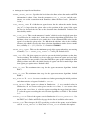
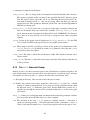
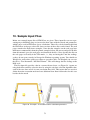
The method of Helbing’s group is used as the starting point of the agent movement algorithm of FDS+Evac, where a so-called “social force” is introduced to keep reasonable
distances to walls and other agents, see Figure 3. This model is shortly described below.
For a longer description, see the papers by Helbing’s group [13, 14, 15, 16] and references
therein. For the modification of the one-circle representation of an agent to a three-circle
one, see the papers by Langston et al. [17] and Korhonen et al. [6, 7, 8, 9].
FDS+Evac uses the laws of mechanics to follow the trajectories of the agents during
the calculation. Each agent follows its own equation of motion:
mi
d2 xi (t)
= fi (t) + ξ i (t) ,
dt2
(1)
where xi (t) is the position of the agent i at time t, fi (t) is the force exerted on the agent
by the surroundings, mi is the mass, and the last term, ξ i (t), is a small random fluctuation
force. The velocity of the agent, vi (t), is given by dxi /dt. FDS+Evac treats agents
as combination of three circles moving on a two-dimensional plane [17]. These circles
are approximating the elliptical shape of the human body, see Figure 2. The default
body dimensions and the unimpeded walking speeds of different predefined agent types
of FDS+Evac are listed in Table 1. Note, that FDS+Evac uses stochastic properties for the
Table 1. Unimpeded walking velocities and body dimensions in FDS+Evac. The offset of shoulder
circles is given by ds = Rd − Rs , for the definition of the other body size variables, Rd , Rt , Rs ,
see Figure 2. The body sizes and walking velocities of the agents are personalised by using them
from uniform distributions, whose rages are also given.
Body type
Adult
Male
Female
Child
Elderly
Rd
Rt /Rd
(m)
(-)
0.255±0.035 0.5882
0.270±0.020 0.5926
0.240±0.020 0.5833
0.210±0.015 0.5714
0.250±0.020 0.6000
18
Rs /Rd
(-)
0.3725
0.3704
0.3750
0.3333
0.3600
ds /Rd
Speed
(-)
(m/s)
0.6275 1.25±0.30
0.6296 1.35±0.20
0.6250 1.15±0.20
0.6667 0.90±0.30
0.6400 0.80±0.30
3. Theoretical Basis for the Evacuation Model
r
r
soc
Fiw
soc
Fij
soc
Fji
11
00
00
11
00
11
00
11
00
11
00
11
0011111111111111
11
00000000000000
00000000000000000000
11111111111111111111
00000000000000
11111111111111
00000000000000000000
11111111111111111111
Figure 3. The concept of the social force.
characteristics of the agents. E.g., the body sizes and walking velocities are drawn from
uniform distributions by default. The ranges of these distributions are also given in the
table.
The force on the agent i has many components:
fi =
X
X soc
X soc
mi 0
c
att
v i − vi +
fij + fijc + fijatt +
(fiw + fiw
)+
fik
,
τi
w
j6=i
k
(2)
where the first sum describes agent–agent interactions, the sum over w describes agent–
att
wall interactions, and the terms in the last sum, fik
, may be used for other agent–
environment interactions, like the fire–agent repulsion. The first term on the right hand
side describes the motive force on the evacuating agent. Each agent tries to walk with
its own specific walking speed, vi0 = |vi0 |, towards an exit or some other target, whose
direction is given by the direction of the field vi0 . The relaxation time parameter τi sets
the strength of the motive force, which makes an agent to accelerate towards the preferred
walking speed.
The agent–agent interaction force in Eq. 2 has three parts. For the social force term,
soc
fij , the anisotropic formula proposed by Helbing et al. [15] is used
fijsoc
= Ai e
−(rij −dij )/Bi
1 + cos ϕij
λi + (1 − λi )
2
nij ,
(3)
where rij is the distance between the centres of the circles describing the agents, dij is
the sum of the radii of the circles, and the vector nij is the unit vector pointing from
the agent j to i. For a three circle representation of agents, the circles used in Eq. 3 are
those circles of the two agents, which are closest to each other. The angle ϕij is the angle
between the direction of the motion of the agent i feeling the force and the direction to
the agent j, which is exerting the repulsive force on the agent i. The parameters Ai and
Bi describe the strength and spatial extent of the force, respectively. The parameter λi
controls the anisotropy of the social force. If λi = 1, then the force is symmetric and if
it is 0 < λi < 1, the force is larger in front of an agent than behind. The psychological
wall–agent interaction, fijsoc , is treated similarly, but values Aw , Bw , and λw are used for
the force constants.
The physical contact force between the agents, fijc , is given by
fijc = kij (dij − rij ) + cd ∆vijn nij + κij (dij − rij )∆vijt tij ,
19
(4)
3. Theoretical Basis for the Evacuation Model
R
soc
Rc
f soc
fc
Figure 4. Definitions of the radial vectors Rc and Rsoc .
where ∆vijt is the difference of the tangential velocities of the circles in contact, ∆vijn
is the difference of their normal velocities, and vector tij is the unit tangential vector
of the contacting circles. This force applies only when the circles are in contact, i.e.,
dij − rij ≥ 0. The radial elastic force strength is given by the force constant kij and the
strength of the frictional force by the force constant κij . Note, that Eq. 4 contains also
a physical damping force with a damping parameter cd that was added by Langston et
al. [17]. The original model by Helbing et al. did not have this force. This parameter
reflects the fact that the collision of two humans is not an elastic one. The physical wall–
c
agent interaction, fiw
, is treated similarly and same force constants are used.
att
The term fij can be used to describe attraction (or repulsion) between agents, like a
herding behaviour or an adult–children interaction. It could also be used to form pairs of
agents, e.g., describing a fire fighter pair entering the building. All of the force terms in
Eq. 2 are relatively short ranged and they need a line-of-sight connection. Longer ranged
forces could be taken in to account by changing the preferred walking velocity field vi0 of
the agent.
Equations 1–4 describe the translational degrees of freedom of the evacuating agents.
The rotational degrees of freedom are treated similarly, i.e., each agent has its own rotational equation of motion:
Iiz
d2 ϕi (t)
= Miz (t) + ηiz (t) ,
dt2
(5)
where ϕi (t) is the angle of the agent i at time t, Iiz is the moment of inertia, ηiz (t), is a
small random fluctuation torque, and Miz (t) is the total torque exerted on the agent by its
surroundings
Miz = Mic + Misoc + Miτ ,
(6)
where Mic , Misoc , and Miτ are the torques of the contact, social, and motive forces, respectively.
The torque of the contact forces is calculated as
X
Mci =
Rci × fijc ,
(7)
j6=i
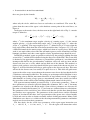
where Rci is the radial vector, which points from the centre of the agent i to the point of
contact, see Figure 4. In FDS+Evac, also the social forces exert torques on the agents and
20
3. Theoretical Basis for the Evacuation Model
these are given by the formula
Msoc
=
i
X
soc
Rsoc
,
i × fij
(8)
j6=i
where only the circles, which are closest to each other, are considered. The vector Rsoc
i
points from the centre of the agent i to the fictitious contact point of the social force, see
Figure 4.
Analogous to the motive force, the first term on the right hand side of Eq. 2, a motive
torque is defined as
Miτ =
Iiz 0
Iiz
0
0
(ϕ
(t)
−
ϕ
)ω
−
ω(t)
= z ω
˜ i − ω(t) ,
i
i
z
τi
τi
(9)
where ω 0 is the maximum target angular velocity of a turning agent, ω(t) the current
angular velocity, ϕi (t) the current body angle, and ϕ0i is the target angle, i.e., where the
vector vi0 is pointing. The target angular speed, ω
˜ i0 , defined in Eq. 9 is larger when the
body angle differs much from the desired movement direction. Langston et al. [17] used
a different formula for the motive torque, which had a form of a spring force. During this
work, it was noticed that a force like that will make agents to rotate around their axis like
harmonic oscillators and, thus, some angular velocity dependent torque should be used.
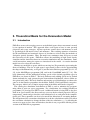
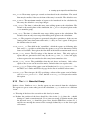
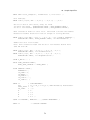
In FDS+Evac method, agents are guided to exit doors by the preferred walking direction
vector field, vi0 , and this field is obtained using the flow solver of the FDS. This vector field
is obtained as an approximate solution to a potential flow problem of a two-dimensional
incompressible fluid to the given boundary conditions, where all walls are inert and the
chosen exit door acts as a fan, which extracts fluid out of the domain. This method, or
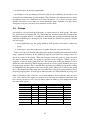
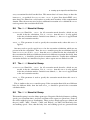
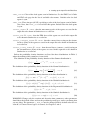
rather a trick, produces a nice directional field for egress towards the chosen exit door, see
Figure 5. A field of this kind will always guide agents to the chosen exit door. This route
will not be the shortest one, but usually it is quite close to it. This field will guide more
agents to the wider escape routes than on the narrower ones due to the fact that the field is
a solution to an incompressible flow. The analogy to an incompressible fluid flow is not a
bad starting point to find the movement directions of large human crowds. For example,
when humans are leaving a large sports or entertainment event, they usually just follow
the egress flow to the outside of the building without much control on the process.
The agent movement method presented in Eqs. 1–9 has many parameters. Some of
these parameters are related to physical dimensions of humans, like mi and Iiz , but many
parameters are related to the chosen model. Some of these parameters are chosen to be
the same as found in the literature [14, 17] and some are estimated from test calculations.
The parameters of the social force were chosen such that the specific flows through doors
and corridors were appropriate. The parameters of the contact forces and the rotational
degrees of freedom for the three circle representation of the agents were selected mainly
by trial and error in order to obtain reasonably realistic looking movement. Monte Carlo
simulations were done to see, which are the most important model parameters and further
analysis was focused on those parameters.
The first choice for the social force parameters of the agent–agent interaction was
Ai = 2000 N, Bi = 0.04 m, and λi = 0.5. For the agent–wall interaction values
21
3. Theoretical Basis for the Evacuation Model
Figure 5. A 2D flow field used to guide agents to the exit doors. In this case, only the left exit has
an “outflow” boundary condition, i.e., this fictitious agent flow field is used to find the left exit only.
The main evacuation mesh should also have an “outflow” boundary at the top exit.
Aw = 2000 N, Bw = 0.08 m, and λw = 0.2 were used. It was noticed that these values
are not good for congested situations if three circles are used to describe the human body.
These parameters were modified such that the interaction strength parameter A was made
velocity dependent, A(vi ) = 2000 Max(0.5, vi /vi0 ) N.
For the contact force parameters, values kij = 12 × 104 kg m-2 , κij = 4 × 10⁴ kg s-1 m-1 ,
and cd = 500 kg s-1 are used both for the agent–agent and for the agent–wall interactions.
Note that in Eq. 4 the effective elastic constant between two agents is calculated as kij =
(ki kj )/(ki + kj ), where ki and ki are the elastic constants of the agents, i.e., if the agents
have same elastic constants then ki = 2kij . The friction coefficient between two agents is
simply assumed to be independent of the agents in contact, κij = κi .
The mass of a default male agent is mi = 80 kg and its moment of inertia was chosen to
be Iiz = 4.0 kg m2 . For other agents, the mass and the moment of inertia are obtained by
scaling. For the angular relaxation time parameter, τz , a value of 0.2 s is used. The angular
velocity parameter ω 0 has a value of 4π s-1 , i.e., two rounds per second. The random
force in Eq. 1 is taken to be a truncated Gaussian with mean zero, standard deviation of
ξi /mi = 0.1 m s-2 , and it is truncated at three times of the standard deviation. The random
torque in Eq. 5 is treated similarly and its standard deviation is ηiz /Iiz = 0.1 s-2 .
In principle, all the above parameters may be dependent on the person in question. But
in FDS+Evac, only the body sizes, walking velocities, and the motive force parameter
τi are personalised by choosing them from random distributions. A uniform distribution
ranging from 0.8 s to 1.2 s is used for τi and the used uniform distributions for the body
dimensions and for the unimpeded walking speeds are shown in Table 1.
3.3
Fire and Human Interaction
By using FDS as the platform of the evacuation calculation we have direct and easy access
to all local fire related properties, like gas temperature, smoke and gas densities, and
22
3. Theoretical Basis for the Evacuation Model
radiation levels. Fire influences evacuation conditions; it may incapacitate humans and in
extreme cases block major exit routes. On the other hand, humans may influence the fire
by opening doors or actuating various fire protection devices. For now, the effect of smoke
on the movement speeds of agents and the toxic influence of the smoke are implemented
in movement algorithm of FDS+Evac. The exit selection algorithm of the agents uses
smoke density to calculate the visibility of the exit doors and to categorise the doors to
different preference groups.
Smoke reduces the walking speed of humans due to the reduced visibility, its irritating
and asphyxiant effects. Recently, Frantzich and Nilsson [25] made experiments on the
effect of smoke concentration on the walking speeds of humans. They used larger smoke
concentrations than Jin [26] and they fitted the following formula to the experimental
values
vi0
0
0
(α + βKs ) ,
(10)
vi (Ks ) = Max vi,min ,
α
where Ks is the extinction coefficient ([Ks ] = m-1 ) and the values of the coefficients α
and β are 0.706 m s-1 and -0.057 m2 s-1 , respectively. The minimum walking speed of
0
an agent is vi,min
= 0.1 · vi0 , i.e., the agents are not stopping due to a thick smoke, they
continue to move with a slow speed until they are incapacitated by the toxic effects of
the fire products. The standard deviations are reported to be σα = 0.069 m s-1 and σβ =
0.015 m2 s-1 , but only the mean values are used in FDS+Evac, i.e., there is no variation
between the agents.
The toxic effects of gaseous fire products are treated by using Purser’s Fractional Effective Dose (FED) concept [24]. The present version of FDS+Evac uses only the concentrations of the narcotic gases CO, CO2 , and O2 to calculate the FED value
FEDtot = FEDCO × HVCO2 + FEDO2
(11)
Note, that the above equation does not contain the effect of HCN, which is also narcotic,
and the effect of CO2 is only due to the hyperventilation, i.e., it is assumed that the concentration of CO2 is such low that it does not have narcotic effects. Carbon dioxide does
not have toxic effects at concentrations of up to 5 per cent, but it stimulates breathing
which increases the rate at which the other fire products are taken up. The fraction of an
incapacitating dose of CO is calculated as
FEDCO = 4.607 · 10−7 (CCO )1.036 t ,
(12)
where t is time in seconds and CCO is the CO concentration (ppm). The fraction of an
incapacitating dose of low O2 hypoxia is calculated as
FEDO2 =
t
,
60 exp [8.13 − 0.54(20.9 − CO2 )]
(13)
where t is time in seconds and CO2 is the O2 concentration (volume per cent). The carbon
dioxide induced hyperventilation factor is calculated as
HVCO2 =
exp(0.1930 CCO2 + 2.0004)
,
7.1
23
(14)
3. Theoretical Basis for the Evacuation Model
where CCO2 is the CO2 concentration (percent).
An agent is considered to be incapacitated when the FED value exceeds unity. An
incapacitated agent is modelled as an agent, which does not experience any social forces
from the other agents and walls and whose target movement speed, vi0 , is set to zero. The
size of an incapacitated agent is not changed, i.e., it remains on its feet. This is a very
crude model and it needs to be modified in later versions of FDS+Evac.
3.4
Exit Selection
FDS+Evac uses game theoretic reaction functions and best response dynamics to model
the exit route selection of evacuees [34, 27]. In the model, each evacuee observes the
locations and actions of the other evacuees and selects the exit through which the evacuation is estimated to be the fastest. Thus, the exit selection is modelled as an optimisation
problem, where each evacuee tries to select the exit that minimises the evacuation time.
The estimated evacuation time consists of the estimated time of walking and the estimated
time of queueing. The walking time is estimated by dividing the distance to the exit by the
walking speed. The estimated time of queueing is a function of the actions and locations
of the other evacuees. It is also assumed that people change their course of action only if
there is an alternative that is clearly better than the current choice. This behaviour is taken
into account by subtracting a parameter from the estimated evacuation time of the exit
currently chosen. Note, that the present implementation of the exit selection algorithm
of FDS+Evac does not include all aspects of the method ideally and there are some quite
crude approximation made, see Sec. 3.6 for details.
Apart from the locations of exits and the actions of other agents, there are also other
factors that influence the decision making process of an agent. These factors are the
conditions related to the fire, the familiarity of the agent with the exits and the visibility
of the exits. The effect of these factors is taken into account by adding constraints to
the evacuation time minimisation problem. According to the three factors mentioned, the
exits are divided to seven groups so that each exits will belong to one group. The groups
are given an order of preference.
The familiarity of each exit for each agent can be determined by the user in the inputfile of FDS+Evac. It is also possible to give a probability for the familiarity of an exit,
and FDS+Evac will randomly set the familiarity of the exit. FDS+Evac determines the
visibility of an exit to an agent by taking into account the blocking effect of smoke and
obstacles. The possible blocking effect of other agents is not considered in the current
version of the programme. The existence of disturbing conditions is estimated from the
fire-related data of FDS on the visible part of the route to the exit. By disturbing conditions
we mean conditions, like temperature and smoke, that disturb an evacuee but are not
lethal. If there are lethal conditions on an exit route, the exit has no preference. Here also
some approximation are made, see Sec. 3.6 for details.
The exit selection algorithm consists of the above described two phases. First the exits
are divided to the preference groups according to Table 2. Then, an exit is selected from
the most preferred nonempty preference group by minimising the estimated evacuation
time.
24
3. Theoretical Basis for the Evacuation Model
According to socio-psychological literature [20, 28], the familiarity of exit routes is an
essential factor influencing decision making. This is because the unknown factors related
to unknown routes are considered to increase the threat. As a result, evacuees prefer
familiar exit routes even if there are faster unfamiliar routes available. For this reason,
emergency exits are used rarely in evacuations and fire drills.
3.5
Groups
According to socio-psychological literature, a crowd consists of small groups, like families, that tend to act together [20, 35]. This behaviour should be taken into account when
building evacuation models. A method for modelling this grouping behaviour with the
equations of Helbing was developed [34]. In the model, the actions of a group are divided
into two stages:
1. In the gathering stage the group members walk towards each other to gather the
group.
2. In the egress stage the group moves together along the selected exit route.
These two stages are modelled by altering the preferred walking direction field of Helbing’s equation of motion. In the gathering stage the pedestrians are trying to move towards the centre of the group. When the distances from the centre to each pedestrian
are under a threshold value, the group is considered to be complete. When a group is
complete, it starts to move towards an exit. This means that each group member is set to
follow the same flow field. While moving towards an exit, the group members also try to
keep the group together. This is modelled by adjusting the walking speeds and by adding
an additional force that points to the centre of the group. This force is called as the group
force. The magnitude of the group force describes how eagerly the group members try to
keep the group together. It can be given different values for different kinds of groups. For
Table 2. Preference order used in the exit selection algorithm. The last two rows have no preference. This is because the agents are unaware of the exits that are unfamiliar and invisible and,
thus, can not select these exits. The last column shows the colours used in Smokeview to show
the status of the agents.
Preference
1
2
3
4
5
6
No preference
No preference
Visible
yes
no
yes
yes
no
yes
no
no
Familiar
yes
yes
no
yes
yes
no
no
no
25
Disturbing conditions
no
no
no
yes
yes
yes
no
yes
black
yellow
blue
red
green
magenta
cyan
cyan
3. Theoretical Basis for the Evacuation Model
example, a group consisting of a mother and a child should have a larger group force than
a group of work mates.
The group-model is not yet available in FDS, but it will be added to later versions of
the programme. The model has been programmed to a test-version and the results are
promising, but quantitative effects of the model are yet to be analysed.
3.6
Numerical Method
The translational and rotational equations of motion are solved using a modified velocityVerlet algorithm, where the translational motive force part is solved using a self-consistent
dissipative velocity-Verlet algorithm [30] and the other parts are solved using the standard velocity-Verlet algorithm, which can be found in any basic textbooks on molecular
dynamics simulations. The time step used in the algorithm is adjusted during the simulations by the maximum forces exerted on agents. The minimum time step varies between
0.01 and 0.001 seconds, by default.
The estimated evacuation time used in the exit door selection algorithm is approximated
in the present version of FDS+Evac simply by dividing the distance to the door by the
unimpeded walking velocity of the person. The distance to a door is calculated along
a bee line both for the visible and non-visible doors. The distance should be calculated
along the exit path and also an estimated queueing time at the door should be added to
the estimated evacuation time, but this is not yet implemented in the model. Agents are
updating their target exit doors on every second, on the average.
The smoke density calculated by the FDS fire simulation can be used to detect a fire.
By default, smoke density is not used for detection. User gives as inputs a detection time
(distribution) and a reaction time (distribution) for the evacuating agents. If smoke is
used to detect fire then user should give the detection threshold concentration (mg/m3 ).
An agent detects a fire when the smoke concentration reaches its threshold value at the
position of the agent or if the user given detection time has been reached.
The smoke or toxic gas concentrations affect the exit door selection algorithm. By
default, toxic gas concentrations are used (CO, CO2 , O2 ): a door is ’smoke free’ if the
estimated value of FED less than 0.000001. A door is usable (and visible) as long as the
estimated FED value is less than unity. If smoke concentration is used then the user gives
the threshold visibility value for a door to be ’smoke free’. A door is usable as long as
visibility is larger than half the distance to the door, where local visibility = 3/extinction
coefficient. If there is no line-of-sight to the door, then local concentrations at the position
of the agent are used and the distance to the door is calculated along a bee line (this is a
crude approximation but fast to compute).
26
4. Testing and Verification
4.1
Introduction
In the verification test cases the default parameter values of FDS+Evac for the different
predefined agent types were used unless otherwise stated. In many cases the simulation
runs were also done using a value of 0.3 for the anisotropy parameter of the social force
instead of the default value of 0.5. An archive of the verification tests of FDS+Evac are at
the FDS+Evac web pages. This manual contains only a short summary of these test and
it might not be up to date, so more interested reader should visit the web pages to get the
most recent information.
Note, that most of the results reported below are just based on one FDS+Evac simulation per each scenario. FDS+Evac is a stochastic modelling programme, i.e., it uses
stochastic distributions to generate the initial positions of the agents and their properties.
There are also small random forces and torques in the equations of motion. For the qualitative verification, however, it is enough just to run the model once for each scenario.
Same is true for the numerical verification of some of the sub-models.
Some of the qualitative verification cases of the agent movement algorithm are based
on the IMO document “Interim Guidelines for Evacuation Analyses for New and Existing
Passenger Ships” [29], where eleven different test cases are listed. These tests are referred
below as “IMO 1” etc. Note, that the IMO document specifies the test persons to be 30–50
years old males defined in the IMO document [29]. This person group is similar to the
default “Male” of FDS+Evac but the unimpeded walking velocities are generated from
an uniform distribution between 0.97–1.62 m/s. If the test case in question is a IMO test
case, then the reference to a “Male” person type is the default “Male” of FDS+Evac, but
with different walking speed.
The tests suggested by IMO do not include any quantitative verification, because IMO
sees that “At this stage of development there is insufficient reliable experimental data to
allow a through quantitative verification of egress models. Until such data becomes available the first three components of the verification process (component testing, functional
verification, qualitative verification) are considered sufficient.”
27
4. Testing and Verification
4.2
Component Testing
The movement algorithm of FDS+Evac was tested first using some simple geometries to
show that the agents do not walk through walls and that their speed is correct and they
move towards the exit doors, which the user has specified in the input. These simulations
were done in an evacuation trial mode, i.e., there was no smoke or fire calculation present
in the simulations. The effect of smoke on the moving speeds of the agents and the
calculation of the FED were tested separately. An interested reader could download the
input files of the test simulations from the FDS+Evac web pages and rerun the cases. This
is especially true for some IMO verification cases, where the results can not be checked
as numbers but one should see “by own eyes” that the programme is working as it should.
1. IMO 1: Maintaining set walking speed in corridor: One person with a walking
speed of 1.0 m/s should walk a 40 m distance in 40 s. FDS+Evac passed the test.
2. IMO 2: Maintaining set walking speed up staircase: One person with a walking
speed of 1.0 m/s should walk a 10 m distance in 10 s. FDS+Evac passed the test.
Both existing models for staircases (&CORR and &EVSS namelists in the input)
were used.
3. IMO 3: Maintaining set walking speed down staircase: One person with a walking
speed of 1.0 m/s should walk a 10 m distance in 10 s. FDS+Evac passed the test.
This test is actually the same as the test number IMO 2, because the staircase algorithm of FDS+Evac is the same for up and down, only the user input for the speed
reduction factors specifies it the agent is going up or down the stairs.
4. IMO 4: Exit flow rate: 100 persons in a room with a 1.0 m exit, the flow rate should
not exceed 1.33 p/s. FDS+Evac passed the test, if an “Male” with the parameter
value λi = 0.3 is used (1.21 p/s). If the default male (λi = 0.5) is used then the
flow is somewhat larger, 1.43 p/s. The default for this parameter is 0.5. See also
the door flow test case in Sec. 6.3. It should be noted that larger specific flows
through doors than 1.33 p/s/m are obtained if a wider door is used even for the case
λi = 0.3.
5. IMO 5: Response time: Verify that the humans start to walk according to a given
uniform reaction time distribution. FDS+Evac passed the test. FDS+Evac prints
out the main properties of the agents, including their response and detection times,
unimpeded walking velocities, main body diameters, motive force time constants
τi , and the initial positions.
6. IMO 6: Rounding corners: Persons approaching a corner will successfully navigate
around the corner without penetrating the boundaries. FDS+Evac passed the test.
The social force model used for the movement of the agents does not allow the
agents to go inside walls if the time step is small enough as it is in FDS+Evac for
reasonable values of the model parameters.
28
4. Testing and Verification
1.0
Fractional Effective Dose
FED, FDS+Evac
FED, Spreadsheet
0.8
0.6
0.4
0.2
0.0
0
30
60
Time (s)
90
Figure 6. A FED test.
7. IMO 7: Assignment of population demographics parameters: Distribute the walking speeds over a population of 50 people and show that the walking speeds are
consistent with the distribution specified in the input. FDS+Evac passed the test,
see the test number IMO 5 above.
8. FED calculation: To test the implementation of Fractional Effective Dose (FED)
concept [24] a simple one room geometry with a fire source and one agent in the
middle of the room is used. The agent is fixed at its initial position by putting
the detection time large and setting random noise of the movement equations to
zero. FDS point measurements of the gas densities are placed at the position of
the agent. The FDS+Evac output for the value of the maximum FED among the
agents is compared to a value computed using an external worksheet and the FDS
point measurements for gas densities. The results of the comparison are shown in
Figure 6. The results indicate that the FED calculation in FDS+Evac is implemented
correctly.
9. Unimpeded walking speed vs smoke density: Smoke reduces the walking speed
due to the reduced visibility. The prediction of this effect is tested in a long corridor
geometry. The source code of FDS+Evac was modified a little bit for this test.
The evacuation calculation did not use the smoke densities calculated by FDS but
an artificial smoke density history with stepwise behaviour was introduced: soot
density was increased by an amount of 114.9 mg/m3 on every 10 seconds. The
length of the simulation was 100 s and the unimpeded walking velocity for a smoke
clear environment was set to 1.0 m/s. The result of this test is shown in Figure 7.
In the figure, the line labelled as “Theory” is the experimental correlation given
in Eq. 10. The velocities of the agents in FDS+Evac simulations were calculated
using 8 s periods, like 22 s – 30 s, because an agent needs a little bit time to adjust
its speed (the inertia of mass) when the smoke density is changed. The results show
that FDS+Evac accurately reproduces the anticipated reduction of walking speed.
29
4. Testing and Verification
0
2
Extinction coefficient (1/m)
4
6
8
10
12
1.2
Velocity (m/s)
1.0
Theory
FDS+Evac
0.8
0.6
0.4
0.2
0.0
0
500
1000
1500
3
Soot density (mg/m )
Figure 7. A smoke vs speed test.
4.3
Functional Verification
For the functional verification required by IMO, a good technical documentation should
be enough. The manual should set out in a comprehensible manner the complete range
of model capabilities and inherent assumptions and give a guide to the correct use of the
capabilities. It is left to the reader to decide if this manual together with the FDS+Evac
web pages satisfies this criterion.
4.4
Qualitative Verification
The qualitative features of FDS+Evac were tested using some simple geometries to show
that the agents behave like they are told in the input and that their movement is qualitatively correct. Most of these simulations were done in an evacuation trial mode, i.e., there
was no smoke or fire calculation present in the simulations. The effect of smoke and toxic
gases on the decision making processes of the agents were tested separately. An interested reader could download the input files of the test simulations from the FDS+Evac
web pages and rerun the cases. This is especially true for some cases, where the results
can not be checked as numbers but one should see “by own eyes” that the program is
working as it should.
1. IMO 8: Counterflow – two rooms connected via a corridor: Two 10×10 m2 rooms
are connected with a 10m long and 2 m wide corridor. Initially there are 100 persons
in the room 1 and the room 2 has 0, 10, 50, 100 persons and both rooms move off
simultaneously. The expected result is that the time the last person from the room
1 enters the room 2 increases as the number of persons in counterflow increases.
FDS+Evac results were 41 s and 305 s for the cases, where there were 0 and 10
persons in the room 2, respectively. The case, where there were 50 persons in the
room 2, resulted a very slow movement towards the room 2 and the simulation was
not run until the end. If there were 100 persons in the room 2 then there were
30
4. Testing and Verification
practically no movement in the corridor, i.e., a total jam was formed. This is due
to the fact that the human density in the corridor is high and the default parameters
describe agents that are competitive.
2. IMO 9: Exit flow – crowd dissipation from a large public room: A 30×20 m2 public
room with four 1.0 m wide exits has 1000 persons. Calculate the time the last person
leaves the room. Close two doors and repeat the calculation. The expected result is
an approximate doubling of the time to empty the room.
FDS+Evac passed the test. The total evacuation times calculated using the default
person properties were 189 s and 361 s when all four doors were open and when
two doors were closed, respectively. These times were 246 s and 455 s when the
parameter value λi is changed from the default, which is 0.5, to 0.3. Note that
the flows through the 1.0 m doors were below 1.33 p/s when an “Male” with the
parameter value λi = 0.3 is used (1.08 and 1.13 p/s for the cases all doors open and
two doors open, respectively). The default for this parameter is 0.5 and then flows
through the doors are slightly larger. See also the door flow test case in Sec. 6.3.
3. IMO 10: Exit route allocation: Populate a cabin corridor section with 23 persons
and allocate the main exit for 15 persons and the secondary exit for 8 persons. The
expected result is that the allocated passengers move to the appropriate exits.
FDS+Evac passed the test. Note that this geometry needed some more effort to
model, see the FDS+Evac input file on the FDS+Evac web pages for more information. This is due to the fact that in order to model the test geometry rigorously
the mesh cell sizes for the evacuation calculation meshes were 0.1 m in both the x
and y directions. This is a little bit too fine mesh to construct the guiding floor flow
fields for evacuation. This problem does not arise if one is modelling the cabinets
to have closed doors and enters the agents in to the calculation at the cabin doors.
4. IMO 11: Staircase: A room populated with 150 persons is connected to a 2.0 m
wide and 12 m long corridor which ends to a 2.0 m wide stairs going upwards.
The expected result is that congestion appears at the exit from the room, which
produces a steady flow in the corridor with the formation of congestion at the base
of the stairs.
FDS+Evac passed the test, if the user is giving reasonable input parameters for
the definition of the staircase. Both models for staircases (the &CORR and &EVSS
namelists in the input) were used.
5. Decision making model without smoke: The verification of the exit door selection
algorithm of FDS+Evac was tested using the geometry shown in Figure 8. The
figure on the left shows the target exit doors for the agents (blue: right bottom exit;
green: top left exit) and in the figure on the right the colours of the agents mark
the preference categories of the exit door selection algorithm (black: known visible
door; yellow: known non visible door). This test case has no smoke and as a result,
agents use only the known doors (top left and bottom right ones). The doors on
the left and right walls are not used, because they are not defined as “known doors”
31
4. Testing and Verification
Figure 8. An exit door selection test without smoke. On the left, agents are coloured according to
their exit doors. On the right, they are coloured according to their current preference categories.
in the input. Figure 8 verifies that the door selection algorithm works as intended
when there is no smoke. The agents first choose the nearest visible known door, if
such exists. If there are no visible doors, the agents choose the nearest non visible
but known door; see the agents in the bottom left corner of the building. Note
however, that in the present version of FDS+Evac, the distance to the non visible
doors is calculated along a straight line through the internal walls. In later versions,
the algorithm may be changed to calculate the distance along the streamlines used
to guide the agents towards the doors.
6. Decision making model with smoke: The above test was modified by adding a fire
that produces smoke to the building. Figure 9 shows the visibility at the height of the
human eyes at 10 s from the ignition. The door selections and preference categories
at the same time are shown in Figure 10. Now the smokiness has changed the
Figure 9. The visibility at 10 s in the test case. Red and blue colours indicate good and very bad
visibilities, respectively.
32
4. Testing and Verification
x
Figure 10. An exit door selection test with smoke. On the left, agents are coloured according to
their exit doors. On the right, they are coloured according to their current preference categories.
preferences. First choices are still the doors with no smoke. The input files for the
exit selection tests are on the FDS+Evac web page an interested reader is able to
rerun the simulations and use Smokeview to see that the door selection algorithm is
functioning like intended.
4.5
Numerical Tests
The numerical accuracy of the model depends on the time step used to solve the equations
of motion of the agents. The time step was chosen mainly by trial-and-error. There are
some convergence checks made, see the paper by Korhonen et al. [9].
33
5. Model Sensitivity
5.1
Introduction
This section concentrates on the effects of different input parameters on the FDS+Evac
results. Especially the flows through doors, corridors and stairs are examined, because
these are usually the main bottlenecks of an evacuation of a building. This section does
not address the point if the chosen algorithms, numerical methods, etc. are appropriate
for the evacuation simulation or not. Only the sensitivity of the chosen algorithms and
numerical methods are examined and reported. The tests presented here are done in a
“fire drill” mode, i.e., the egress process is simulated without any fire calculation.
5.2
Numerical Mesh Sensitivity
In principle, the movement algorithm of the agents described in Sec. 3 does not have
any underlying computational mesh. The algorithm is continuous in time and space.
But the implementation of the method in FDS+Evac introduces computational meshes.
These meshes are used to define the geometry of the calculation. The most obvious mesh
sensitivity issue is that the resolution for the obstructions, like doors, stairs, etc., is the
mesh resolution. The other, subtler effect, is the way how the mesh resolution changes
the evacuation flow fields used to guide agents to the exit doors. In some cases, a finer grid
does not always mean a better guiding field for agents. If the evacuation mesh resolution
is much less than the half of the body dimension then one may find some difficulties to
obtain nice evacuation flow fields, see the IMO test case 10 in Sec. 4.4.
The FDS fire calculation mesh has effects on the evacuation calculation via the smoke,
toxic gas, temperature, and radiation level calculation. These quantities are taken to have
constant values in the evacuation mesh cells. How accurate are the predictions of FDS
for the fire products will, of course, depend on the FDS mesh resolution. See the FDS
Technical Guide [1], and the verification and validation guides [3, 4] for the effects of the
mesh resolution on the FDS fire calculation. The evacuation calculation interpolates the
fire calculation results to the 2D evacuation meshes and the evacuation mesh resolution
will have an effect on the spatial accuracy of this fire related information, but usually grid
sizes are equal or less than the dimensions of a human body and, thus, the accuracy of
34
5. Model Sensitivity
2m
2m
5m
10 m
10 m
5m
10 m
2m
111111111111111111111
000000000000000000000
000000000000000000000
111111111111111111111
000000000000000000000
111111111111111111111
000000000000000000000
111111111111111111111
000000000000000000000
111111111111111111111
000000000000000000000
111111111111111111111
000000000000000000000
111111111111111111111
000000000000000000000
111111111111111111111
000000000000000000000
111111111111111111111
000000000000000000000
111111111111111111111
000000000000000000000
111111111111111111111
000000000000000000000
111111111111111111111
000000000000000000000
111111111111111111111
000000000000000000000
111111111111111111111
000000000000000000000
111111111111111111111
000000000000000000000
111111111111111111111
000000000000000000000
111111111111111111111
000000000000000000000
111111111111111111111
000000000000000000000
111111111111111111111
000000000000000000000
111111111111111111111
000000000000000000000
111111111111111111111
2m
15 m
Figure 11. Test geometries used to calculate the specific flows through doors and corridors.
the fire information in the evacuation meshes is fine enough for the accuracy level of the
evacuation calculation. There are many more factors affecting the calculation of the fire–
agent interaction more than the spatial resolution of the evacuation and fire meshes, e.g.,
the production of CO and other toxic gases depend largely on the user inputs.
5.3
Human Parameter Sensitivity
The agent movement algorithm of FDS+Evac has many parameters. Some of these are
related to the physical description of humans, like the body size, the mass, the walking
speed, and the moment of inertia. The others are the parameters of the chosen movement
model, τi , τiz , ωi0 , the parameters of the social force, Ai , Bi , λi , and the parameters of
the contact force, ki , κi , cd . To test the relative importance of these parameters, Monte
Carlo simulations were performed to find the parameters, which have the greatest effect
on specific flows. The calculations were done using Evac version 2.0.0, but the basic
movement algorithm has not changed for version 2.1.1, so there is no need to recalculate
these simulations.
Two different geometries were used in the Monte Carlo simulations, see Figure 11.
One of the geometries was used to study the flow through a narrow door and through a
wide door and the other geometry was used to study flows in a corridor using densities
1.0 and 2.0 persons per square metre. There were 100 agents randomly located at the
5 × 5 m2 square in the door flow calculations. Corridor flow calculations had 96 or 192
agents inside the corridor depending on the density. Thousand egress simulation with
different random initial properties were performed for each of these four different cases.
The default “Adult” agent type of FDS+Evac was used in the calculations, but in total
eleven model parameters, Ai , Bi , λi , vi0 , τi , Aw , Bw , λw , ωi0 , τiz , and Iiz were varied
±20 % about their means using uniform distributions. The monitored output quantity
was the specific flow in all cases and the Spearman’s rank correlation coefficients (RCC)
were calculated for these four cases and they are shown in Figure 12.
It is seen from Figure 12 that the parameters Ai , Bi , λi , vi0 , τi , and Bw have the largest
impact on the specific flows through doors and corridors. Thus, further simulations were
35
5. Model Sensitivity
v0
Aw
Bw
τ
λw
λ
A
B
-0.6
-0.4
Door 0.8 m
Door 2.0 m
Corr 2.0/m2
Corr 1.0/m2
Door 0.8 m
Door 2.0 m
Corr 2.0/m2
Corr 1.0/m2
-0.2 0.0
0.2
0.4
0.6
Rank Correlation Coefficient
0.8
1.0
-0.20
τz
ω0
-0.15
-0.10
-0.05
0.00
0.05
Rank Correlation Coefficient
Iz
0.10
Figure 12. Rank correlation coefficients (RCC) for specific flows through doors and corridors.
Widths 0.8 m and 2.0 m were used for doors and human densities 1.0 m-2 and 2.0 m-2 were used
for corridors.
done to quantify these effects. Each of these six parameters were varied separately and
100 simulations were done for each discretely chosen value of the parameters. Two different door widths, 1.0 m and 2.0 m, were chosen to represent a narrow and a wide door.
Corridor flow was calculated using a density of 2.0 persons per square metre, because it is
known that around this density the specific flow has its maximum value. For the density
1. 0 persons per square metre the corridor flow is mainly specified by the used distribution
for the unimpeded walking speeds, because at this density the agents can move relatively
independently of each others in the corridor. The results of these, in total almost 20 000
simulations, are shown in Figure 13, where the markers represent the average of 100 simulations and standard deviations are shown as error bars. Note that in FDS+Evac the
initial properties and positions of the agents are not deterministic, because agents are randomly positioned, the parameters Rd , v 0 , and τi , are sampled from random distributions
and there are small random forces in Eqs. 1 and 5. Increasing the values of Ai and Bi
increases the social force which tries to keep agents apart from each other and, thus, the
specific flow for door geometry will decrease. The corridor case has a constant agent
density. Thus, these two parameters can not have an effect through the density. Larger
social force, i.e., larger A and/or B, will make a forward walking person to reduce his/her
speed in order not to step on someone’s heels, when the anisotropy parameter, λi , is less
than unity. Increasing the walking velocity will, of course, increase the specific flow. Decreasing τi , i.e., increasing the motive force to go forward, increases specific flows quite
rapidly for the door geometry. This effect is not as pronounced in the corridor case, because there is no free space in front of the agents to accelerate and also the agents are
already moving with some velocity whereas they are almost standing and waiting their
turn in front of the door. The anisotropy parameter of the social force, λi , controls how
eager agents are to push those who are in front of them. When λi is large then agents are
’pushy’. The effect of the wall force parameter Bw is to modify the effective width of
doors and corridors, thus, increasing its value will make the effective width smaller and
this will decrease specific flows slightly.
36
5. Model Sensitivity
4.0
4.0
Door, 1.0 m
Door, 2.0 m
Corr, 2.0 m2
3.5
2.0
3.0
Flow (1/m/s)
2.5
2.5
2.0
2.5
2.0
1.5
1.5
1.5
1.0
1.0
1.0
0.5
1000
1500
2000
A (N)
2500
0.5
0.04
3000
0.5
0.06
0.08
B (m)
0.10
0.12
0.3
Door, 1.0 m
Door, 2.0 m
Corr, 2.0 m2
3.5
Door, 1.0 m
Door, 2.0 m
Corr, 2.0 m2
3.0
Flow (1/m/s)
Flow (1/m/s)
2.0
2.5
2.0
2.5
2.0
1.5
1.5
1.5
1.0
1.0
1.0
0.5
0.5
0.7
0.9
1.1
1.3
v0 (s)
1.5
1.7
Door, 1.0 m
Door, 2.0 m
Corr, 2.0 m2
3.5
3.0
2.5
0.7
4.0
3.5
3.0
0.5
λ (-)
4.0
4.0
Door, 1.0 m
Door, 2.0 m
Corr, 2.0 m2
3.5
3.0
Flow (1/m/s)
Flow (1/m/s)
Door, 1.0 m
Door, 2.0 m
Corr, 2.0 m2
3.5
3.0
Flow (1/m/s)
4.0
0.3
0.5
0.7
τ (s)
0.9
1.1
1.3
0.5
0.00
0.02
0.04
Bw (m)
0.06
0.08
Figure 13. Effects of different model parameters, Ai , Bi , λi , v 0 , τi , and Bw on the specific flows
through doors and corridors. The corridor is 2.0 m wide, the agent density is 2.0 m-2 , and two
different doors widths, 1.0 m and 2.0 m, are used.
5.4
Summary
One should be very careful when constructing the geometry, where agents are moving.
One should use Smokeview to see the guiding flow fields for the agents before making a
full evacuation simulation. To see the actual evacuation geometry and the flow fields, one
should do just a plain evacuation calculation without any fire meshes and see the results
in Smokeview. One should especially check that there are no smaller than about 0.7 m
wide “holes” in the evacuation geometry, because the agents need at least this wide exit
paths.
The effect of the parameters in the agent movement algorithm, Eqs. 1–9, are understood well and user should usually not use any other than the predefined person types
in FDS+Evac. The default predefined person types use a value of 0.5 for the anisotropy
parameter, λi , of the social force. For some applications the resulting specific flows may
be considered to be too large. If this is the case then the user should use 0.3 as the value
of λi .
37
6. Model Validation
6.1
Introduction
Previous chapters are dealing on the fact that how the implementation of the model
worked as a computer code. I.e. it was tested that the programme is functioning as planned
and it was also considered how sensitive the model is to its input parameters. These tests
give confidence on how the model is working and how accurate the model equations are
solved numerically. But these tests do not necessary tell how well the model is modelling
the actual evacuation scenarios. For this reason, in this chapter the model predictions are
tested against experimental data from evacuation experiments and trial evacuations. The
model predictions are also compared to other evacuation models.
6.2
Comparisons with Test Data
This chapter lists three test cases, where the FDS+Evac predictions are compared to experimental data on human flows on horizontal paths and stairs. These calculations were
done using Evac version 2.0.0, but the basic movement algorithm has not changed for
version 2.1.1, so there is no need to recalculate these simulations.
1. Specific flows through corridors: In the research of pedestrian flows, the dependence of the specific human flow rate on the human density is called as “fundamental diagram”. It shows how the specific flow first increases when the human
density is increased, but then starts to decay as the density becomes high enough to
hinder the walking. In this test case, the specific flow rates given by the FDS+Evac
code are compared to experimental walking velocities on horizontal floors in corridor geometry. The geometry is shown in Figure 11. The corridor is modelled
as a loop to avoid the effects of inflow and outflow boundary conditions. In Figure 14, the predicted flow rates are compared against some experimental results for
pedestrian traffic flows taken from Daamen’s thesis [31]. Note that almost all of the
experimental information is obtained by studying bidirectional pedestrian flows, the
results for unidirectional flows might give different results. The FDS+Evac simulations were performed with two different parameter sets, labels “1” refer to the
38
6. Model Validation
3.0
Flow (1/m/s)
2.5
2.0
FDS5+Evac 1
FDS5+Evac 2
Fruin
Lam et al.
Navin & Wheeler
Older
Pauls
Polus et al.
Sarkar & Janardhan
Tanariboon et al.
Virkler & Elayadath
1.5
1.0
0.5
0.0
0
1
2
3
4
2
Density (1/m )
Figure 14. The specific flows in corridors.
defaults of FDS+Evac and labels “2” refer to parameter sets, where λi = 0.3 is
used.
2. Staircase of an office building: The evacuation experiment at the large office building [11] was modelled using FDS+Evac. Since the experiment was strongly focused
on just one staircase, only this staircase was modelled. Figure 15 shows the geometry of the studied staircase. The actual dimensions and door positions can be found
in the experimental report [11]. The experimental entry times of humans to the
stair landings were taken as inputs to the simulations. The standard adult person
Figure 15. A snapshot from a FDS+Evac simulation showing the geometry of the staircase.
39
6. Model Validation
Stairs, type 1, λ = 0.5
Stairs, type 1, λ = 0.3
300
300
FDS, k=0.2
FDS, k=0.5
FDS, k=0.6
FDS, k=0.7
FDS, k=0.8
FDS, k=1.0
Exper
Count
200
150
FDS, k=0.5
FDS, k=0.6
FDS, k=0.7
FDS, k=0.8
Exper
250
200
Count
250
150
100
100
50
50
0
0
60
120
180
240
300
360
60
120
180
Time (s)
240
300
360
Time (s)
Figure 16. Comparison of FDS+Evac (staircase model type 1) and experimental observations of
a staircase flow. Values 0.3 (left) and 0.5 (right) for the anisotropy parameter of the social force
are used. Different curves correspond to the different values of the staircase speed reduction
parameter k.
type of FDS+Evac was used in the simulations. Two different values were used
for the anisotropy parameter of the social force, λi = 0.5 which is the default, and
λi = 0.3 which corresponds to more relaxed egress. The calculations for staircases
were performed using both models for staircases available in FDS+Evac.
Figure 16 shows a comparison of the experimental observations and the simulation
results using the simple staircase model (type 1). This model is implemented using the CORR namelist, which is a crude model for stairs. In each figure, several
simulated curves are shown corresponding to different values of the staircase speed
reduction parameter. In Figure 16, the best results are obtained when the value for
the speed reduction parameter is 0.5, i.e., the movement speeds of the agents are
reduced to v = 0.5v0 at the stairs. The results using more sophisticated way of
defining staircases (type 2) are compared to the observed values in Figure 17. In
these simulations, the stairs are modelled as inclines (EVSS namelist), where agents
move at reduced speed. Reducing the walking speed by a factor 0.7 gives a good
Stairs, type 2, λ = 0.5
Stairs, type 2, λ = 0.3
300
200
150
100
FDS, k=0.2
FDS, k=0.5
FDS, k=0.6
FDS, k=0.7
FDS, k=0.75
FDS, k=0.8
FDS, k=0.9
FDS, k=1.0
Exper
250
200
Count
250
Count
300
FDS, k=0.2
FDS, k=0.5
FDS, k=0.6
FDS, k=0.7
FDS, k=0.75
FDS, k=0.8
FDS, k=0.9
FDS, k=1.0
Exper
150
100
50
50
0
0
60
120
180
240
300
360
60
Time (s)
120
180
240
300
360
Time (s)
Figure 17. Comparison of FDS+Evac (staircase model type 2) and experimental observations of
a staircase flow. Values 0.3 (left) and 0.5 (right) for the anisotropy parameter of the social force
are used. Different curves correspond to the different values of the staircase speed reduction
parameter k.
40
6. Model Validation
NORTH
DOOR
MAIN
EXIT B
MAIN
EXIT A
WEST DOOR
Figure 18. A snapshot from a FDS+Evac simulation shows the geometry of the FDS+Evac model
for the second floor of the public library.
agreement with the observations. Whether the anisotropy parameter λi is 0.3 or 0.5
does not have effect of any practical importance.
3. Public library: An observed evacuation experiment of a public library [11] was
simulated to study the capability to predict the entire movement phase of the evacuation, consisting of movement inside the floor, queueing to the staircase and finally
movement through a narrow staircase to the exit. The simulation geometry and the
initial positions of the persons are shown in Figure 18. As the majority of persons
in the building used the north exit door, the main results are for this door. Shown
are also the results for the west door, where about 50% of the people originated
from the first floor. In the simulations, only the second floor of the building was
simulated and people originating from the first floor were placed into the second
floor. The north door was the only door with observed crowding.
The decision making processes were not modelled. Instead, the people were allocated for the north and west doors according to the ratio observed in the experiment.
The simulations were performed using the standard agent type “Adult”. The premovement times were generated from symmetric triangular distribution with mean
of 41 s and lower and upper limits of 11 s and 71 s, respectively. A comparison
of the simulated and experimentally observed flows is shown in Figure 19. As can
be seen, the predicted flow rates are in very good agreement with the experiments.
For the west door, the results reflect the goodness or badness of the assumed premovement time distribution because the flow rate through the door is so small. For
the north door, the simulation is very relevant, because the flow rate is mainly determined by the geometry and the crowd dynamics during the queueing process.
41
6. Model Validation
120
FDS5+Evac North
Number of Humans
100
FDS5+Evac West
80
Exp. North
60
Exp. West
40
20
0
0
60
120
180
240
Time (s)
Figure 19. Comparison of FDS+Evac simulation results and observations at the north and west
doors of the public library.
6.3
Comparisons with Other Evacuation Models
The FDS+Evac model is compared here to other evacuation models using four different
geometries. The FDS+Evac results and corresponding input files are on the FDS+Evac
web pages and some of these cases are also discussed in the summary report of the
FDS+Evac development project [10]. These calculations were done using Evac version
2.1.0, but the basic movement algorithm has not changed for version 2.1.1, so there is no
need to recalculate these simulations.
1. Sports hall: FDS+Evac simulations were compared to Simulex [19, 21, 22, 23]
simulations in a sports hall shown in Figure 20. The hall was previously analysed
by Paloposki et al. [32]. The sports hall is used to practice different kind of sports.
There are no spectator stands in the hall and neither are there any social spaces like
showers. People enter the hall through the main entrance (“Door 1”), which is 1.8 m
18 m
Door 4
74 m
Door 5
18 m
20 m
72 m
5m
25 m
Door 2 44.5 m
3m
Door 1
Door 3
Figure 20. The geometry of the studied sports hall. The open grey area shows, where the agents
are at the start of the simulations. The red rectangle shows the fire location, which is close to door
3 and, thus, this door is not used.
42
6. Model Validation
Number of Persons
500
Simulex LogN
400
Simulex N(180,15)
Simulex N(60,15)
300
FDS5+Evac N(60,15)
FDS5+Evac N(180,15)
200
FDS5+Evac LogN
100
0
0
60
120 180 240 300 360 420 480
Time (s)
Figure 21. The comparison of FDS+Evac to Simulex in a sport hall case. Results of five different
simulations are shown for each case.
wide. Doors 2 and 3 are 4.0 m wide two leaf doors and doors 4 and 5 are 0.9 m
wide single leaf doors. It is assumed that a fire starts close to door 3 (the shaded
rectangle in Figure 20) so that this door cannot be used for egress. 235 persons
use the closest door (“Door 5”), 130 persons use the main entrance (“Door 1”), 60
persons door 2, and 75 persons use door 4. Persons are initially located at the east
end of the hall in an area of 20×25 m2 (the open rectangle in Figure 20). Three
different reaction time scenarios were considered, two having a normal distribution
with a standard deviation of 15 s but different means (60 s and 180 s), and one
having a log-normal distribution (median 75 s, standard deviation of the logarithm
of reaction time was 0.7). Actually, the log-normal distribution was approximated
by two uniform distributions, because the version of the Simulex, which was used,
did not support log-normal distributions for the reaction time.
The results of the simulations are shown in Figure 21. Since both FDS+Evac and
Simulex are modelling human egress as a stochastic process, the presented results
were collected from five different runs per case. The FDS+Evac and Simulex results
agree very well for the log-normal reaction time case, but for the other two cases
the results differ somewhat. These differences arise due to the “Door 5”, which
is only 1.0 m wide in the FDS+Evac simulations, but through which 235 persons
escape. The flow through this door is larger in Simulex than in FDS+Evac. The
flow through this door in the FDS+Evac simulations is 1.55 p/s for the cases, where
normal distributions were used for the reaction times. If a value of 0.3 is used for
the anisotropy parameter λi the flow is reduced to 1.1 p/s. The other doors are not
as crowded and there the capacities of the doors do not show up as much.
2. Open floor office: This test geometry was an open floor office, whose floor plan is
shown in Figure 22. The floor has dimensions of 40×40 m2 and there are initially
216 persons on this floor. The properties of these agents were assumed to be as
the “Office Staff” category in the Simulex model and the reaction times of the
agents were assumed to follow a normal distribution with mean of 90 s and standard
deviation of 11 s. There are three stairs located at the central core of the building.
The widths of the doors opening to the stairs are 1.2 m. In total seven different
43
6. Model Validation
Exit 2
Exit 3
Exit 1
Figure 22. The geometry of the open floor office test case.
egress scenarios were simulated, covering the cases where all stairs are in use, one
stair is blocked and a case where two stairs are blocked.
The results of FDS+Evac simulations are compared to results of Simulex simulations in Figure 23. Only when two exit doors were blocked, queues were formed at
the door. For two or three operational doors the main form of the evacuation curves
arise from the reaction time distribution. The FDS+Evac and Simulex results are
quite similar. It should be mentioned, that in the FDS+Evac simulations, the initial
(random) positions of agents do not change between different door scenarios (see
Figure 22), whereas in Simulex runs the random initial positions are different in
each calculation. This explains why the Simulex results have larger scatter in the
cases where a certain number of doors are operational.
200
Simulex d123
FDS5+Evac d123
Simulex d13
FDS5+Evac d13
Simulex d12
FDS5+Evac d12
Simulex d23
FDS5+Evac d23
Simulex d1
FDS5+Evac d1
Simulex d2
FDS5+Evac d2
Simulex d3
FDS5+Evac d3
175
Persons
150
125
100
75
50
25
0
60
90
120
150
180
210
240
Time (s)
Figure 23. The comparison of FDS+Evac to Simulex in an open floor office case.
44
6. Model Validation
12.8 m
7.2 m
20 m
21.4 m
7.2 m
50 m
10 m
7.2 m
60 m
Figure 24. A snapshot from (a) FDS+Evac, (b) Simulex calculation.
3. Assembly space: The second test case is a large fictitious assembly space having dimensions of 50×60 m2 and 1000 people initially inside. There is only one
7.2 m wide corridor leading to the exit. The geometry is shown in Figure 24a.
The FDS+Evac results (“Evac”) are compared to those of Simulex (“Simulex”) and
buildingExodus [33] (“Exodus”) in Figure 25. Note, that the FDS+Evac simulations
were also done using parameters describing more relaxed egress (labels “Evac 2”),
where the value of the anisotropy parameter of the social force, λi , had a value of
0.3 instead of the default 0.5.
Considerable differences are shown between the results of FDS+Evac and the results of Simulex and buildingExodus programmes. These differences can be traced
back to the motion of the agents in the corridor, see Figure 24. Simulex and
buildingExodus are not using the whole width of the corridor efficiently, when the
simulations are done using the default values and standard input. (An advanced
user of these codes might be able to get different results by using some additional
features.) The results of FDS+Evac model look more realistic.
In Figure 25 also shown are the results of the simulations for a case, where there is
45
6. Model Validation
Number of Persons
1000
Evac, corr
Evac, door
Evac 2, corr
Evac 2, door
Simulex, corr
Simulex, door
Exodus, corr
Exodus, door
800
600
400
200
0
0
60
120
180 240
Time (s)
300
360
Figure 25. The comparison of FDS+Evac to buildingExodus and Simulex in an assembly space.
no corridor at all, i.e., there is just one 7.2 m wide exit door located at the wall of
the room. In this case, the agreement between the different evacuation programmes
is much better. The calculated specific flows (1/p/m) are: Simulex 1.48, Exodus
1.95, FDS+Evac 2.15 (λi = 0.5), and 1.73 (λi = 0.3).
4. Specific flows through doors: The fourth test geometry is the same as used in Section 5.3 for human parameter sensitivity studies and it is shown on the left hand
side in Figure 11. This geometry is commonly used in the literature to calculate
the specific flows through doors. In the test, there are 100 agents randomly located at the 5×5 m2 square. In Figure 26, the results of FDS+Evac simulations for
specific flows through doors are compared to simulation programmes Simulex and
MASSEgress [20]. The results of the programmes MASSEgress and Simulex are
extracted from Pan’s thesis [20]. The FDS+Evac simulations are performed with
two different parameter sets, labels “Male”/“Female”/“Adult” refer to the corresponding default agent types of FDS+Evac and labels “Male 2”/“Female 2”/“Adult
2.5
Flow (1/m/s)
2.0
1.5
1.0
0.5
MASSEgress
Simulex
FDS: Adult
FDS: Male
FDS: Male 2
FDS: Female
FDS: Female 2
FDS: Adult 2
0.0
0.5
1.0
1.5
2.0
2.5
3.0
Door Width (m)
Figure 26. The specific flows through doors.
46
6. Model Validation
2” refer to parameter sets, where λi = 0.3 is used. It is seen that FDS+Evac is able
to produce reasonable flows through doors. For some applications, the flows generated by the default parameter values may be considered too large, but it is quite
straightforward to modify the parameters of FDS+Evac to reach specific flows that
are more relevant to a more relaxed egress.
47
7. Running FDS+Evac
Running FDS+Evac is similar to running FDS, i.e., relatively simple. All of the parameters that describe a given fire and egress scenario are typed into a text file that will be
referred to as the “fds” or the “input” file. In this document, the data file will be designated as CHID.fds. In practice, the user should choose the input string CHID on the
HEAD namelist group to be the same as in the file name so that all of the files associated
with a given calculation will have a common prefix.
In Chapter 10, example input files will be presented. Several other example files exist
at the FDS+Evac web site http://www.vtt.fi/fdsevac. It is suggested that a
new user starts with an existing input file, runs it as is, and then makes the appropriate
changes to the input file for the desired scenario. By running a sample case, the user will
become familiar with the procedure, learn how to examine the results, and ensure that
her/his computer is up to the task before embarking on learning how to create new input
files.
If the user wants to do a combined fire and evacuation simulation, she/he should first
learn how to do fire simulations using FDS. If the user is not experienced on doing FDS
fire simulations, it is suggested that the user uses FDS+Evac just to simulate “fire drills”,
i.e., simulate only the egress part of the problem. Even in this case the user should read
carefully the User’s Guide of FDS [2], because the evacuation simulation geometry is
constructed similarly as the fire simulation geometry.
7.1
Starting a FDS+Evac Calculation
A FDS+Evac simulation is run similarly as a FDS fire simulation, so read the User’s Guide
of FDS [2], where you can find information on how to run the fire simulation and see the
results by using Smokeview [12]. Below is a short description how to run FDS+Evac on
MS Windows.
Assuming that an input file called CHID.fds exists in some directory, the user must
run the program in a DOS command shell as follows:
Open up a Command Prompt window, and change directories to where the input file for
the case is, then run the code by typing
fds5.exe CHID.fds
48
7. Running FDS+Evac
to begin a run, which will output some text on the Command Prompt window. If the user
wants to save the text output going on the Command Prompt window, she/he should type
fds5.exe CHID.fds 2&>1 > CHID.err
to begin a run.
FDS+Evac can also be run using the multiple processor version of the programme
(fds5_mpi.exe). You should first learn how to run parallel fire calculations by reading
the User’s Guide of FDS. The combined fire and evacuation simulation can be run almost
similarly, but you should be sure that all fire mesh definitions are preceding all evacuation mesh definitions, because all the evacuation meshes are treated as a single thread,
i.e., all evacuation meshes are assigned to same process number. For example, if you are
using MPIH2, the example config.txt file given in the User’s Guide of FDS should
be modified as:
exe \\fire_1.nist.gov\NIST\FDS\fds5_mpi.exe job_name.fds
dir \\fire_1.nist.gov\Projects\
hosts
fire_1.nist.gov 2
fire_2.nist.gov 2
fire_3.nist.gov 2
So the first five processes are fire meshes and the evacuation calculation is using the sixth
process, i.e., it is run in the machine fire_3.nist.gov.
Note that for now the evacuation part of the programme is always run as a single thread,
i.e., all evacuation calculation meshes are run on a single processor. This means that the
model size is limited by the computer memory, because the evacuation calculation can
not be spread over many processors and computers.
7.2
Updating an Existing FDS Input File to a FDS+Evac Input
File
• Make a FDS fire input file for your project and do the fire/smoke spread calculations
using the FDS executable. If the memory requirements of your fire calculation
demand the use of the MPI version of FDS then you can do simultaneous fire and
evacuation simulation using the parallel version so that the different fire meshes
can be divided to different processor and the evacuation calculation to some other
processor. If you are going to run FDS+Evac only in the “fire drill mode” then it
is best to use the serial version of the executable, because all evacuation meshes
are always calculated as a single thread, i.e., evacuation calculation utilises just one
processor.
• Save the fire input file to some other name (and change also the CHID on the HEAD
namelist group).
• Add the following line to your input file:
&SURF ID='OUTFLOW', VEL=+0.000001, TAU_V=0.1 /
49
7. Running FDS+Evac
• Define the main evacuation meshes with the MESH namelist groups, which have
both the EVAC_HUMANS and the EVACUATION keywords set to .TRUE. Each
floor of the building should have its own mesh main evacuation mesh. The z coordinates for these meshes should be at a level, where the most obstacles for the
movement are, usually about one meter above the floor. The EVAC_Z_OFFSET
parameter defines the floor level of this mesh measured from the mid z level of the
mesh. See Figure 27 and Sec. 8.1. Note, that the smoke and other fire related quantities are taken at the level defined by the HUMAN_SMOKE_HEIGHT parameter on
(some) PERS namelist. Try to make the mesh division such that the mesh cell sizes
in the x and y are nice round numbers, like 0.25 m, 0.35 m, 0.5 m, etc, depending
on the widths of the egress paths.
• If your are using the parallel version of FDS executable, then note that the evacuation meshes should be defined after all fire meshes in the input file. This order
of meshes is assumed by the programme when it assigns processes for different
meshes.
• Put T_END=0.0 on the TIME namelist group, comment out the fire meshes, i.e.,
remove ampersands at the beginnings of the fire mesh lines, and run FDS+Evac.
Use Smokeview to see, if the 2D geometry is looking right. You can play around
with the zmin and zmax to take the evacuation layout at different heights. Note: If you
are using devices and controls in the fire calculation you might need to comment
these things out also, because these may not belong to some mesh anymore.
• Define additional obstacles with EVACUATION=.TRUE., where you do not want
agents walking. No need to define SURF_ID for evacuation obstacles, because the
default for these is INERT.
• Make additional holes with EVACUATION=.TRUE., where they are needed. Usually these are needed at exits or doors. See Figure 1 and Sec. 1.2.
• Run FDS+Evac (T_END=0.0) and see if the 2D geometry is looking correct. If
not, correct it by adding more OBSTs and HOLEs.
• Define evacuation flow field vents (EVACUATION=.TRUE., MESH_ID=’xx’,
SURF_ID=’OUTFLOW’) that suck fluid out of the evacuation meshes at the places
where you exit doors are. These vents should be placed at the doors and exits. Note,
that in FDS5 vents should be defined on solid surfaces. If you are using multiple
evacuation flow fields on a floor then you should specify the MESH_ID on the VENT
lines. This specifies the evacuation mesh, where this vent is put. Same applies
to holes and obstacles as well, but usually one can use same obstacles and holes
on each flow field. Many flow fields per a floor are needed if the door selection
algorithm of FDS+Evac is wanted to be used. Remember to define slice output files
at your evacuation mesh heights, e.g.,
&SLCF PBZ=x.x, QUANTITY='VELOCITY',VECTOR=.TRUE./
50
7. Running FDS+Evac
• Run a short simulation (T_END=1.0). Check the evacuation flow fields by using Smokeview, i.e., open the velocity vector slice files of the evacuation meshes.
Check also that your evacuation geometry looks fine. If not, add obstacles or holes
to the evacuation calculation.
• Define your person classes, the PERS namelist groups. These namelists define
the properties of the agents in the model. Also the detection and reaction time
distributions are given here.
• Define your doors, exits, stairs, and entries using the DOOR, EXIT, CORR, EVSS,
and ENTR namelists, respectively. Activate grid locations in Smokeview to see
the actual positions of your obstacles in the evacuation meshes, which might be a
little bit different than the values given in the input file due to the fact that FDS
moves OBSTs, HOLEs, and VENTs to match the mesh cell boundaries. Note, that
the Evac version 2.1.1 also moves the DOOR, EXIT, and ENTR to match the mesh
cell boundaries. The older versions of FDS+Evac were not doing this matching to
the underlying computational mesh. See Sec. 1.2 and Figure 1 how doors should be
defined.
• Place the agents inside the building using the EVAC namelists. Use EVHO namelists
if needed. Note, that agents should not be placed between outflow vents and exits/doors, but this is no problem, because exits and doors are usually defined on
solid OBSTs, see Figure 1.
• Once again, run a short simulation. See, that your agents have correct initial positions. You can change the way how agents are shown in Smokeview by using the
menu “Show/Hide” and choosing different “Avatars”.
• Run a longer simulation and see that the agents are moving correctly, i.e., they are
following correct flow fields and the exits, stairs, and doors are working correctly.
You can speed up the calculation by just entering only a few agents in the calculation. Note that the reaction and detection time distributions given on the PERS lines
should be shorter than the simulation time to see some movement (pre-evacuation
time = detection time + reaction time).
• Do a full evacuation calculation and save the results, i.e., the CHID_evac.csv
file. Repeat this step a dozen or so times and collect the results to some spreadsheet programme, where you can plot the results. Note, that the results are not
exactly similar, because the agents have random properties and initial positions.
These simulations correspond to a fire drill. After this, activate the fire meshes, i.e.,
put the ampersands back to the fire mesh lines, and do a full FDS+Evac simulation. Now the fire and evacuation simulations are done at the same time and a file
CHID_evac.fed is written to the hard drive. This file can be used to run many
evacuation simulations per one fire simulation, i.e., no need to calculate the same
fire for many times. Note, that the CHID_evac.eff file is always (re)calculated
when there are active fire meshes.
51
7. Running FDS+Evac
• If you are doing more than one evacuation calculation per one fire scenario (as
you should) then save the CHID_evac.eff and CHID_evac.fed files after the
previous step, where fire and evacuation calculations were done at the same time.
Add a keyword EVACUATION_MC_MODE=.TRUE. on the MISC namelist, which
will direct the FDS+Evac read the CHID_evac.eff file from the hard disk, if it
exists. Then comment the fire meshes out, i.e., the ampersands away once again,
and rerun the case. Copy the results (CHID_evac.csv) to some other name or
collect them directly to a spreadsheet and rerun once again, etc. For a given fire,
you should run the evacuation part a couple of dozen times, because the FDS+Evac
is not deterministic model. After the runs, examine the results: plot the number of
agents vs time, calculate averages, variances, etc.
7.3
Getting Help, Error Statements, Bug Reports
• Send bug reports to: “[email protected]”. The subject line should start
with the characters “FDS+Evac Bug:”.
• Or use the FDS-SMV issue tracker to report bugs:
http://code.google.com/p/fds-smv/issues/list
• Send help requests to: “[email protected]”. The subject line should
start with the characters “FDS+Evac Help:”.
• Or read and ask questions on the FDS-SMV discussion group:
http://groups.google.com/group/fds-smv
• If the run stops early and the error message “ERROR: FDS improperly set up” is
printed on stderr then the initialisation of agents failed, i.e., FDS+Evac was not
able to put the agents on the areas specified in the input file. Check that you are not
trying to put too many agents on a too small area. See the positions of those agents
that FDS+Evac was able to generate by using Smokeview and check the diagnostic
text file of the evacuation calculation, CHID_evac.out. Note, that in some runs
with the exactly same input file you might get the error message and in some other
runs not. The reason for this is that FDS+Evac uses random numbers to generate
the properties of agents and their initial positions. The keyword DENS_INIT on
the PERS namelist may be given a large value and the FDS+Evac will then try to
put the agents more densely, but this is not helping to get more than about 4 agents
per square metre.
52
8. Setting up the Input File for FDS+Evac
This section is a short manual to the FDS+Evac programme. Read first the FDS User’s
Guide [2], because here only those features and keywords are presented, which differ from
the ordinary FDS fire input. The optional keywords are presented with a slanted typewriter
font, like KAPPA, and the normal keywords with upright typewriter font, like XB. One can
use the optional keywords to override the default values of different parameters. The units
of the input numbers are the standard SI units if not stated otherwise.
Note, that the FDS+Evac is still under construction and so is this manual. See the example FDS+Evac calculations and read through the example input files on the FDS+Evac
web page. These example input files contain many comment lines, which explain all the
major features of the FDS+Evac input file format and how to do a FDS+Evac simulation. Some general notes on FDS+Evac and some special features and warnings are listed
below:
• New meshes must be defined for the evacuation calculation part. These meshes
are not related to the fire calculation meshes, i.e., their dx and dy may be different
and the spatial extent of the meshes may also be different. Usually one defines
one main evacuation mesh per one floor of the building, if the spaces on this floor
are connected. If there are more than one evacuation zone on a given floor then
different main evacuation meshes may (and should) be used for this floor.
• The evacuation input should be matched to the evacuation floor mesh definition.
Check the actual locations of the obstacles using Smokeview. The evacuation related inputs, the namelists DOOR, EXIT, and ENTR are moved to the closest mesh
points starting from the Evac version 2.1.1, whereas the other evacuation specific
namelists are not. For now, Smokeview does not show these evacuation related
objects.
• The evacuation meshes are two dimensional, i.e., they should have IJK=Nx ,Ny ,1
on the MESH lines, where Nx and Ny are the number of cells in the x and y directions, respectively.
• The present version of FDS+Evac places the different evacuation objects to the
different evacuation meshes according to their x, y, z coordinates by default. One
53
8. Setting up the Input File for FDS+Evac
object should belong only to one main evacuation mesh. If the position of the
evacuation objects, like exits and doors, is ambiguous then a keyword MESH_ID
should be given to specify the correct main evacuation mesh.
• There are many keywords, which might be given in the FDS+Evac input file and
these are also read in, but the values are not used yet. This manual only explains
keywords, which actually have some effect on the calculation. (If one looks the
evac.f90 source code, one finds a quite many non-used keywords.)
• The positions of doors and exits are not checked, i.e., the user should give VENTs
and OBSTs so that in the final FDS+Evac calculation geometry there is an evacuation VENT corresponding to every EXIT and DOOR in the main evacuation meshes
or otherwise agents can not enter these doors, because they feel repulsive forces exerted by the solid objects behind the doors. Note that the outer boundary of meshes
is solid by default, if there is no vents specified. It is a good practice to add SLCF
output for velocity vectors at the levels of the evacuation meshes and see these
vectors in Smokeview.
• Check your EVAC namelists that you are not putting agents in areas, where they
should not be. You can use EVHO namelists to exclude the initialisation of agents
at some place. If you want that the agents never go somewhere, then you should
use evacuation OBST, not EVHO. Check also that agents can not go ’out of bounds’,
i.e., that there are no openings in the evacuation geometry where no door nor exit is
defined.
• Check your EVAC namelists that you are not trying to put too many agents on a
too small area. Typical diameter of an agent is somewhere between 0.5–0.6 m,
so you can not put more than about four persons per a square meter. If you are
trying to populate the floor denser, the programme will stop after the initialisation
phase. Note, that the initial position of agents are random so different runs with the
same input file may or may not stop for this reason, if the initial density is close to
the critical value. Use Smokeview to see the initial positions of those agents who
were positioned successfully and see the output on the diagnostic evacuation output
file CHID_evac.out to see the position of the agent, which could not be placed
correctly at the initialisation.
8.1
The MESH Namelist Group
The fire and evacuation meshes are separate ones. One can do only a fire calculation, only
an evacuation calculation, or both at the same time. The calculation mode is chosen by
activating the meshes or deactivating them, i.e., commenting the corresponding &MESH
namelists out.
EVACUATION Should be .TRUE. for all evacuation meshes. Default is .FALSE.
54
8. Setting up the Input File for FDS+Evac
Figure 27. A 2D evacuation mesh.
EVAC_HUMANS Should be .TRUE. for all main evacuation meshes. Default is .FALSE.
ID The specific ID string of this mesh. An unique name should be given for each evacuation mesh.
EVAC_Z_OFFSET The distance from the mid height of the main evacuation mesh to the
floor. This parameter is used to show the bodies of the agents in Smokeview so that
their feet are touching the floor (default is 1.0 m). This needs to be given only for
the main evacuation meshes. This parameter also defines the reference floor level
for the smoke and FED calculation, see the parameter HUMAN_SMOKE_HEIGHT
on the PERS namelist.
Evacuation mesh lines should have a keyword EVACUATION=.TRUE.. The default
is .FALSE., i.e., the fire meshes do not need the keyword EVACUATION. This is true
also more generally, i.e., one can always run a fire simulation even if there exists evacuation input in the input file. The FDS5 fire calculation ignores all evacuation lines and
keywords, if there is no active evacuation meshes.
Main evacuation meshes should have also a keyword EVAC_HUMANS=.TRUE. (default is .FALSE.), which says that this mesh will contain agents. Usually, one main
evacuation mesh represents a ’floor’. You need more main evacuation meshes on a floor
if there exists separate parts of the floor, where the agents are not going to be using same
exit routes. If you have a main evacuation mesh, where two or more parts are not directly
connected by open routes, then the flow field of that mesh is not nice. Note also that
the evacuation calculation is faster if you define different meshes for the parts, which do
not interact with each other, because the computational cost is additive between different
55
8. Setting up the Input File for FDS+Evac
meshes and inside one mesh there are loops which scale as N 2 , where N is the number of
the agents.
All evacuation meshes should have a name, i.e., a keyword ID should be given on the
&MESH line. The name of the mesh should not be too long, max 26 characters. Of course,
the names of different meshes can not be the same. The ID is used later to specify the
mesh, where some additional evacuation objects are placed.
Evacuation meshes should have only one cell in the z direction, i.e., they are two dimensional horizontal meshes, see Figure 27. Choose IJK and XB so that the dx and dy are
nice round numbers that will fit nicely to your geometry. You should give the positions of
all evacuation objects as multiples of dx and dy. This is not obligatory but one makes less
mistakes this way. The earlier FDS+Evac versions did not move the evacuation objects to
the closest mesh points, but the present version (2.1.1) and onwards the namelists DOOR,
EXIT, and ENTR are move to closest mesh points.
Evacuation meshes, which are only used to calculate the (additional) evacuation movement flow fields towards different doors/exits should have EVAC_HUMANS=.FALSE. or
just no EVAC_HUMANS keyword at all. Note, that these meshes should have exactly the
same IJK and XB definitions as the corresponding main evacuation meshes. This is not
(yet) checked by the program so the user should do the check.
8.2
The TIME Namelist Group
EVAC_DT_FLOWFIELD is the time step of the calculation of the evacuation flow fields.
These fields are calculated before the fire and evacuation calculation, i.e., simulation
time has negative values. (Default is 0.01 s.)
EVAC_DT_STEADY_STATE is the maximum time step of the agent movement algorithm, this should not be too large, should not be larger than 0.1 s. Note that the time
step in the output files will not be shorter than this value. This parameter defines
the minimum coupling frequency of different main evacuation meshes. Coupling is
faster if the time step of the fire calculation is shorter. (Default is 0.05 s.)
8.3
The SURF Namelist Group
One should always define a new surface type for the evacuation calculation, which is used
to construct the flow fields that guide the agents to the doors (or to other targets), see
Figure 5. The following line should be given on the input file:
&SURF ID = 'OUTFLOW', VEL = +0.000001, TAU_V=0.1 /
Note, that VEL should be a really small number, otherwise one might not get a nice 2D
potential flow solution.
56
8. Setting up the Input File for FDS+Evac
8.4
The MISC Namelist Group
EVACUATION_MC_MODE This parameter has only an effect when there are no fire meshes
in the calculation. If the EFF file is wanted to be read in then this keyword should
be set to .TRUE.. The default is .FALSE., i.e., the evacuation flow fields are
(re)calculated.
EVAC_SURF_DEFAULT is the surface default for the evacuation meshes. The default is
INERT. You could specify some other solid material for the default surface material, but FDS+Evac uses only the colour information.
EVAC_PRESSURE_ITERATIONS is the number of Poisson solver iterations at each
evacuation flow field time step. If you evacuation flow fields do not look nice, you
might need to increase this. A too large number makes the flow field calculation to
take too much CPU time. (Default is 50.)
EVAC_TIME_ITERATIONS is the number of evacuation flow field calculation time
steps. One should have a nice converged evacuation flow field, so some iterations
are needed. A too large number means too long CPU time. (Default is 50.)
The flow fields, which are used to guide agents out of the building or to some other
targets, are calculated before the actual fire and evacuation simulation, i.e., flow field calculation has t < tstart . The product of the keywords tflow = EVAC_TIME_ITERATIONS
× EVAC_DT_FLOWFIELD defines the duration of the evacuation flow field calculation.
The fields should reach ’steady-state’ during this time. Note, that the ramp up time of the
boundary conditions TAU_V=0.1 is given on the &SURF ID=’OUTFLOW’ line and
it should be well below the duration of the flow field calculation tflow . Default tflow is
50 × 0.01 s = 0.5 s.
8.5
The VENT Namelist Group
EVACUATION Should be .TRUE. for all evacuation flow field vents used to generate the
guiding flow field towards different exits and doors. Default is .FALSE., i.e., fire
mesh vents are not noticed in the evacuation meshes. There should be an evacuation
VENT defined at each exit/door on the main evacuation meshes, or otherwise the
agents will not be able to use these doors.
MESH_ID This parameter is used to specify the evacuation mesh, where this VENT is
applied.
Because one needs to specify special VENTs for the evacuation calculation, the VENT
namelist group has an additional logical item EVACUATION. If it is .TRUE. then this
VENT is omitted in the fire calculation. The default value is .FALSE., i.e., the fire
calculation boundary conditions are not used in the evacuation geometry. The keyword
MESH_ID should also be given, if the VENT is not needed in all evacuation flow field
calculations on this floor. Note, that an evacuation VENT without MESH_ID is put on
57
8. Setting up the Input File for FDS+Evac
every evacuation flow field on this floor. This means that it is better always to have the
item MESH_ID specified, if EVACUATION=.TRUE. is given. Note, that in FDS5 VENT
must always be defined on a solid surface or on the outer boundary of the computational
domain. Thus, the user may need to place additional evacuation OBSTs behind the VENTs
used to generate the evacuation flow fields.
8.6
The OBST Namelist Group
EVACUATION Should be .TRUE. for all evacuation mesh obstacles, which are not
needed in the fire calculation. If it is .FALSE. then this OBST is only applied
in the fire calculation meshes. Default is not defined, i.e., the OBST is applied both
to fire and evacuation meshes.
MESH_ID This parameter is used to specify the evacuation mesh, where this OBST is
applied.
One may need to specify special OBSTs for the evacuation calculation, which are not
present in the fire calculation. Thus, the OBST namelist group has an additional logical
item EVACUATION. If it is .TRUE. then this OBST is omitted in the fire calculation. If
the evacuation flow fields need different obstacles for different evacuation flow fields, then
the item MESH_ID should be given for the evacuation obstacles. Usually these additional
evacuation obstacles are introduced at places, where agents are not allowed to walk.
8.7
The HOLE Namelist Group
EVACUATION Should be .TRUE. for all evacuation mesh obstacles, which are not
needed in the fire calculation. If it is .FALSE. then this HOLE is only applied
in the fire calculation meshes. Default is not defined, i.e., the HOLE is applied both
to fire and evacuation meshes.
MESH_ID This parameter is used to specify the evacuation mesh where this HOLE is
applied.
This is similar to the OBST namelist group. If the evacuation flow fields need different
holes for different fields, then the item MESH_ID should be given for the evacuation
calculation holes.
8.8
The PERS Namelist Group
This namelist group is used to define agent types. Properties like body diameters, walking
speeds, pre-evacuation times, and force constants of the agents are given here. Some of
the values might be given as distributions. There are five default agent types defined and
they are ’Adult’, ’Male’, ’Female’, ’Child’, and ’Elderly’, see Table 1 for their body sizes
and walking speeds. Note, that the body sizes and walking speeds are generated from
58
8. Setting up the Input File for FDS+Evac
Table 3. Statistical distributions, which may be used to define the characteristics of the agents
on the PERS namelists. The most used ones are: 0) no distribution, x_MEAN is used; 1) uniform distribution, x_LOW and x_HIGH are used; 2) normal distribution, x_MEAN is the mean,
x_PARA is the std.dev., x_LOW and x_HIGH are the cut offs, i.e., the values are within the interval
(x_LOW,x_HIGH). If x_LOW is not given ⇒ x_LOW=0.0. If x_HIGH is not given, then x_HIGH is
a ’very large’ number. Above, x refers to one of the strings DIA, VEL, TAU , DET, or PRE. See
Eqs. 15–20 for the definition for the distributions.
Distribution
No distribution
Uniform
Truncated normal
Gamma
Normal
Log-normal
Beta
Triangular
Weibull
Exponential
Gumbel
Index
0
1
2
3
4
5
6
7
8
8
9
Parameters
_MEAN (x)
_LOW, _HIGH (xmin , xmax )
_MEAN, _PARA, _LOW, _HIGH (¯
x, σ, xmin , xmax )
_PARA, _PARA2 (α, β)
_MEAN, _PARA (¯
x, σ)
_MEAN, _PARA (ln(x), σln(x) , ln(x) normal distr.)
_PARA, _PARA2 (α, β)
_MEAN, _LOW, _HIGH (xpeak , xmin , xmax )
_PARA, _PARA2 (α, λ)
_PARA=1, _PARA2 (α=1, λ)
_PARA (α)
uniform distributions, whose ranges are also given in the table. The default values of
the other agent related parameters are listed at the end of Ch. 3.2. The user should not
usually change any of the optional parameters. It is enough to give some predefined agent
type and set the detection and reaction time distributions. Sometimes also the parameter
L_NON_SP could be set to a value of 0.3, see Chapters 5 and 6.
This namelist is also used to set some miscellaneous (global) parameters for evacuation
calculation, which need to be given only on some PERS namelist group.
DEFAULT_PROPERTIES ’Adult’, ’Male’, ’Female’, ’Child’, or ’Elderly’. If not given,
default values are used, see the end of Sec. 3.2. Note, that the default values of
these agent types may be overridden if the various values are explicitly given in the
PERS namelists.
DET_EVAC_DIST The type index of the detection time distribution, see Table 3 and
Section 9.1.
DET_MEAN,DET_PARA,DET_PARA2,DET_LOW,DET_HIGH The parameters of the
detection time distribution, see Table 3.
PRE_EVAC_DIST The type index of the reaction time distribution, see Table 3 and Section 9.1.
PRE_MEAN,PRE_PARA,PRE_PARA2,PRE_LOW,PRE_HIGH The parameters of the
reaction time distribution, see Table 3.
59
8. Setting up the Input File for FDS+Evac
DIAMETER_DIST The type index of the body size distribution, see Table 3. Note, that
the distribution is given for the diameter of the large body circle, which encircles
the whole body ellipse, see Figure 2.
DIA_MEAN,DIA_PARA,DIA_PARA2,DIA_LOW,DIA_HIGH The parameters of the
distribution used for the diameter of the agent circle (2Rd ), see Figure 2 and Tables 1
and 3.
VELOCITY_DIST The type index of the unimpeded walking speed distribution, see
Table 3.
VEL_MEAN,VEL_PARA,VEL_PARA2,VEL_LOW,VEL_HIGH The parameters of the
target walking speed, vi0 , distribution, see Eq. 2 and Tables 1 and 3.
TAU_EVAC_DIST The type index of the relaxation time parameter distribution, see Table 3.
TAU_MEAN,TAU_PARA,TAU_PARA2,TAU_LOW,TAU_HIGH The parameters of the
relaxation time, τi , distribution, see Eq. 2 and Table 3.
FCONST_A,FCONST_B,L_NON_SP Social force parameters Ai , Bi , λi , see Eq. 3.
C_YOUNG,KAPPA Contact force parameters ki and κi , see Eq. 4.
D_TORSO_MEAN,D_SHOULDER_MEAN The mean diameters of the torso and shoulder
circles, see Table 1 and Figure 2. The variations of these diameters are determined
by the diameter distribution of the agent circle (2Rd ).
TAU_ROT The relaxation time, τiz , for the rotational equation of motion, see Eq. 9.
M_INERTIA The moment of inertia, Iiz , for the rotational equation of motion, see Eq. 5.
NOTE: For the keywords listed below, only the last values read from PERS namelists are
used. So, it is nice practice to give these keywords just on one PERS namelist group or
have exactly same values on every PERS namelist group. Some of these keywords set
some global model parameters for all agents and some are used to specify the outputs and
the mode of operation of the programme.
FAC_A_WALL Social force constant Aw for wall–agent interaction is FAC_A_WALL×Ai .
FAC_B_WALL Social force constant Bw for wall–agent interaction is FAC_B_WALL×Bi .
LAMBDA_WALL Social force constant λw for wall–agent interaction.
FC_DAMPING Damping coefficient cd of the radial contact force, see Eq. 4.
V_ANGULAR Maximum target angular speed of the agents, ω 0 , see Eq. 9.
NOISEME,NOISETH,NOISECM Gaussian noise, see Eqs. 1 and 5. These parameters
determine both the noise in the translational equation, ξ i in Eq. 1, and the noise in
the rotational equation, ηiz in Eq. 5.
60
8. Setting up the Input File for FDS+Evac
HUMAN_SMOKE_HEIGHT Specifies the level above the floor, where the smoke and FED
information is taken. Note, that the parameter EVAC_Z_OFFSET and the coordinates XB on the evacuation mesh namelists define the floor levels. (Default is
1.6 m.)
TDET_SMOKE_DENS If > 0.0 then an agent detects the fire when the smoke density
(mg/m3 ) is larger than the given value at the position of the agent if the agent
has not yet detected the fire due to the detection time distribution. Default is no
detection by smoke.
FED_DOOR_CRIT This sets the amount of “smoke” which is used to decide if some door
is considered to be “smoke free” in the door selection algorithm of FDS+Evac. If >
0.0 then a door is considered to be smoke free, if the estimated FED value for this
agent is less than the given value. If < 0.0 then the absolute value is the visibility
distance (m) which is used by the door selection algorithm to rank a door as smoke
free (visibility S = 3/K). See Sec. 3.3. Default is 0.000001.
SMOKE_MIN_SPEED This sets the minimum speed of the agents when they are moving
0
in smoke, vi,min
= SMOKE_MIN_SPEED × vi0 in Eq. 10. Default is 0.1.
DENS_INIT If > 2.0, then agents are tried to put on the initial positions so that they
can be touching. The default is to leave some space between agents and very large
agent densities are not possible. Note that FDS+Evac puts agents randomly in their
initial positions and, thus, the initial density of agents can not be much larger than
four agents per square meter. Default is 0.0.
EVAC_DT_MAX The maximum time step for the agent movement algorithm, default
0.01 s.
EVAC_DT_MIN The minimum time step for the agent movement algorithm, default
0.001 s.
NOT_RANDOM If .TRUE. do not use random seed when generating the initial positions
and characteristics of agents. Default is .FALSE.
COLOR_METHOD How agents are shown in Smokeview. -1: use standard colors in
Smokeview, 0: use avatar colors given on the EVAC lines, 3: use avatar colors
given on the PERS lines, 4: color the agents according the target door/exit colors,
5: color the agents according the exit selection algorithm, see Table 2. The default
is -1.
AVATAR_COLOR Color of the agents seen in Smokeview if COLOR_METHOD=3. See
the FDS User’s Guide and FDS web page for the list of available color names.
AVATAR_RGB Three integers (0–255) specifying a color of the agents seen in Smokeview if COLOR_METHOD=3. Note, that AVATAR_COLOR overrides this option.
61
8. Setting up the Input File for FDS+Evac
DEAD_COLOR Color of the dead agents seen in Smokeview. See the FDS User’s Guide
and FDS web page for the list of available color names. Default color for dead
agents is cyan.
DEAD_RGB Three integers (0–255) specifying a color of the dead agents seen in Smokeview. Note, that DEAD_COLOR overrides this option. Default color for dead agents
is cyan.
OUTPUT_SPEED If .TRUE. then the movement speeds of the agents are saved in the
ouput file to be shown in Smokeview as a color bar.
OUTPUT_FED If .TRUE. then the FED doses of the agents are saved in the ouput file
to be shown in Smokeview as a color bar.
OUTPUT_CONTACT_FORCE If .TRUE. then the contact forces acting on the circumferences (N/m) of the agents are saved in the ouput file to be shown in Smokeview
as a color bar.
OUTPUT_TOTAL_FORCE If .TRUE. then the total forces (contact + social) acting on
the circumferences (N/m) of the agents are saved in the ouput file to be shown in
Smokeview as a color bar.
Below the probability density functions are listed for those distributions in Table 3,
where the naming of the parameters is not trivial.
The definition of the probability density function of the Gamma distribution is:
f (x) =
1
xα−1 e−x/β , x > 0, α, β > 0
Γ(α)β α
The definition of the probability density function of the Normal distribution is:
1
x − x¯ 2
f (x) = √
)
exp −0.5(
, σ>0
σ
σ 2π
(15)
(16)
The definition of the probability density function of the Beta distribution is:
f (x) = const · xα−1 (1 − x)β−1 , x ∈ [0; 1], α, β > 0
(17)
The definition of the probability density function of the Weibull distribution is:
f (x) = αλ(λx)α−1 exp(−(λx)α ) , x ≥ 0, α, λ > 0
(18)
The definition of the probability density function of the Exponential distribution is:
f (x) = λe−λx , x ≥ 0, λ > 0
(19)
The definition of the probability density function of the Gumbel distribution is:
f (x) = αe−αx exp(−e−αx ) , α > 0
(20)
WARNING: Change only the reaction and detection time parameters, other parameters
should have the default values and use the predefined person types, unless you know what
you are doing. The parameter L_NON_SP may be changed from its default value 0.5 to a
value 0.3, if a more relaxed egress is wanted, see Chapters 5 and 6.
62
8. Setting up the Input File for FDS+Evac
8.9
The EVAC Namelist Group
Places agents in the evacuation meshes, i.e., this namelist group is used to define the initial
positions of the agents.
ID ID string of the group of agents.
XB Defines the rectangle, where the agents are put, z should belong to the correct main
evacuation mesh. If the coordinates XB intersects many evacuation meshes then the
keyword MESH_ID should be given.
MESH_ID If there are overlapping main evacuation meshes then this parameter could be
used to specify the mesh, where this EVAC namelist is applied.
NUMBER_INITIAL_PERSONS How many persons are put in the rectangle XB.
PERS_ID The ID string of the PERS namelist, which is used to define the characteristics
of the (randomly) generated agents.
ANGLE By default the orientation of agents is random, but by giving an angle (0–360)
the orientation of the agents can be specified. Angle 0 means that the agents are
facing towards +x and the positive direction of the angle is anti-clockwise.
AVATAR_COLOR Colour of the agents seen in Smokeview if COLOR_METHOD=0. See
the FDS User’s Guide and FDS web page for the list of available colour names.
AVATAR_RGB Three integers (0–255) specifying a colour of the agents seen in Smokeview if COLOR_METHOD=0. Note, that AVATAR_COLOR overrides this option.
FLOW_FIELD_ID Specifies which evacuation flow field the agents are following if
there are no known nor visible doors available at the main evacuation mesh, where
the agents are placed.
KNOWN_DOOR_NAMES The ID strings of the known doors and exits for the agents.
KNOWN_DOOR_PROBS The probabilities that the exit doors are known. At the initialisation phase the known doors for agents are drawn using these probabilities. Default
values are equal to ones, i.e., the listed known doors will be known to all agents
generated by this EVAC namelist.
NOTE: If no PERS_ID is given on EVAC lines, then the default values are used for the
properties of persons. These default values are given inside the programme source code,
and they might be changing during the development of the programme. So, one should
not use the default values.
63
8. Setting up the Input File for FDS+Evac
8.10
The EVHO Namelist Group
Specifies a place where no agents are generated by the EVAC namelists.
ID ID string of the hole. One can refer to this hole by its name.
XB Defines the rectangle, where the agents are not put, z should belong to a main evacuation mesh. If XB intersects many evacuation meshes then the keyword MESH_ID
should be given.
MESH_ID If there are overlapping main evacuation meshes then this parameter could be
used to specify the mesh, where this EVHO namelist is applied.
PERS_ID This hole applies just for this person type, i.e., it has effect only on those
EVAC namelists, where PERS_ID matches.
EVAC_ID This hole applies just for the given EVAC namelist. If both PERS_ID and
EVAC_ID are given, they are treated using the logical operator OR.
8.11
The EXIT Namelist Group
Defines an exit, which removes agents from the calculation for good. Note, that an
’outflow’ vent is not automatically created, so the user should give a separate VENT
namelist for each exit. Exits might be used just to count agents, then the keyword
COUNT_ONLY=.TRUE. is used and, thus, these can be placed anywhere inside the building. Agents, which move through an exit (COUNT_ONLY=.FALSE.), are removed from
the calculation, i.e., they are supposed to be gone outside of the building and be safe.
ID ID string of the exit. One can refer to this exit by its name.
XB Defines the position of the exit, should be a line in the (x, y) plane, the z should
belong to a main evacuation mesh. If XB intersects many evacuation meshes then
the keyword MESH_ID should be given. Note, that the FDS+Evac versions 2.1.1.
and later are moving the corners of the rectangle defined by XB to the closest grid
cell corners.
MESH_ID If there are overlapping main evacuation meshes then this parameter could be
used to specify the mesh where this exit is applied.
XYZ Coordinates, which are used in the exit door selection algorithm to decide if the exit
is visible or not. Default is the mid-point of XB.
IOR Direction of the door, e.g., +1 agents are going +x direction, -2 agents are going −y
direction (direction means: room ⇒ exit ⇒ outside of the building)
COUNT_ONLY If .TRUE., agents are not removed, they are just counted (default is
.FALSE.). The CHID_evac.csv file has a column for each EXIT regardless if
COUNT_ONLY is true or false.
64
8. Setting up the Input File for FDS+Evac
VENT_FFIELD The ID string of the evacuation flow field mesh behind this exit door.
The agents are guided to this exit door by the specified flow field. If none is given
then the agents, whose target this exit is, are following the flow field of the current main evacuation mesh, i.e., they are just going where the flow goes and not
towards this exit. This parameter should be given if the exit selection algorithm of
FDS+Evac is being used.
FLOW_FIELD_ID Used, if this exit is a target for some other evacuation element and
there are no known doors nor visible ones available. If FLOW_FIELD_ID is not
given, then the main evacuation mesh flow field is used. WARNING: It is better to
use a door or an entry instead of an exit if it is a target of some other evacuation
element.
COLOR Colour of the agents seen in Smokeview if COLOR_METHOD=4. See the FDS
User’s Guide and FDS web page for the list of available colour names.
RGB Three integers (0–255) specifying a colour of the agents seen in Smokeview if the
COLOR_METHOD=4 is specified on (some) PERS namelist. Note, that the COLOR
keyword overrides this option.
TIME_OPEN The time (s) when this exit becomes usable. The default is that the exit is
always usable.
TIME_CLOSE The time (s) when this exit becomes unusable. The default is that the exit
is always usable.
8.12
The ENTR Namelist Group
Defines an entry. An entry can enter agents to the calculation at a constant frequency. An
entry with frequency zero can just be used as an end point of a corridor or stairs. An entry
corresponds to a one way door, i.e., agents can only come out from this ’door’.
ID ID string of the entry. One can refer to this entry by its name.
XB Defines the position of the entry, should be a line in the (x, y) plane, the z should
belong to a main evacuation mesh. If XB intersects many evacuation meshes then
the keyword MESH_ID should be given. Note, that the FDS+Evac versions 2.1.1.
and later are moving the corners of the rectangle defined by XB to the closest grid
cell corners.
MESH_ID If there are overlapping main evacuation meshes then this parameter could be
used to specify the mesh where this ENTR line is applied.
IOR The direction of the entry, e.g., +1 agents are entering towards +x direction -2
agents are entering towards −y direction (direction means: somewhere ⇒ entry ⇒
room). Note that the namelist EXIT has just the opposite rule for the sign of IOR.
65
8. Setting up the Input File for FDS+Evac
MAX_FLOW How many agents per second are introduced in the calculation. The actual
flow may be smaller, if the area in front of the entry is crowded. The default is zero.
MAX_HUMANS The maximum number of agents to be introduced in the calculation by
this entry, the default is a very large integer.
TIME_START The time (s) when this entry starts adding agents to the calculation. The
default is the starting time of the simulation, the T_BEGIN keyword given on the
TIME namelist group.
TIME_STOP The time (s) when this entry stops adding agents to the calculation. The
default is that an entry never stops introducing new agents to the calculation.
PERS_ID The properties of agents are generated using these parameters, if they are not
coming to this entry form some other node, i.e., they are ’new’ agents. If not given,
the default values are used.
FLOW_FIELD_ID Flow field in the ’room/floor’, which the agents are following after
their entry, i.e., specifies to which door the agents try to go if no known nor visible
doors are available. If not given, the flow field of the main evacuation mesh is used.
KNOWN_DOOR_NAMES The ID strings of the known exit doors. This only apply to
agents that are generated at this entry by the MAX_FLOW, i.e., it does not apply
to those agents who are transfered to this entry from somewhere else.
KNOWN_DOOR_PROBS The probabilities that the exit doors are known. Only values
equal to one or zero can be used for entries. Default values are equal to ones.
AVATAR_COLOR Colour of the agents seen in Smokeview if COLOR_METHOD=0. See
the FDS User’s Guide and FDS web page for the list of available colour names.
AVATAR_RGB Three integers (0–255) specifying a colour of the agents seen in Smokeview if COLOR_METHOD=0. Note, that the AVATAR_COLOR keyword overrides
this option.
8.13
The DOOR Namelist Group
Defines a door. Similar to EXIT, but the agents are not removed from the calculation.
The agents are put to some other part of the calculation, e.g., to stairs or to a different
’room’.
ID ID string of the door. One can refer to this door by its name.
XB Defines the position of the door, should be a line in the (x, y) plane, the z should
belong to a main evacuation mesh. If XB intersects many evacuation meshes then
the keyword MESH_ID should be given. Note, that the FDS+Evac versions 2.1.1.
and later are moving the corners of the rectangle defined by XB to the closest grid
cell corners.
66
8. Setting up the Input File for FDS+Evac
XYZ Coordinates, which are used in the exit door selection algorithm to decide if the
door is visible or not. Default is the mid-point of XB.
MESH_ID If there are overlapping main evacuation meshes then this parameter could be
used to specify the mesh where this door is applied.
IOR Direction of the door, e.g., +1 agents are going +x direction, -2 agents are going
−y direction (direction means: room ⇒ door ⇒ some other place). Note that the
namelist EXIT has the same rule for the sign of IOR.
TO_NODE Where agents are going, when going inside this door. TO_NODE can be
DOOR, EXIT, CORR, or ENTR namelist ID.
EXIT_SIGN If .TRUE. then this door is considered as an “exit door” in the door selection algorithm. Agents can use this door even if it is not described as “known
door”, i.e., it can be classified as a “visible, unknown door” in the door selection
algorithm. (Default is .FALSE.)
KEEP_XY saves the information on the position of the agent relative to the width of
the door, i.e., if the target of this door is a DOOR or an ENTR then the agent is
placed according to this information. If this is not set true, then the algorithm seeks
randomly empty space in front of the target node. One should set this true, if one is
modelling stairs or spectator stands using EVSS. Default is .FALSE.
VENT_FFIELD The ID string of the evacuation flow field mesh behind this door. The
agents are guided to this door by the specified flow field. If none is given then the
agents, whose target this door is, are following the flow field of the current main
evacuation mesh, i.e., they are just going where the flow goes and not towards this
door. This parameter should be given if the exit selection algorithm of FDS+Evac
is being used.
FLOW_FIELD_ID Used, if this door is a target for some other evacuation element and
there are no known doors nor visible ones available. If no FLOW_FIELD_ID is
given, then the main evacuation mesh flow field of this floor is used.
COLOR Colour of the agents seen in Smokeview if COLOR_METHOD=4. See the FDS
User’s Guide and FDS web page for the list of available colour names.
RGB Three integers (0–255) specifying a colour of the agents seen in Smokeview if the
COLOR_METHOD=4 is specified on (some) PERS namelist. Note, that the COLOR
keyword overrides this option.
TIME_OPEN The time (s) when this door becomes usable. The default is that the door
is always usable.
TIME_CLOSE The time (s) when this door becomes unusable. The default is that the
door is always usable.
67
8. Setting up the Input File for FDS+Evac
8.14
The CORR Namelist Group
Defines stairs (or a horizontal corridor). Namelists CORR are used to move agents from
one floor to the next one, i.e., from one main evacuation mesh to some other one. The
corridor (actually stairs) model is a really simple one. One gives the length of the stairs
and reduces the movement speed of the agents. One also gives the maximum number
of persons inside the corridor. For now there is no relation between the density and the
movement speed (nor specific flow) inside the stairs.
ID ID string of the corridor. One can refer to this CORR by its name.
MAX_HUMANS_INSIDE how many agents fit inside the corridor. A rule of thumb: two
persons per square metre.
TO_NODE Where agents are going, when leaving this corridor. TO_NODE can be DOOR,
EXIT, CORR, or ENTR namelist ID.
XB, XB1, XB2 Used to specify the points, where FED data is taken for this corridor/stairs.
If only one value is used for the corridor/stairs, give XB. If the values at the beginning and at the end of the corridor/stair is used, give both XB1 and XB2, respectively, and the FED data values are linearly interpolated between the start and the
end of the corridor/stairs.
FAC_SPEED How much slower agents move in the corridor/stairs compared to the walking speed vi0 in horizontal floors. (Default is 1.0)
EFF_LENGTH The effective length of the corridor/stairs. The movement time of the
agents inside the stairs is calculated as EFF_LENGTH/(FAC_SPEED×vi0 ).
Note, that CORR is usually used to define stairs between two floors: Door2nd floor →
Corr → Door1st floor . Stairs could also be constructed using the EVSS namelists, but this
is not as straight forward as to use CORR constructions. See the example input files on
the FDS+Evac web pages. If you have merging flows in stairs, then you should model
the landings explicitly and you can use CORR to move the agents from one landing to the
next one.
8.15
The EVSS Namelist Group
Defines an incline, e.g., stairs, a spectator stand, or an escalator. The defined “incline”
could also be horizontal. Then it specifies a piece of the current floor at different vertical position than given on the MESH line of the evacuation floor. This way intermediate
landings in stairs could be modelled, see the “stairs” example case on the FDS+Evac web
pages. The EVSS namelists just change the z coordinates of the agents, when these are
saved on the hard disk to be plotted by Smokeview. Thus, the internal agent movement
algorithm of FDS+Evac does not use the z coordinates. All agents on a given main evacuation mesh are always projected to the same horizontal plane. EVSS can also be used
just to change the movements speeds of the agents at some parts of the floor.
68
8. Setting up the Input File for FDS+Evac
ID ID string of the incline.
XB Defines the position of this “incline”, should define a rectangle in the (x, y) plane, the
z should belong to a main evacuation mesh. If XB intersects many main evacuation
meshes then the keyword MESH_ID should be given.
IOR Direction of the incline, e.g., +1 means that the +x edge of the EVSS plane is a
horizontal line at a height HEIGHT0 above (or below if < 0 m) the main evacuation
plane defined by the z of XB and the -x edge is a horizontal line a height HEIGHT
above (or below if < 0 m) the main evacuation plane.
MESH_ID If there are overlapping main evacuation meshes then this parameter could be
used to specify the mesh where this EVSS line is applied.
HEIGHT The height of the “-IOR” edge of the incline measured from the level of the
main evacuation plane defined by the z of XB. This edge has z = zXB + HEIGHT.
HEIGHT can have a positive or a negative value. Default is 0 m.
HEIGHT0 The height of the “IOR” edge of the incline measured from the level of the
main evacuation plane defined by the z of XB. This edge has z = zXB + HEIGHT0.
HEIGHT0 can have a positive or a negative value. If HEIGHT0=HEIGHT the EVSS
defines a horizontal plane and IOR has no effect. Default is 0 m.
FAC_V0_UP The unimpeded speed of an agent upwards is FAC_V0_UP × vi0 .
FAC_V0_DOWN The unimpeded speed of an agent downwards is FAC_V0_DOWN × vi0 .
FAC_V0_HORI The unimpeded speed of an agent horizontally is FAC_V0_HORI × vi0 .
ESC_SPEED The speed of an escalator (m/s). The EVSS can be used to model a simple
escalator, where all agents are moving with the specified velocity ESC_SPEED
along the escalator, i.e., they are not overtaking each others nor walking on the
escalator. The escalator is running along the IOR direction, i.e., from the HEIGHT0
edge towards the HEIGHT edge with a speed ESC_SPEED.
69
9. Miscellaneous Information
9.1
Controlling the Start Time of the Egress Movement
The reference time for the evacuation calculation is the starting time of the FDS simulation, which is by default zero. This value can be changed on the TIME namelist
group by giving the keyword T_BEGIN in seconds. The detection time distributions
(DET_EVAC_DIST) are given with respect to this reference time. The reaction time distributions (PRE_EVAC_DIST) are given with respect to the detection times, so the agents
start to move towards the exits when
tmove = tbegin + tdet + tpre ,
(21)
where tdet and tpre are the detection and reaction times for this agent generated from the
distributions, respectively. Note, that the detection time in the above equation could be
shorter than the value that is generated from the detection time distribution, if the “detection by smoke” feature of the programme is used, see the TDET_SMOKE_DENS keyword
on the PERS namelist group.
9.2
Additional FDS+Evac Input Files
The FDS+Evac calculation might have also other input files than the CHID.fds file.
These files are not needed but they may be used to speed up the calculation and also to
separate the fire and evacuation parts of the calculation.
The file CHID_evac.eff contains the converged evacuation flow fields, which are
calculated at the beginning of the FDS+Evac calculation. This file depends only on
the evacuation meshes. By default, this file is always (re)calculated. If the keyword
EVACUATION_MC_MODE=.TRUE. is given on the MISC namelist group then this file
is tried to read in, if this file exist and there are no fire meshes in the FDS+Evac input file.
Otherwise it is always (re)calculated and saved on the disk. Same is true, if there occurs
some read error.
Because FDS+Evac is a stochastic egress simulation programme, one should always
run the same FDS+Evac simulation a dozen or so times to see the stochastic variability in
the results. This is why the EFF file is useful. The same is true when one is doing many
70
9. Miscellaneous Information
egress calculations using exactly the same geometry but with different egress scenarios,
e.g., varying the number of the agents and the demographics of the agents. One do not
need to recalculate the evacuation flow fields and, thus, one is saving some CPU seconds.
This file need not to be recalculated, if only the namelists EVAC, EVHO, PERS, EVSS,
and ENTR are changed in the FDS+Evac input file. Also the simulation time T_END on
the TIME namelist may be changed together with any only fire mesh related changes that
do not change the evacuation geometry.
The file CHID_evac.fed contains the smoke and gas concentration information from
the FDS fire calculation. This file is tried to read in, if there are no fire meshes specified in
the input file. If there is at least one ’fire’ mesh specified and also at least one main evacuation mesh (EVAC_HUMANS=.TRUE. and EVACUATION=.TRUE.) specified, then this
file is (re)calculated and saved on the disk. Because FDS+Evac is stochastic, one should
do a couple of dozens evacuation simulation per one fire calculation and then this file will
speed up the calculation very much, i.e., the fire calculation has to be done only once.
See also Ch. 7.2. The FED file should be recalculated if the main evacuation meshes
are changed of the namelists DOOR, EXIT, or CORR are changed. Note, that the FED
file is always (re)calculated and saved to the hard disk when there are both fire and main
evacuation meshes present in the input file.
Note, that both files CHID_evac.eff and CHID_evac.fed are assuming that the
(main) evacuation meshes and the evacuation geometry are exactly the same in the new
calculation than was in the one, which wrote the files. One can add more additional door
flow field meshes to the evacuation calculation and still use the old FED file. The FED file
is just written for the main evacuation meshes. This is sometimes very useful if there are
problems with the amount of the available RAM memory. One can do the fire calculation
and define just the main evacuation meshes to produce the FED file. Then one can add
additional evacuation door flow fields and deactivate the fire meshes and read the FED
file, so the evacuation calculation is using the fire information.
9.3
FDS+Evac: Output Files
FDS+Evac produces a file CHID_evac.csv, which has information on the number of
agents on the different floors and stairs at a given time as well as the total number of
agents inside the building. The file also list the number of agents gone through each exit
and door. The keyword DT_HRR on the DUMP namelist defines the output time step.
The first column is the time and the second column is the number of agents inside the
whole building. Then the number of agents in each main evacuation meshes (“floors”)
and in each corridor/stairs (CORR namelists) are given. After these the number of agents
gone through various exits and doors are reported. The next columns are counters for the
exit selection algorithm. They report the number of agents heading to the different exits
and doors. The last three columns are printed only if the FED is used, i.e., the smoke
and toxic gas information is available. The first of these columns reports the number of
dead agents, i.e., those whose FED values are larger than unity. The next column is the
maximum value of FED among all agents, dead or alive. Note, that the FED value of the
“dead” agents will continue to build up as if they would be alive. Finally, the last column
71
9. Miscellaneous Information
is the maximum FED value of the agents which are alive at a given time.
Agent movement may be visualised by Smokeview, where ’Evacuation’ is shown on
the “Load/Save” menu. The agents are saved on ’.prt5’ files. You can change the appearance of the agents using the “Show/Hide” menu and the “Use Avatar:” sub menu. The
colouring scheme of the agents can be changed using the “Show/Hide” menu and the sub
menu “Humans” if the chosen COLOR_METHOD on the PERS namelist allows that. The
DT_PART keyword on the DUMP namelist defines the output frequency for the agents to
be shown in Smokeview. The evacuation “particle” files are using same format as the FDS
fire calculation particle files, see the FDS User’s Guide for the details on the format.
During the run of FDS+Evac some evacuation information is printed on the text file
CHID_evac.out, like the initial positions and characteristics of the agents.
A FDS+Evac run always produces the file CHID_evac.eff, which contains the evacuation flow fields used to guide the agents towards the different doors and exits. This file
can be used to speed up the initialisation phase of FDS+Evac run, if the evacuation geometry is not changed between different runs, see Ch. 9.2. A FDS+Evac run, which has both
fire and main evacuation meshes present, produces the file CHID_evac.fed contains
the smoke and gas concentration information for the evacuation calculation. This file can
be used later, if more evacuation calculations are done using the fire scenario and same
evacuation geometry, e.g., if one is doing a Monte Carlo simulation of the egress scenario,
see Chapters 7.2 and 9.2.
72
10. Sample Input Files
Below two example inputs files of FDS+Evac are given. These input files are not representing any real building, they are just used to show some of the keywords and parameters,
which can be used in FDS+Evac egress calculation. These files can be downloaded from
the FDS+Evac web pages, where the latest versions of these files can be found. The web
pages contain also many more examples. Note that the examples on the web page have
much more comment lines than the printed examples below. Do not cut-and-paste the files
from this manual, go to the web pages and download the files. Note also that the files on
the web pages are usually in the Unix-mode, i.e., they are having the Unix line endings,
so they do not open correctly in Notepad in Windows operating system. You should use
Wordpad or some other (plain) text editor to open these files. In Wordpad you can save
the file as “Text Document - MS-DOS Format”. This will change the line endings to the
DOS style.
The first input file specifies a fire in a room with two doors, see Figure 28. Agents are
using both doors and they select the door by using the exit door selection algorithm, thus,
each of the two doors needs its own evacuation flow field. This means that one needs to
define the main evacuation mesh and two additional door flow field meshes for this case
besides the fire mesh.
Figure 28. Example 1: Evacuation and fire calculation geometries.
73
10. Sample Input Files
&HEAD CHID='evac_example1', TITLE='Test 1, fire+evac'
/
Fire mesh(es).
&MESH IJK=60,54,12, XB= -0.4,11.6, -0.4,10.4, 0.0,2.4 /
One floor with 2 exit doors, thus, we need:
one main evac mesh
(EVACUATION=.TRUE., EVAC_HUMANS=.TRUE.)
two door flow meshes (EVACUATION=.TRUE., EVAC_HUMANS=.FALSE.)
Main evacuation mesh for this floor. This mesh contains the humans.
Evacuation meshes should all have an unique ID string defined.
&MESH IJK=60,54,1,XB=-0.4,11.6, -0.4,10.4, 0.4,1.6,EVAC_Z_OFFSET=1.0,
EVACUATION=.TRUE., EVAC_HUMANS=.TRUE., ID='MainEvacGrid' /
Additional door flow fields.
Note: main evacuation mesh and the door flow meshes should have
same XB and IJK.
&MESH IJK=60,54,1, XB= -0.4,11.6, -0.4,10.4, 0.4,1.6,
EVACUATION=.TRUE., ID='LeftExitGrid' /
&MESH IJK=60,54,1, XB= -0.4,11.6, -0.4,10.4, 0.4,1.6,
EVACUATION=.TRUE., ID='RightExitGrid' /
&TIME T_END=200.0 /
&MISC SURF_DEFAULT='WALL',
EVAC_SURF_DEFAULT = 'EVAC_WALL' /
&DUMP SMOKE3D=.TRUE.,
NFRAMES=200,
DT_PART=0.5,
DT_HRR=1.0,
DT_SLCF=1.0,
DT_PL3D=100.0,
DT_ISOF=5.0 /
&REAC ID
FYI
SOOT_YIELD
CO_YIELD
N
C
H
O
=
=
=
=
=
=
=
=
'POLYURETHANE'
'C_6.3 H_7.1 N O_2.1, NFPA Handbook, Babrauskas'
0.10
0.05
1.0
6.3
7.1
2.1 /
&SURF ID='BURNER', HRRPUA=1000., COLOR='RASPBERRY' /
&MATL ID
= 'GYPSUM PLASTER'
74
10. Sample Input Files
FYI
CONDUCTIVITY
SPECIFIC_HEAT
DENSITY
&SURF ID
RGB
MATL_ID
THICKNESS
=
=
=
=
'Quintiere, Fire Behavior'
0.48
0.84
1440. /
=
=
=
=
'WALL'
200,200,200
'GYPSUM PLASTER'
0.012 /
Boundary condition for the evacuation flow fields:
&SURF ID='OUTFLOW', VEL = +0.000001, TAU_V=0.1 /
&SURF ID='EVAC_WALL', RGB= 200,0,200 / or COLOR
Ordinary
&OBST XB=
&OBST XB=
&OBST XB=
&OBST XB=
&OBST XB=
&OBST XB=
&HOLE XB=
&HOLE XB=
fire calculation geometry input.
-0.20, 0.00, -0.20, 10.20, 0.00,
10.00,10.20, -0.20, 10.20, 0.00,
-0.20,10.20, -0.20, 0.00, 0.00,
-0.20,10.20, 10.00, 10.20, 0.00,
10.00,11.60, 4.20, 4.40, 0.00,
10.00,11.60, 5.60, 5.80, 0.00,
-0.21, 0.01, 4.39, 5.61, 0.00,
9.99,10.21, 4.39, 5.61, 0.00,
2.40, SURF_ID='WALL'
2.40, SURF_ID='WALL'
2.40, SURF_ID='WALL'
2.40, SURF_ID='WALL'
2.40, SURF_ID='WALL'
2.40, SURF_ID='WALL'
2.00 /
2.00 /
/
/
/
/
/
/
The fire as a burner.
&OBST XB= 3.00, 4.00, 3.00, 4.00, 0.00, 0.60, SURF_ID='INERT' /
&VENT XB= 3.00, 4.00, 3.00, 4.00, 0.60, 0.60, SURF_ID='BURNER' /
&VENT MB='YMIN',SURF_ID='OPEN' /
&VENT MB='YMAX',SURF_ID='OPEN' /
Evacuation geometry input.
Define the evacuation vents for the main evacuation mesh, there
should be an evacuation vent at every place, where humans can
go 'inside' some door, exit, etc object.
This vent is not at an outer boundary of the domain nor at a solid
object, thus, there should be an OBST behind it (FDS5 restriction).
Left Exit:
&VENT XB= -0.20,-0.20, 4.40,5.60, 0.40,1.60, SURF_ID='OUTFLOW',
MESH_ID='MainEvacGrid', EVACUATION=.TRUE., RGB=0,0,255 /
&OBST XB= -0.40,-0.20, 4.40,5.60, 0.40,1.60, SURF_ID='INERT',
EVACUATION=.TRUE., RGB=30,150,20 /
This vent is at the outer boundary of the domain, i.e., it is
on a solid object (by default).
Right Exit:
75
10. Sample Input Files
&VENT XB= 11.60,11.60, 4.40,5.60, 0.40,1.60, SURF_ID='OUTFLOW',
MESH_ID='MainEvacGrid', EVACUATION=.TRUE., RGB=0,0,255/
An exit namelist defines an exit door which takes humans
out of the calculation.
&EXIT ID='LeftExit', IOR=-1,
FYI= 'Comment line',
VENT_FFIELD='LeftExitGrid',
COLOR='BLUE',
XYZ= 0.20, 5.00, 1.00,
XB= -0.20,-0.20, 4.40,5.60, 0.40,1.60 /
&VENT XB= -0.20,-0.20, 4.40,5.60, 0.40,1.60, SURF_ID='OUTFLOW',
MESH_ID='LeftExitGrid', EVACUATION=.TRUE./ Left Exit Fan
&EXIT ID='RightExit', IOR=+1,
FYI= 'Comment line',
VENT_FFIELD='RightExitGrid',
COLOR='RED',
XYZ= 11.40, 5.00, 1.00,
XB= 11.60,11.60, 4.40,5.60, 0.40,1.60 /
&VENT XB= 11.60,11.60, 4.40,5.60, 0.40,1.60, SURF_ID='OUTFLOW',
MESH_ID='RightExitGrid', EVACUATION=.TRUE./ Right Exit Fan
Next is just a counter, i.e., it just produces a column in
the CHID_evac.csv file.
&EXIT ID='RightCounter', IOR=+1,
FYI= 'Comment line',
COUNT_ONLY=.TRUE.,
XB= 10.00,10.00, 4.40,5.60, 0.40,1.60 /
Evacuation calculation, human properties
&PERS ID='Adult',
FYI='Male+Female diameter and velocity',
DEFAULT_PROPERTIES='Adult',
PRE_EVAC_DIST=1,PRE_MEAN=10.0,PRE_LOW=5.0,PRE_HIGH=15.0,
DET_EVAC_DIST=1,DET_MEAN=10.0,DET_LOW=5.00,DET_HIGH=15.0,
TDET_SMOKE_DENS=0.1 ,
HUMAN_SMOKE_HEIGHT=1.6,
DENS_INIT=4.0,
OUTPUT_SPEED=.TRUE.,
OUTPUT_FED=.TRUE.,
COLOR_METHOD = 0 /
&PERS ID='Male',
FYI='Male diameter and velocity',
DEFAULT_PROPERTIES='Male',
PRE_EVAC_DIST=1,PRE_MEAN=10.0,PRE_LOW=5.0,PRE_HIGH=15.0,
DET_EVAC_DIST=1,DET_MEAN=10.0,DET_LOW=5.00,DET_HIGH=15.0 /
76
10. Sample Input Files
&PERS ID='Female',
FYI='Female diameter and velocity',
DEFAULT_PROPERTIES='Female',
PRE_EVAC_DIST=1,PRE_MEAN=10.0,PRE_LOW=5.0,PRE_HIGH=15.0,
DET_EVAC_DIST=1,DET_MEAN=10.0,DET_LOW=5.00,DET_HIGH=15.0 /
&PERS ID='Child',
FYI='Child diameter and velocity',
DEFAULT_PROPERTIES='Child',
PRE_EVAC_DIST=1,PRE_MEAN=10.0,PRE_LOW=5.0,PRE_HIGH=15.0,
DET_EVAC_DIST=1,DET_MEAN=10.0,DET_LOW=5.00,DET_HIGH=15.0 /
&PERS ID='Elderly',
FYI='Elderly diameter and velocity',
DEFAULT_PROPERTIES='Elderly',
PRE_EVAC_DIST=1,PRE_MEAN=10.0,PRE_LOW=5.0,PRE_HIGH=15.0,
DET_EVAC_DIST=1,DET_MEAN=10.0,DET_LOW=5.00,DET_HIGH=15.0 /
Initial positions of the humans
These humans will use the left exit, if it is not blocked by smoke.
&EVAC ID = 'HumanLeftDoorKnown',
NUMBER_INITIAL_PERSONS = 25,
XB = 1.0,9.0, 1.0,9.0, 0.4,1.6
AVATAR_COLOR = 'BLUE',
KNOWN_DOOR_NAMES = 'LeftExit',
KNOWN_DOOR_PROBS = 1.0,
PERS_ID = 'Male' /
These humans will use the right exit, if it is not blocked by smoke.
&EVAC ID = 'HumanRightDoorKnown',
NUMBER_INITIAL_PERSONS = 25,
XB = 1.0,9.0, 1.0,9.0, 0.4,1.6
AVATAR_COLOR = 'RED',
KNOWN_DOOR_NAMES = 'RightExit',
KNOWN_DOOR_PROBS = 1.0,
PERS_ID = 'Female' /
These humans know both doors so they will use the nearest visible
known door which is not blocked by smoke.
&EVAC ID = 'HumanBothDoorsKnown',
NUMBER_INITIAL_PERSONS = 25,
XB = 1.0,9.0, 1.0,9.0, 0.4,1.6
AVATAR_COLOR = 'GREEN',
KNOWN_DOOR_NAMES = 'LeftExit','RightExit',
KNOWN_DOOR_PROBS = 1.0,1.0,
PERS_ID = 'Child' /
These humans do not have a known door and they will try to go to the
77
10. Sample Input Files
Figure 29. Example 2: Evacuation calculation geometry.
nearest visible exit door.
&EVAC ID = 'HumanNoDoorKnown',
NUMBER_INITIAL_PERSONS = 25,
XB = 1.0,9.0, 1.0,9.0, 0.4,1.6
AVATAR_COLOR = 'BLACK',
PERS_ID = 'Adult' /
An evacuation hole, e.g., do not put humans on top of the fire.
&EVHO ID = 'Evho_Fire',
FYI = 'Do not put humans close to the fire',
XB = 2.0,5.0, 2.0,5.0, 0.4,1.6 /
Fire calculation output.
&BNDF QUANTITY='WALL_TEMPERATURE' /
&SLCF PBX=2.40, QUANTITY='TEMPERATURE' /
Next line could be used to plot the evacuation flow fields:
&SLCF PBZ = 1.000, QUANTITY = 'VELOCITY', VECTOR = .TRUE. /
&TAIL /
The second input file specifies a two-floor building, see Figure 29, each floor consisting
of one egress area, thus only one main evacuation mesh per floor is needed. There is a
fire in downstairs and the smoke is going to the second floor by an opening at the ceiling.
The second floor is connected to the first floor in the egress calculation, i.e., the second
floor agents are transfered to the first floor by the combination of doors and stairs. The
second floor has two exit doors, one leading to the stairs going to the first floor (the right
exit door) and one leading to the stairs leading directly to outside of the building (the left
exit). The first floor has two exit doors and one entry, which the agents from the second
floor are using when entering the first floor.
78
10. Sample Input Files
&HEAD CHID='evac_example2', TITLE='Test 2, fire+evac'
Fire mesh(es).
&MESH IJK=54,50,25, XB= -0.2,10.6,
/
0.0,10.0, 0.0,5.0 /
Main evacuation meshes for the floors. These meshes contains the
humans. Evacuation meshes should all have an unique ID string
defined.
&MESH IJK=60,54,1,XB=-0.4,11.6, -0.4,10.4, 0.4,1.6,EVAC_Z_OFFSET=1.0,
EVACUATION=.TRUE., EVAC_HUMANS=.TRUE., ID='MainEvacGrid' /
&MESH IJK=54,54,1,XB=-0.4,10.4, -0.4,10.4, 3.0,4.2,EVAC_Z_OFFSET=1.0,
EVACUATION=.TRUE., EVAC_HUMANS=.TRUE., ID='MainEvacGrid2' /
Additional door flow fields.
Note: main evacuation grid and the door flow grids should have
same XB and IJK.
&MESH IJK=60,54,1, XB= -0.4,11.6, -0.4,10.4, 0.4,1.6,
EVACUATION=.TRUE., ID='LeftExitGrid' / Left, 1st floor
&MESH IJK=60,54,1, XB= -0.4,11.6, -0.4,10.4, 0.4,1.6,
EVACUATION=.TRUE., ID='RightExitGrid' / Right, 1st floor
&MESH IJK=54,54,1, XB= -0.4,10.4, -0.4,10.4, 3.0,4.2,
EVACUATION=.TRUE., ID='LeftDoorGrid2' / Left, 2nd floor
&MESH IJK=54,54,1, XB= -0.4,10.4, -0.4,10.4, 3.0,4.2,
EVACUATION=.TRUE., ID='RightDoorGrid2' / Right, 2nd floor
&TIME T_END=200.0 /
&MISC SURF_DEFAULT='WALL',
EVAC_SURF_DEFAULT= 'EVAC_WALL' /
&DUMP SMOKE3D=.TRUE.,
NFRAMES=200,
DT_PART=0.5,
DT_HRR=1.0,
DT_SLCF=1.0,
DT_BNDF=5.0,
DT_PL3D=100.0,
DT_ISOF=5.0 /
&REAC ID
FYI
SOOT_YIELD
N
C
H
O
=
=
=
=
=
=
=
'POLYURETHANE'
'C_6.3 H_7.1 N O_2.1, NFPA Handbook, Babrauskas'
0.10
1.0
6.3
7.1
2.1 /
79
10. Sample Input Files
&SURF ID='BURNER', HRRPUA=1000., COLOR='RASPBERRY' /
&MATL ID
FYI
CONDUCTIVITY
SPECIFIC_HEAT
DENSITY
&SURF ID
RGB
MATL_ID
THICKNESS
=
=
=
=
=
'GYPSUM PLASTER'
'Quintiere, Fire Behavior'
0.48
0.84
1440. /
=
=
=
=
'WALL'
200,200,200
'GYPSUM PLASTER'
0.012 /
Boundary condition for the evacuation flow fields:
&SURF ID = 'OUTFLOW', VEL = +0.000001, TAU_V=0.1 /
&SURF ID = 'EVAC_WALL', RGB= 200,0,200 / or COLOR
Ordinary fire calculation geometry input.
&OBST XB= -0.20,10.20, -0.20, 10.20, 2.40,
&HOLE XB= 2.20, 7.80, 2.20, 7.80, 2.39,
&OBST XB= 2.00, 8.00, 2.00, 2.20, 2.60,
&OBST XB= 2.00, 8.00, 7.80, 8.00, 2.60,
&OBST XB= 2.00, 2.20, 2.00, 8.00, 2.60,
&OBST XB= 7.80, 8.00, 2.00, 8.00, 2.60,
&OBST XB= 10.20,11.60, 4.20, 5.80, 2.40,
&OBST
&OBST
&OBST
&OBST
&OBST
&OBST
&HOLE
&HOLE
XB=
XB=
XB=
XB=
XB=
XB=
XB=
XB=
-0.20, 0.00,
10.00,10.20,
-0.20,10.20,
-0.20,10.20,
10.00,11.60,
10.00,11.60,
-0.21, 0.01,
9.99,10.21,
2.60
2.61
3.60
3.60
3.60
3.60
2.60
/
/
/
/
/
/
/
floor
floor hole
balustrade
balustrade
balustrade
balustrade
floor
-0.20, 10.20, 0.00, 5.00 /
-0.20, 10.20, 0.00, 5.00 /
-0.20, 0.00, 0.00, 5.00 /
10.00, 10.20, 0.00, 5.00 /
4.20, 4.40, 0.00, 2.40 / Right Corridor Wall
5.60, 5.80, 0.00, 2.40 / Right Corridor Wall
4.39, 5.61, 0.00, 2.00 / Left Door
4.39, 5.61, 0.00, 2.00 / Right Door Hole
The fire as an burner.
&OBST XB= 3.00, 4.00, 3.00, 4.00, 0.00, 0.60, SURF_ID='INERT' /
&VENT XB= 3.00, 4.00, 3.00, 4.00, 0.60, 0.60, SURF_ID='BURNER' /
&VENT MB='YMIN',SURF_ID='OPEN' /
&VENT MB='YMAX',SURF_ID='OPEN' /
Evacuation geometry input.
&HOLE XB= -0.21, 0.01,
&HOLE XB= 9.99,10.21,
7.39,
2.39,
8.61, 2.60, 4.60, EVACUATION=.TRUE. /
3.61, 2.60, 4.60, EVACUATION=.TRUE. /
80
10. Sample Input Files
Define the evacuation vents for the main evacuation meshes, there
should be an evacuation vent at every place, where humans can
go 'inside' some door, exit, etc object.
This vent is not at an outer boundary of the domain nor at a solid
object, thus, there should be an OBST behind it (FDS5 restriction).
Left Exit, 1st Floor:
&VENT XB= -0.20,-0.20, 4.40,5.60, 0.40,1.60, SURF_ID='OUTFLOW',
MESH_ID='MainEvacGrid', EVACUATION=.TRUE., RGB=0,0,255 /
&OBST XB= -0.40,-0.20, 4.40,5.60, 0.40,1.60,
EVACUATION=.TRUE., RGB=30,150,20 /
This vent is at the outer boundary of the domain, i.e., it is
on a solid object (by default).
Right Exit, 1st Floor:
&VENT XB= 11.60,11.60, 4.40,5.60, 0.40,1.60, SURF_ID='OUTFLOW',
MESH_ID='MainEvacGrid', EVACUATION=.TRUE., RGB=0,0,255 /
This vent is not at an outer boundary of the domain nor at a solid
object, thus, there should be an OBST behind it.
Right Exit, 2nd Floor:
&VENT XB= 10.20,10.20, 2.40,3.60, 3.0,4.2, SURF_ID='OUTFLOW',
MESH_ID='MainEvacGrid2', EVACUATION=.TRUE., RGB=0,0,255 /
&OBST XB= 10.20,10.40, 2.40,3.60, 3.0,4.2,
EVACUATION=.TRUE., RGB=30,150,20 / Right Door, 2nd
This vent is not at an outer boundary of the domain nor at a solid
object, thus, there should be an OBST behind it.
Left Exit, 2nd Floor:
&VENT XB= -0.20,-0.20, 7.40,8.60, 3.0,4.2, SURF_ID='OUTFLOW',
MESH_ID='MainEvacGrid2', EVACUATION=.TRUE., RGB=0,0,255 /
&OBST XB= -0.40,-0.20, 7.40,8.60, 3.0,4.2,
EVACUATION=.TRUE., RGB=30,150,20 / Left Door, 2nd
An exit namelist defines an exit door which takes humans out
of the calculation.
&EXIT ID='LeftExit', IOR=-1,
FYI= 'Comment line',
VENT_FFIELD='LeftExitGrid',
COLOR='BLUE',
XYZ= 0.20, 5.00, 1.00,
XB= -0.20,-0.20, 4.40,5.60, 0.40,1.60 /
&VENT XB= -0.20,-0.20, 4.40,5.60, 0.40,1.60, SURF_ID='OUTFLOW',
MESH_ID='LeftExitGrid', EVACUATION=.TRUE./ Left Exit Fan
&EXIT ID='RightExit', IOR=+1,
FYI= 'Comment line',
VENT_FFIELD='RightExitGrid',
COLOR='RED',
81
10. Sample Input Files
XYZ= 11.40, 5.00, 1.00,
XB= 11.60,11.60, 4.40,5.60, 0.40,1.60 /
&VENT XB= 11.60,11.60, 4.40,5.60, 0.40,1.60, SURF_ID='OUTFLOW',
MESH_ID='RightExitGrid', EVACUATION=.TRUE./ Right Exit Fan
Next is just a counter, i.e., it just produces a column in
the CHID_evac.csv file.
&EXIT ID='RightCounter', IOR=+1,
FYI= 'Comment line',
COUNT_ONLY=.TRUE.,
XB= 10.00,10.00, 4.40,5.60, 0.40,1.60 /
Second floor doors etc.
This is a combination of a door leading to a stairs, which is
leading directly to outside of the building:
DOOR ==> CORR ==> EXIT combination.
&DOOR ID='LeftDoor2nd', IOR=-1,
FYI= 'Comment line',
VENT_FFIELD='LeftDoorGrid2',
COLOR='GREEN',
EXIT_SIGN=.TRUE.,
TO_NODE= 'LeftCorr'
XYZ= 0.2, 8.00, 3.6,
XB= -0.20,-0.20, 7.40,8.60, 3.0,4.2 /
&VENT XB= -0.20,-0.20, 7.40,8.60, 3.0,4.2 SURF_ID='OUTFLOW',
MESH_ID='LeftDoorGrid2', EVACUATION=.TRUE./ Left Door Fan, 2nd
&CORR ID='LeftCorr',
FYI='Comments',
MAX_HUMANS_INSIDE=20,
EFF_LENGTH= 8.5,
FAC_SPEED=0.7,
TO_NODE='LeftCorrExit' /
&EXIT ID='LeftCorrExit',
FYI='A dummy exit, the end point to a corridor object',
IOR=-1,
XB= -0.40,-0.40, 7.40,8.60, 0.40,1.60 /
This is a combination of a door leading to a stairs, which is
leading to the first floor: DOOR ==> CORR ==> ENTR combination.
&DOOR ID='RightDoor2nd', IOR=+1,
FYI= 'Comment line',
VENT_FFIELD='RightDoorGrid2',
TO_NODE= 'RightCorr'
COLOR='MAGENTA',
EXIT_SIGN=.TRUE.,
XYZ= 9.8, 3.00, 3.6,
XB= 10.20,10.20, 2.40,3.60, 3.0,4.2 /
&VENT XB= 10.20,10.20, 2.40,3.60, 3.0,4.2, SURF_ID='OUTFLOW',
82
10. Sample Input Files
&CORR
&ENTR
&HOLE
&OBST
MESH_ID='RightDoorGrid2', EVACUATION=.TRUE./
ID='RightCorr',
FYI='Comments',
MAX_HUMANS_INSIDE=20,
EFF_LENGTH= 8.5,
FAC_SPEED=0.7,
TO_NODE='RightEntry' /
ID='RightEntry',
FYI='Comments',
IOR=-1,
XB=10.20,10.20, 1.00,2.20, 0.40,1.60 /
XB= 9.99,10.21, 1.00,2.20, 0.40,1.60,
EVACUATION=.TRUE., RGB=30,150,20 / 1st Floor Entry
XB=10.20,10.40, 1.00,2.20, 0.40,1.60,
EVACUATION=.TRUE., RGB=30,150,20 / 1st Floor Entry
Evacuation calculation, human properties
&PERS ID='Adult',
FYI='Male+Female diameter and velocity',
DEFAULT_PROPERTIES='Adult',
PRE_EVAC_DIST=1,PRE_MEAN=10.0,PRE_LOW=5.0,PRE_HIGH=15.0,
DET_EVAC_DIST=1,DET_MEAN=10.0,DET_LOW=5.00,DET_HIGH=15.0,
TDET_SMOKE_DENS=0.1 ,
HUMAN_SMOKE_HEIGHT=1.6,
DENS_INIT= 4.0,
OUTPUT_SPEED=.TRUE.,
OUTPUT_FED=.TRUE.,
COLOR_METHOD = 0 /
&PERS ID='Male',
FYI='Male diameter and velocity',
DEFAULT_PROPERTIES='Male',
PRE_EVAC_DIST=1,PRE_MEAN=10.0,PRE_LOW=5.0,PRE_HIGH=15.0,
DET_EVAC_DIST=1,DET_MEAN=10.0,DET_LOW=5.00,DET_HIGH=15.0 /
&PERS ID='Female',
FYI='Female diameter and velocity',
DEFAULT_PROPERTIES='Female',
PRE_EVAC_DIST=1,PRE_MEAN=10.0,PRE_LOW=5.0,PRE_HIGH=15.0,
DET_EVAC_DIST=1,DET_MEAN=10.0,DET_LOW=5.00,DET_HIGH=15.0 /
&PERS ID='Child',
FYI='Child diameter and velocity',
DEFAULT_PROPERTIES='Child',
PRE_EVAC_DIST=1,PRE_MEAN=10.0,PRE_LOW=5.0,PRE_HIGH=15.0,
DET_EVAC_DIST=1,DET_MEAN=10.0,DET_LOW=5.00,DET_HIGH=15.0 /
&PERS ID='Elderly',
83
10. Sample Input Files
FYI='Elderly diameter and velocity',
DEFAULT_PROPERTIES='Elderly',
PRE_EVAC_DIST=1,PRE_MEAN=10.0,PRE_LOW=5.0,PRE_HIGH=15.0,
DET_EVAC_DIST=1,DET_MEAN=10.0,DET_LOW=5.00,DET_HIGH=15.0 /
Initial positions of the humans
1st Floor:
These humans will use the left exit, if it is not blocked by smoke.
&EVAC ID = 'HumanLeftDoorKnown',
NUMBER_INITIAL_PERSONS = 25,
XB = 1.0,9.0, 1.0,9.0, 0.4,1.6
AVATAR_COLOR = 'BLUE',
KNOWN_DOOR_NAMES = 'LeftExit',
KNOWN_DOOR_PROBS = 1.0,
PERS_ID = 'Male' /
These humans will use the right exit, if it is not blocked by smoke.
&EVAC ID = 'HumanRightDoorKnown',
NUMBER_INITIAL_PERSONS = 25,
XB = 1.0,9.0, 1.0,9.0, 0.4,1.6
AVATAR_COLOR = 'RED',
KNOWN_DOOR_NAMES = 'RightExit',
KNOWN_DOOR_PROBS = 1.0,
PERS_ID = 'Female' /
These humans know both doors so they will use the nearest visible
known door which is not blocked by smoke.
&EVAC ID = 'HumanBothDoorsKnown',
NUMBER_INITIAL_PERSONS = 25,
XB = 1.0,9.0, 1.0,9.0, 0.4,1.6
AVATAR_COLOR = 'GREEN',
KNOWN_DOOR_NAMES = 'LeftExit','RightExit',
KNOWN_DOOR_PROBS = 1.0,1.0,
PERS_ID = 'Child' /
These humans do not have a known door and they will try to go to
the nearest visible exit door.
&EVAC ID = 'HumanNoDoorKnown',
NUMBER_INITIAL_PERSONS = 25,
XB = 1.0,9.0, 1.0,9.0, 0.4,1.6
AVATAR_COLOR = 'BLACK',
PERS_ID = 'Adult' /
2nd Floor:
All of these humans know the right door on the 2nd floor and the
right exit on the first floor. On the average, only 50 \% know
the left door on the second floor and none knows the left exit
on the first floor.
84
10. Sample Input Files
&EVAC ID = 'Human2ndFloor',
NUMBER_INITIAL_PERSONS = 50,
XB = 0.5,9.5, 0.5,9.5, 3.0,4.2
AVATAR_COLOR = 'MAGENTA',
KNOWN_DOOR_NAMES = 'LeftDoor2nd','RightDoor2nd','RightExit',
KNOWN_DOOR_PROBS = 0.5,1.0,1.0,
PERS_ID = 'Adult' /
An evacuation hole, e.g., do not put humans on top of the fire.
&EVHO ID = 'Evho_Fire',
FYI = 'Do not put humans close to the fire',
XB = 2.0,5.0, 2.0,5.0, 0.4,1.6 /
An evacuation hole, e.g., do not put humans on top of the opening
in the ceiling.
&EVHO ID = 'Evho_2ndFloor',
FYI = 'atrium space',
XB = 2.0,8.0, 2.0,8.0, 3.0,4.2 /
Fire calculation output.
&BNDF QUANTITY='WALL_TEMPERATURE' /
&SLCF PBX=2.40, QUANTITY='TEMPERATURE' /
Next lines could be used to plot the evacuation flow fields:
&SLCF PBZ = 1.000, QUANTITY = 'VELOCITY', VECTOR = .TRUE. /
&SLCF PBZ = 3.600, QUANTITY = 'VELOCITY', VECTOR = .TRUE. /
&TAIL /
85
11. Conclusion
The development work of FDS+Evac is an undergoing project. Read carefully through
the Chapters 1.2 and 2.7 of this guide, where the features and limitations of the current
version of the programme are listed. Read also Ch. 1.3 and the Readme.txt file on the
FDS+Evac web pages to see the latest changes to the user inputs. The development work
of FDS+Evac is nicely summarised on the VTT’s project summary report [10]. The verification and validation work of FDS+Evac is reported on this manual and some additional
work is presented on the FDS+Evac web pages at http://www.vtt.fi/fdsevac/.
The present status of the FDS+Evac (FDS 5.3.0, Evac 2.1.1) is:
• Smoke vs walking speed correlations are included.
• Fractional Effective Dose is calculated and used to ’incapacitate’ agents, but only
CO, CO2 and O2 concentrations are used.
• Smoke density can be used to trigger agent movement (detection by smoke).
• A simple exit door selection algorithm is implemented.
• Inclines, stairs, and escalators can be modelled explicitly by using the equations of
motion for each person.
• A simple stairs algorithm without merging flows is implemented. If there are merging flows in stairs then these should be modelled explicitly, which means some
additional work to construct the input file containing the landings and stairs using.
• The flows through doors, stairs and corridors are reproduced nicely by the underlying dynamics.
• Congestion can be studied.
• The effect of the many input parameters of the agent movement model are understood well and their effect on the specific flows is known.
Below the TO DO list of the development work of FDS+Evac is presented. Note that
some of the items on the list are already added to the programme source code but these
are not discussed on this manual. These features are still work-on-progress stage.
86
11. Conclusion
• Merging flows in stairs: An easy to use staircase model with merging flows and
smoke information is implemented and it is now in V&V phase.
• More predefined human types, especially those referred in the IMO circular [29].
• More intelligence in the exit door selection algorithm, e.g., estimated queueing time
due to the other agents heading/queueing for the same exit door, which is already
implemented and it is on a testing phase. Better treatment of the non-visible known
doors.
• Social interactions like herding, small groups, etc.. A small group feature is already
implemented but it is not yet validated.
• Spreading of the information: agent to agent communication like fire detection.
• Easier generation of the input file.
• Counterflow is implemented but need still V&V work.
• More optimal computer memory usage.
• Parallelisation of the evacuation calculation using MPI/OpenMPI.
The shortcomings of FDS+Evac are:
• Restrictions on the geometry and the computational mesh due to the rectangular
nature of the FDS geometry, i.e., objects, whose edges are along the x and y, are
the main elements used to construct the geometry, including inclines and stairs.
• Merging flows in stairs are not easy to model.
• No elevators.
• The evacuation objects, like exits, doors, etc., are not visualised on the Smokeview
window.
• The user input is not easy to give, i.e., no support for importing CAD drawings for
the evacuation calculation. There exists commercial software tools that generate
FDS fire input and these tools can be used to generate an FDS model of the building.
• CPU and RAM memory intensive.
Users should notice that the evacuation part of FDS5 is under development, and the
features and user input may change in the future. Thus, one should always use the latest
version of FDS, which can be downloaded from http://www.fire.nist/fds/downloads.html.
One should also check the FDS+Evac web pages at http://www.vtt.fi/fdsevac/ for the latest
version of this manual. This page also contains more verification and validation results
and example cases than this manual and the example files there are “up to date” with the
most resent version of the programme.
87
Acknowledgements
The Evacuation Module of the Fire Dynamics Simulator has been under development for
some years. Dr. Kevin McGrattan of NIST is acknowledged for helping to implement the
evacuation subroutine in the FDS code and Dr. Glenn Forney of NIST is acknowledged for
the modifications needed in the visualisation program Smokeview. University of Helsinki
and Helsinki University of Technology are acknowledged for the cooperation.
The development work of FDS+Evac has been funded by the VTT Technical Research
Centre of Finland, the Finnish Funding Agency for Technology and Innovation, the Finnish
Fire Protection Fund, the Ministry of the Environment, and the Academy of Finland. The
Building and Fire Research Laboratory at NIST is acknowledged for the hospitality during the visits of one of the authors (T.K.).
88
References
[1] McGrattan, K., Hostikka, S., Floyd, J., Baum, H., and Rehm, R., “Fire Dynamics Simulator (Version
5) Technical Reference Guide Volume 1: Mathematical Model”, NIST Special Publication 1018-5,
National Institute of Standards and Technology, Gaithersburg, MA, July 2008, 92 p.
[2] McGrattan, K., Klein, B., Hostikka, S., and Floyd, J., “Fire Dynamics Simulator (Version 5) User’s
Guide”, NIST Special Publication 1019-5, National Institute of Standards and Technology, Gaithersburg, MA, July 2008, 188 p.
[3] McGrattan, K., McDermott, R., Hostikka, S., K., and Floyd, J., “Fire Dynamics Simulator (Version
5) Technical Reference Guide Volume 2: Verification”, NIST Special Publication 1018-5, National
Institute of Standards and Technology, Gaithersburg, MA, July 2008, 23 p.
[4] McGrattan, Hostikka, S., K., Floyd, J., and Klein, B., “Fire Dynamics Simulator (Version 5) Technical Reference Guide Volume 3: Validation”, NIST Special Publication 1018-5, National Institute of
Standards and Technology, Gaithersburg, MA, July 2008, 171 p.
[5] Korhonen, T., Hostikka, S., and Keski-Rahkonen, O., “A Proposal for the Goals and New Techniques
of Modelling Pedestrian Evacuation in Fires”, Fire Safety Science 7: pp. 557–567 (2005).
[6] Korhonen, T., Hostikka, S., Heliövaara, S., Ehtamo, H., and Matikainen, K., “Integration of an Agent
Based Evacuation Simulation and the State-of-the-Art Fire Simulation”, Proceedings of the 7th AsiaOceania Symposium on Fire Science & Technology, 20–22 September, 2007, Hong Kong, (in print).
[7] Korhonen, T., Hostikka, S., Heliövaara, S., Ehtamo, H., and Matikainen, K., “FDS+Evac: Evacuation Module for Fire Dynamics Simulator”, Proceedings of the Interflam2007: 11th International
Conference on Fire Science and Engineering, Interscience Communications Limited, London, UK,
pp. 1443–1448 (2007).
[8] Korhonen, T., Hostikka, S., Heliövaara, S., and Ehtamo, H., “FDS+Evac: Modelling Social Interactions in Fire Evacuation”, Proceedings of the 7th International Conference on Performance-Based
Codes and Fire Safety Design Methods, SFPE, Bethesda, MD, USA, pp. 241–250 (2008).
[9] Korhonen, T., Hostikka, S., Heliövaara, S., and Ehtamo, H., “FDS+Evac: An Agent Based Fire Evacuation Model”, Proceedings of the 4th International Conference on Pedestrian and Evacuation Dynamics, February 27–29, 2008, Wuppertal, Germany.
[10] Hostikka, S., Korhonen, T., Paloposki, T., Rinne, T., Heliövaara, S., and Matikainen, K.,
“Development and Validation of FDS+Evac for Evacuation Simulations, Project Summary Report”, VTT Research Notes 2421, VTT Technical Research Centre of Finland, 2007, 64 p.
(http://www.vtt.fi/publications/index.jsp)
[11] Hostikka, S., Paloposki, T., Rinne, T., Saari, J.-M., Korhonen, T., and Heliövaara, S., “Experimental
Observations of Evacuation Situations”, VTT Working Papers 85, VTT Technical Research Centre of
Finland, 2007, 52 p. (http://www.vtt.fi/publications/index.jsp)
[12] Forney, G.P., “User’s Guide for Smokeview Version 5 – A Tool for Visualizing Fire Dynamics Simulation Data”, NIST Special Publication 1017-1, U.S. Government Printing Office, Washington, 2007,
134 p.
89
[13] Helbing, D., and Molnár, P., “Social force model for pedestrian dynamics”, Physical Review E 51:
4282–4286 (1995).
[14] Helbing, D., Farkas, I., and Vicsek, T., “Simulating dynamical features of escape panic”, Nature 407:
487–490 (2000).
[15] Helbing, D., Farkas, I., Molnár, P., and Vicsek,T., “Simulating of Pedestrian Crowds in Normal and
Evacuation Situations”, Pedestrian and Evacuation Dynamics, Schreckenberg, M. and Sharma, S.D.
(eds.), Springer, Berlin, 2002, pp. 21–58.
[16] Werner, T., and Helbing, D., “The social force pedestrian model applied to real life scenarios”, Pedestrian and Evacuation Dynamics – Proceedings of the Seconnd International Conference, University
of Greenwich, London, 2003, pp. 17–26.
[17] Langston, P.A., Masling, R., and Asmar, B.N., “Crowd dynamics discrete element multi-circle
model”, Safety Science 44: 395–417 (2006).
[18] Smith, A., James, C., Jones, R., Langston, P., Lester, E., and Drury, J., “Modelling contra-flow in
crowd dynamics DEM simulation”, Safety Science 47: 395–404 (2009).
[19] “Simulex: Evacuation Modelling Software, User’s Guide”, Integrated Environmental Solutions Ltd.,
Glasgow, Scotland, UK, 1996, 48 p.
[20] Pan, X., “Computational Modeling of Human and Social Behaviors for Emergency Egress Analysis”,
127 p., PhD Thesis, Stanford University, CA, 2006.
[21] Thompson, P.A., and Marchant, E.W., “A Computer Model for the Evacuation of Large Building
Populations”, Fire Safety Journal 24: 131–148 (1995).
[22] Thompson, P.A., and Marchant, E.W., “Testing and Application of the Computer Model ’Simulex”’,
Fire Safety Journal 24: 149–166 (1995).
[23] Thompson, P., Lindstrom, H., Ohlsson, P., and Thompson, S., “Simulex: Analysis and Changes for
IMO Compliance”, Proceedings of 2nd International Conference: Pedestrian and Evacuation Dynamics, pp. 173–184 (2003).
[24] Purser, D.A., “Toxicity Assessment of Combustion Products”, in SFPE Handbook of Fire Protection
Engineering, 2nd ed., pp. 2/28–2/146, National Fire Protection Association, Quincy, MA, 1995.
[25] Frantzich, H., and Nilsson, D., “Utrymning genom tät rök: beteende och förflyttning”, 75 p., Report
3126, Department of Fire Safety Engineering, Lund University, Sweden, 2003.
[26] Jin, T., “Visibility through Fire Smoke”, Journal of Fire & Flammability, 9: 135–155, 1978.
[27] Heliövaara, S., Ehtamo, H., Korhonen, T., and Hostikka, S., “Modeling Evacuees’ Exit Selection
with Best-Response Dynamics”, Proceedings of the 4th International Conference on Pedestrian and
Evacuation Dynamics, February 27–29, 2008, Wuppertal, Germany.
[28] Proulx, G., “A Stress Model for People Facing a Fire”, Journal of Environmental Psychology 13:
137–147, 1993.
[29] IMO, “Interim guidelines for evacuation analyses for new and existing passenger ships”,
MSC/Circ.1033, International Maritime Organization, London, 6 June 2002.
90
[30] Vattulainen, I., Karttunen, M., Besold, G., and Polson, J.M., “Integration Schemes for Dissipative
Particle Dynamics Simulations: From Softly Interacting Systems Towards Hybrid Models”, Journal
of Chemical Physics 116: 3967–3979, 2002.
[31] Daamen, W., “Modelling Passenger Flows in Public Transport Facilities”, 377 p., PhD Thesis, Delft
University of Technology, The Netherlands, 2004 (ISBN 90-407-2521-7).
[32] Paloposki, T., Myllymäki, J., and Weckman, H., “Application of reliability techniques for calculation
of the evacuation safety of a sports hall”, VTT Research Notes 2281, VTT Building and Transport,
Espoo, Finland, 2002, 53 p. + app. 13 p. (in Finnish).
[33] Gwynne, S., Galea, E.R., Lawrence, P., and Filippidis, L., “buildingEXODUS technical manual
V4.00”, 2004.
[34] Heliövaara, S., “Computational Models for Human Behavior in Fire Evacuations”, M.Sc. Thesis,
Department of Engineering Physics and Mathematics, Helsinki University of Technology, 2007
(http://www.sal.hut.fi/Publications/t-index.html).
[35] Matikainen, K., “Käyttäytyminen uhkatilanteessa: Poistumisreitin valintaan vaikuttavat sosiaalipsykologiset tekijät tulipalossa”, M.Sc. Thesis, Faculty of Social Sciences, University of Helsinki,
2007 (in Finnish).
91
VTT CREATES BUSINESS FROM TECHNOLOGY
Technology and market foresight • Strategic research • Product and service development • IPR and licensing
• Assessments, testing, inspection, certification • Technology and innovation management • Technology partnership
• • • VTT WORKING PAPERS 119 Fire Dynamics Simulator with Evacuation: FDS+Evac. Technical Reference and User’s...
ISBN 978-951-38-7180-2 (URL: http://www.vtt.fi/publications/index.jsp)
ISSN 1459-7683 (URL: http://www.vtt.fi/publications/index.jsp)
VTT WORKING PAPERS 119
Timo Korhonen & Simo Hostikka
Fire Dynamics Simulator with
Evacuation: FDS+Evac
Technical Reference and User’s Guide