1
GREAT
14/1/2004
1. Introduction
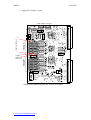
The Pattern Register is a single w
idth VME module designed to operate in the
GREAT TDR environment. There are two groups of 16 inputs, A and B. The purpose
of the module is to regist er the changes on the inputs, and send a tim estamped 16 bit
pattern to the Data Acquisition system via a SHARC link. The timestamp refers to the
selected edge of the input. The two groups can be set to one of three specific digital
interface types. Fast NIM, Differential ECL, and Single ended ECL.
The Pattern input is operated as two Groups, each in one of three operating m odes.
All the pattern inputs are AND' ed with a programm able m ask bit, which allows
individual bits to be disabled, for exam ple where one input is firing in noise. GroupA
can be pulse stretched under computer control.
1.
Gated Group:
The front edge of the Gr oup Gate input will latch the m aster 100MHz counter
and all inpu ts which are active at any tim e during th e Group Gate will b e
included in the pattern. The pattern and timestamp is outpu t at the end of the
Gate.
2. Individual
inputs:
a) The 16 pattern inputs of the Gr oup are individually sam pled on every
clock. Thos e that becam e active s ince th e previous clock generate a
timestamp along with a label to say wh ich of the 16 i nputs caused the
timestamp.
b) In this m ode the user m ay choose (under com puter control) to AND the
input with the Group Gate.
c) GroupA AND GroupB. This m ode uses the GroupA and GroupB inputs to
provide 16 bits of co-incidence pattern. A timestamp is generated when the
input from GroupA AND GroupB are true to-gether.
The Ti mestamp is based on a counter increm ented by a 100Mhz clock and kept in
synchronism with the rest of the T DR sy stem by the SYNC pulse provided by the
GREAT TDR system Metronome module.
The Pattern Register is designed to operate at an average input rate of 10Khz per
input. The maximum burst rate into one input is 10Mhz. T he m inimum input pulse
width for reliable operation is 50ns, howev
er m uch s maller input pulses can be
registered.
The following docum ents will h elp in unders tanding the term s discussed in th is
manual. They can be found at the Nuclear Physics Group web site : http://npg.dl.ac.uk
EDOC502 The GREAT Triggerless Total Data Readout Method (IEEE TNS, VOL.
48, NO. 3, JUNE 2001)
EDOC503 The GREAT 32 Channel Peak Sensing ADC : User Manual
EDOC504 The GREAT data format.
EDOC507 The GREAT TDR system Error recovery, and experiment timing
EDOC511 Metronome User Manual Version6 ( C1100 )
[email protected] 2