1
The following guidelines are from the CSA B149 Code for
combustion air supply in buildings with airtight
construction:
1. When the boiler is installed in buildings with airtight
construction, air supply openings or ducts connected
directly to the outside must be installed.
Buildings without airtight construction
1.
Always have air openings or ducts supplying air directly
from the outside. If there is any doubt about the
combustion air supply, install ducts directly to the outside
for fresh air.
2.
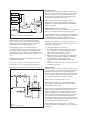
For boilers installed above grade and within 2 ft. of an
outside wall, openings may be used in lieu of a duct. The
openings shall be located within 1 ft. above and 2 ft.
horizontally from the burner level of the appliance with the
largest Btu/h input.
2.
3.
For boilers installed below grade, the combustion air duct
must terminate within 1 ft. above, and within 2 ft.
horizontally, from the burner level of the appliance having
the largest Btu/h input.
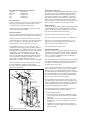
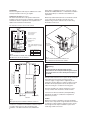
If the boiler is installed in a confined space within the
building (a space with a volume less than 50 ft3 per 1,000
Btu/h of input for all gas burning equipment) then
adequate air for combustion must be provided by two
permanent openings: one located 6˝ below the ceiling, the
other 6˝ above the floor. Each opening shall have a
minimum free area of 1 in2 per 1,000 Btu/h of input for all
gas burning equipment, but not less than 100 in2. Two
openings each with a minimum free area of 200 in2 will be
sufficient for the installation of one ECD-200. Larger
openings can be used. The volume of the boiler space
and the space connected by the air openings must have a
volume greater than 50 ft3 per 1,000 Btu/h of input for all
gas burning equipment.
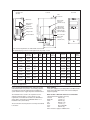
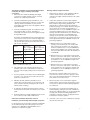
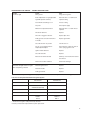
According to the CSA-B149 Code the following diameters
can be used for round corrosion resistant air supply ducts
with smooth internal surfaces. Use equivalent lengths of
10 ft. per 90° elbow and 5 ft. per 45° elbow and 15 ft. for a
grill or louver. See Table 1.
Model
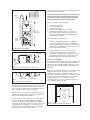
a) When the boiler is in a confined space and the
openings can be made directly on an outside wall to
allow outside air into the boiler room, each opening
shall have a minimum area of 1 in2 per 4,000 Btu/h for
all gas burning equipment. Two openings each with a
free area of 50 in2 will be sufficient for the installation of
one ECD-200.
Dia. for up to
Dia. for up to
20 ft. of equivalent 50 ft. of equivalent
length air duct
length air duct
ECD-65, -80
4˝
5˝
ECD-100, -115
5˝
6˝
ECD-140, -155
5˝
6˝
ECD-180, -200
6˝
7˝
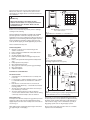
b) When the boiler is in a confined space and horizontal
ducts are connected to crawl spaces or attics which can
freely communicate to the outdoors, the openings shall
be a minimum of 1 in2 per 2,000 Btu/h of input for all
gas burning equipment.
Table 1. Combustion air duct sizes
c) When the boiler is in a confined space and vertical
ducts are connected to crawl spaces or attics which can
freely communicate to the outside, the openings shall
be a minimum of 1 in2 per 4,000 Btu/h of input for all
gas burning equipment.
4.
The outside inlet of the combustion air duct must not
permit the entry of rain or wind and must not reduce the
free area of the air supply opening. It must not be blocked
by snow.
5.
Corrosion resistant screens must not have individual grids
less than 1⁄4˝ x 1⁄4˝. Screens may not reduce the free area
required for combustion air.
6.
Manually operated combustion air dampers are not
allowed. The air opening must be not of a type that could
lead to situations where the air supply may be closed off
while the burner is running.
3.
Wherever possible, it is recommended to supply air
directly from the outdoors through wall openings or ducts
even if previous experience with fuel burning equipment
was satisfactory.
7.
A combustion air supply inlet opening from the outdoors
shall be located not less than 12 inches above the outside
grade.
4.
8.
Certified combustion air supply equipment may be used in
lieu of a duct to provide outside combustion air.
Any change to the construction of the building such as
weather-stripping, caulking around cracks, installation of
exhaust fans, adding insulation, etc. can prevent adequate
air supply and can make the building airtight. When
required by construction changes, air supply ducts must
be installed for safe boiler operation.
5.
If windows or doors are used for combustion air openings,
they must be locked open.
Viessmann recommends above items 1-8 for all
installations, even in buildings without airtight construction.
For structures that do not have tight construction and adequate
air can infiltrate through cracks and openings in doors and
windows refer to ANSI Z223.1 and CSA-B149.1 and .2
guidelines for combustion air supply.
When ducts are used they shall be of the same cross
sectional area as the free area of the openings to which
they connect. The minimum dimension of rectangular air
ducts shall be not less than 3 inches.
7