1
Tracking and Physics
ficient of a medium following the Einstein-Smoluchowski formula whose derivation requires the use of statistical
mechanics, includes temperature, and depends on the isothermal compressibility of the medium. This generator is
convenient when the Rayleigh attenuation length is not known from measurement but may be calculated from first
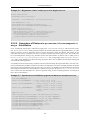
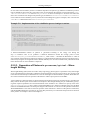
principles using the above material constants. For a medium named Water and no Rayleigh scattering attenutation
length specified by the user, the program automatically calls the RayleighAttenuationLengthGenerator which calculates it for 10 degrees Celsius liquid water.
Boundary Process
Reference: E. Hecht and A. Zajac, Optics [ Hecht1974 ]
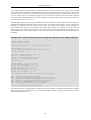
For the simple case of a perfectly smooth interface between two dielectric materials, all the user needs to provide
are the refractive indices of the two materials stored in their respective G4MaterialPropertiesTable. In
all other cases, the optical boundary process design relies on the concept of surfaces. The information is split into
two classes. One class in the material category keeps information about the physical properties of the surface itself,
and a second class in the geometry category holds pointers to the relevant physical and logical volumes involved
and has an association to the physical class. Surface objects of the second type are stored in a related table and
can be retrieved by either specifying the two ordered pairs of physical volumes touching at the surface, or by the
logical volume entirely surrounded by this surface. The former is called a border surface while the latter is referred
to as the skin surface. This second type of surface is useful in situations where a volume is coded with a reflector
and is placed into many different mother volumes. A limitation is that the skin surface can only have one and
the same optical property for all of the enclosed volume's sides. The border surface is an ordered pair of physical
volumes, so in principle, the user can choose different optical properties for photons arriving from the reverse side
of the same interface. For the optical boundary process to use a border surface, the two volumes must have been
positioned with G4PVPlacement. The ordered combination can exist at many places in the simulation. When
the surface concept is not needed, and a perfectly smooth surface exists beteen two dielectic materials, the only
relevant property is the index of refraction, a quantity stored with the material, and no restriction exists on how
the volumes were positioned.
The physical surface object also specifies which model the boundary process should use to simulate interactions
with that surface. In addition, the physical surface can have a material property table all its own. The usage of this
table allows all specular constants to be wavelength dependent. In case the surface is painted or wrapped (but not a
cladding), the table may include the thin layer's index of refraction. This allows the simulation of boundary effects
at the intersection between the medium and the surface layer, as well as the Lambertian reflection at the far side
of the thin layer. This occurs within the process itself and does not invoke the G4Navigator. Combinations of
surface finish properties, such as polished or ground and front painted or back painted, enumerate the different
situations which can be simulated.
When a photon arrives at a medium boundary its behavior depends on the nature of the two materials that join at
that boundary. Medium boundaries may be formed between two dielectric materials or a dielectric and a metal.
In the case of two dielectric materials, the photon can undergo total internal reflection, refraction or reflection,
depending on the photon's wavelength, angle of incidence, and the refractive indices on both sides of the boundary.
Furthermore, reflection and transmission probabilites are sensitive to the state of linear polarization. In the case of
an interface between a dielectric and a metal, the photon can be absorbed by the metal or reflected back into the
dielectric. If the photon is absorbed it can be detected according to the photoelectron efficiency of the metal.
As expressed in Maxwell's equations, Fresnel reflection and refraction are intertwined through their relative probabilities of occurrence. Therefore neither of these processes, nor total internal reflection, are viewed as individual
processes deserving separate class implementation. Nonetheless, an attempt was made to adhere to the abstraction
of having independent processes by splitting the code into different methods where practicable.
One implementation of the G4OpBoundaryProcess class employs the UNIFIED model [A. Levin and C.
Moisan, A More Physical Approach to Model the Surface Treatment of Scintillation Counters and its Implementation into DETECT, TRIUMF Preprint TRI-PP-96-64, Oct. 1996] of the DETECT program [G.F. Knoll, T.F. Knoll
and T.M. Henderson, Light Collection Scintillation Detector Composites for Neutron Detection, IEEE Trans. Nucl. Sci., 35 (1988) 872.]. It applies to dielectric-dielectric interfaces and tries to provide a realistic simulation,
which deals with all aspects of surface finish and reflector coating. The surface may be assumed as smooth and
covered with a metallized coating representing a specular reflector with given reflection coefficient, or painted
162