1
82
geometric routines
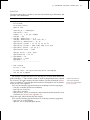
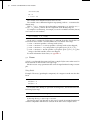
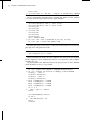
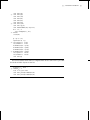
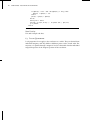
CALL MISALIGN_GIRDER(B,MIS3)
CALL MISALIGN_SIAMESE(B,MIS2,ADD=.FALSE. ,PRESERVE_GIRDER=.TRUE.)
CALL MISALIGN_FIBRE(B,MIS1,ADD=.TRUE.)
8.3 Dynamical Routines
Dynamical routines perform geometric rotations and translations, which act on the
tracked object itself. PTC has an “exact” dynamical group and an “approximate”
dynamical group. It is remarkable that the approximate dynamical rotations and
translations also form a group—but it is not isomorphic to the affine Euclidean
group.
The ultimate goal of PTC is to propagate particles and maps thanks to Taylor
polymorphism. Placing geometric objects in three dimensions is worthless unless
our rotations and translations can be translated into dynamical equivalents acting
on rays (and on spin).
It is useful first to look at the Lie algebra acting on the t-based dynamics because
it contains within it as a subgroup the affine part discussed above.
Exact Patching and Exact Misalignments: Dynamical Group
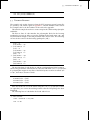
PTC first computes patching and misalignments geometrically. The connection
between two affine frames is always expressed as follows through pure geometric
computations:
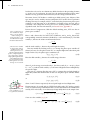
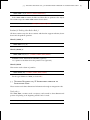
Connection = T (d x , dy , dz ) ◦ Rz ◦ Ry ◦ R x
This product of operators is in the usual matrix ordering. Therefore the rotation
in the x-axis acts first, followed by the y-axis, etc. The rotations are computed using
COMPUTE_ENTRANCE_ANGLE.
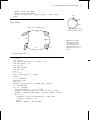
We factor the rotation in that manner because the operators Rx and Ry are drifts
in polar coordinates and are therefore nonlinear. For example, the rotation Ry is a
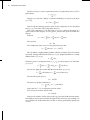
pole face rotation, dubbed “prot” by Dragt in the code MARYLIE. The formula is
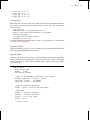
given by:
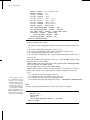
x=
s
x
cos α 1 −
px
pz
tan α
, where pz =
2
1−
pt + p2t
β0
− p2x − p2y
p x = p x cos α + pz sin α
xpy tan α
y = y+ p
pz 1 − pxz tan α
py = py
− pt tan α
t = t+ p
pz 1 − pxz tan α
x
1
β0
pt = pt
Here (t, pt ) form a canonical pair. In PTC (− pt , t) form a canonical pair.