1
1.3 DPVIIOPERATION
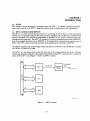
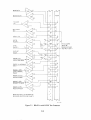
The DPV 11 is a double-buffered program interrupt interface that provides parallel-to-serial conversion
of data to be transmitted and serial-ta-parallel conversion of received data. The DPV II can operate at
speeds up to 56K b/s. * It has five 16-bit registers which can be accessed in word or byte mode. These
registers are assigned a block of four contiguous LSI-II bus word addresses that start on a boundary
with the low-order three bits being zeros. This block of addresses is jumper-selectable and may be
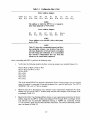
located anywhere between 1600008 and 1777768. Two of these registers share the same address. One is
accessed during a read from the address, the other during a write to the address. For a detailed description of each of the five registers, refer to Chapter 3. These registers are used for status and control
information as well as data buffers for both the transmitter and receiver portions of the DPV 11.
1.4
DPVII FEATURES
Features of the DPVII include:
•
Full-duplex or half-duplex operation
•
Double-buffered transmitter and receiver
•
EIA RS-232-C compatibility
•
All EIA RS-449 Category I modem control
•
Partial Category Ii modem control to indude incoming cali, test mode, remote loopback,
and localloopback
•
Program interrupt on transitions of modem control signals
•
Operating speeds up to 56K bls (may be limited by software or CPU memory)
•
Software-selectable diagnostic loopback
•
Operation with bit-, byte count-, or character-oriented protocols
•
Internal cyclic redundancy check (CRC) character generation and checking (not usable
with BISYNC)
.
•
Internal bit-stuff and detection with bit-oriented protocols.
•
Programmable sync character, sync insertion, and sync stripping with byte count-oriented
protocols.
•
Recognition of secondary station address with bit-oriented protocols.
1.5 GENERAL SPECIFICATIONS
This paragraph contains environmental, electrical, and performance specifications for the DPVII.
1.5.1
Environmental Specifications
The DPV II is designed to operate in a Class C environment as specified by DEC Standard 102 (extended).
50 C (41 0 F) to 60 0 C (140 0 F)
Operating Temperature
Relative Humidity
10% to 90% with a max. wet bulb temperature of 28 0 C (82 0
F) and a min. dew point of 2 0 C (36 0 F)
• The actual speed realized may be significantly less because of limitations imposed by the software and/or CPU memory
refresh.
1-2