1
Application Note 138
Transmitter Solutions
Basic transmitter
Currently there are four transmitter options available for
design or off-the-shelf purchase:
The basic transmitter for the LTC4120, described in the
following sections, combined with a receive coil and
LTC4120-based receiver electronics can be used to
produce a wireless battery charging system. This wireless battery charging system enables evaluation of the
LTC4120 using standard components.
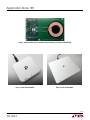
1.Basic: This wireless power design (Figure 2) was
developed by collaboration between PowerbyProxi
Inc. and Linear Technology. It is provided as an open
source reference design that can be used to integrate
the LTC4120 into a wireless power system. The details
of the push-pull current-fed resonant converter are
described later in this document.
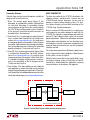
2.Proxi-Point: This is an advanced transmitter (Figure 3)
that is available from PowerbyProxi. For further information visit www.powerbyproxi.com. It is ready to use
or incorporate directly into a product. Unlike the basic
transmitter, it offers features such as foreign metal detection, low standby power and a stable crystal-controlled
operating frequency. The transmit coil is built in.
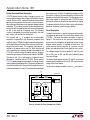
3.Proxi-2D: This is an advanced transmitter (Figure 4) that
is available from PowerbyProxi. For further information visit www.powerbyproxi.com. It is ready to use or
incorporate directly into a product. Unlike Proxi-Point,
it is capable of charging multiple receivers simultaneously in any orientation on the 2D charging surface.
The transmit coil is built in.
4.Proxi Custom: If the above options are not suitable for
your application, a custom transmitter can be designed
and manufactured to meet your requirements. Please contact PowerbyProxi at [email protected] for further
information and pricing or visit www.powerbyproxi.com.
Basic is a resonant DC-AC transmitter. It is a simple, easy
and inexpensive transmitter designed to work with the
LTC4120. Pre-regulation is required to provide a relatively
precise DC input voltage to meet a given set of receive
power requirements. The basic transmitter does not feature
foreign object metal detection and can therefore cause
these objects to heat up. Furthermore, the operating frequency of the basic transmitter can vary with component
selection and load.
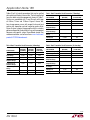
The system draws power from a DC power supply to wirelessly charge multi-chemistry batteries. A block diagram
of the system is shown in Figure 5.
While the basic transmitter can be used to build a wireless battery charging system, a Proxi-Point or Proxi-2D
transmitter is recommended for applications requiring
enhanced features as described in the Appendix.
COUPLING (Tx + Rx COIL)
DC POWER SUPPLY
Tx CIRCUIT
Tx
Tx COIL
LTC4120
CIRCUIT
Rx COIL
BATTERY
Rx
WIRELESS BATTERY CHARGING SYSTEM
an138 F05
Figure 5. Functional Block Diagram of Wireless Battery Charging System
an138fb
AN138-3