1
Bulletin 71.1:HSR
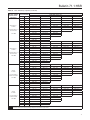
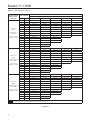
Table 5. Standard Inlet Pressures for Set Flows
Inches
1/8
3/16
1/4
3/8
1/2
ORIFICE SIZE
INLET PRESSURE FOR SET FLOWS
psi
bar
60
4.1
50
3.5
30
2.1
15
1.0
10
0.69
mm
3.2
4.8
6.4
9.5
13
For each orifice size, the outlet pressure setting is made with the same inlet pressure regardless of outlet pressure. Example: 3/16-inch / 4.8 mm orifice uses 50 psi / 3.5 bar inlet for 5-inches w.c.
through 2 psi / 12 mbar through 0.14 bar outlet settings.
Principle of Operation
Capacity Information
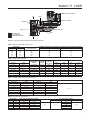
Refer to Figure 2. When downstream demand decreases, the pressure
under the diaphragm increases. This pressure overcomes the regulator
setting (which is set by a spring). Through the action of the pusher post
assembly, lever, and stem the valve disk moves closer to the orifice and
reduces gas flow. If demand downstream increases, pressure under the
diaphragm decreases. Spring force pushes the pusher post assembly
downward and the valve disk moves away from the orifice. Type HSR
regulators include an internal relief valve for overpressure protection. If
the downstream pressure exceeds the regulator setting by 7-inches w.c.
to 1.25 psig / 17 mbar to 0.09 bar, depending on the main spring used,
the relief valve opens and excess gas escapes through the vent in the
upper spring case.
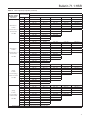
The high efficiency flow-through design provides maximum capacity
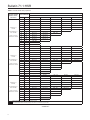
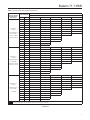
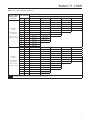
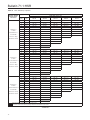
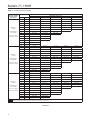
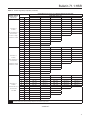
for a given orifice size. Tables 8 through 1 give the HSR Series flow
capacities at selected inlet pressures and outlet pressure settings.
Flows are in SCFH (at 60°F and 14.7 psia) and Nm3/h (at 0°C
and 1.01325 bar) of 0.6 specific gravity natural gas. To determine
equivalent capacities for air, propane, butane, or nitrogen,
multiply the listed SCFH capacity by the following appropriate
conversion factor: air–0.775 for air, propane–0.628, butane–0.548,
nitrogen–0.789. For gases of other specific gravities, multiply the
given SCFH capacity by 0.775 and divide by the square root of the
appropriate specific gravity. If capacity is desired in Nm3/h, multiply
SCFH by 0.0268.
Installation
The HSR Series regulators may be installed in any position.
However, the spring case vent should be pointed downward. If
gas escaping through the Type HSR internal relief valve could
constitute a hazard, the spring case vent must be piped to a
location where escaping gas will not be hazardous. If the vented
gas will be piped to another location, obstruction-free tubing or
piping at least equal to the vent, and the end of the vent pipe must
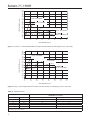
be protected from anything that might clog it. Dimensions are
shown in Figure 6.
Type HSR Flow Capacity for Pressure
Factor Measurement
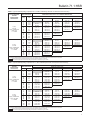
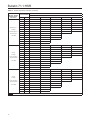
Tables 6 and 7 contain the flow capacities for the Type HSR at
accuracies of +/- 1% of absolute pressure. This data can be used
in applying the regulator in Pressure Factor Measurement (also
called Fixed Factor Measurement) or other applications requiring
better accuracy. Normally pilot operated regulators with high
accuracy are required for these applications. However, as shown
in the table, by flow testing and by limiting the droop on flow
capacity, +/- 1% of absolute pressure is obtained.
Overpressure Protection
The wide-open Cg for relief sizing (see Table 1) along with the
capacity information should be used in choosing appropriate
overpressure protection devices to ensure that none of the limits in
the Specifications section are exceeded.
Overpressuring any portion of a regulator or associated equipment
may cause leakage, parts damage, or personal injury due to
bursting of pressure-containing parts or explosion of accumulated
gas. Regulator operation within ratings does not prevent the
possibility of damage from external sources or from debris in the
pipeline. A regulator should be inspected for damage after any
overpressure condition.
4
For Critical Pressure Drops
Use this equation for critical pressure drops (absolute outlet pressure
equal to one-half or less than one-half the absolute inlet pressure).
Q = P1(abs)Cg(1.29)
where,
Q
Cg
P1
= gas flow rate, SCFH
= gas sizing coefficient
= absolute inlet pressure, psia
For Non-Critical Pressure Drops
For pressure drops lower than critical (absolute outlet pressure greater
than one-half of absolute inlet pressure), use the following formula:
Q =
520
GT
CgP1SIN
3417
C1
P
P1
DEG
where,
Q
G
T
Cg
P1
C1
P
= gas flow rate, SCFH
= specific gravity of the gas
= absolute temperature of gas at inlet, °Rankine
= gas sizing coefficient
= absolute inlet pressure, psia
= flow coefficient
= pressure drop across the regulator, psi
Then, if capacity is desired in normal cubic meters per hour at 0°C
and 1.01325 bar, multiply SCFH by 0.0268.
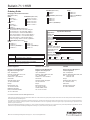
Ordering Information
Carefully review each specification and complete the Ordering Guide
on page 20. Send the Ordering Guide to your local Sales Office.