1
• Designed-in Insight Technology software capability for microburst
monitoring and reporting, as well as hotspot statistics and visibility
• Plug-and-play deployable architectures such as Virtual Chassis,
Virtual Chassis Fabric, and QFabric System with simplified
management and operation
• Support for standards-based network virtualization protocols
such as Virtual Extensible LAN (VXLAN), Open vSwitch Database
(OVSDB) protocol, Network Virtualization using Generic Routing
Encapsulation (NVGRE), and integration with Juniper Networks
Contrail and VMware NSX SDN controllers
• Advanced Junos OS features such as BGP Add-path, MPLS, L3
VPN, and IPv6 6PE
• Investment protection enabled by compatibility with Juniper
Networks EX4300 Ethernet Switch, QFX3500 Switch, and
QFX3600 Switch in integrated fabric solutions
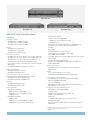
QFX5100 Switch Models
The QFX5100 line includes two compact 1 U models and one 2 U
model, each providing wire-speed packet performance, very low
latency, and a rich set of Junos OS features. In addition to a high
throughput Packet Forwarding Engine (PFE), the performance
of the control plane running on all QFX5100 models is further
enhanced with a powerful 1.5 GHz dual-core Intel CPU with 8 GB
of memory and 32 GB SSD storage.
QFX5100-48S: Compact 1 U 10GbE data center access switch
with 48 small form-factor pluggable and pluggable plus (SFP/
SFP+) transceiver ports and six quad SFP+ (QSFP+) ports with an
aggregate throughput of 1.44 Tbps or 1.08 Bpps per switch.
QFX5100-24Q: Compact 1 U high-density 40GbE data center
access and aggregation switch starting at a base density of 24
QSFP+ ports with the option to scale to 32 QSFP+ ports with two
four-port expansion modules. All 32 ports support wire-speed
performance with an aggregate throughput of 2.56 Tbps or 1.44
Bpps per switch.
QFX5100-96S: Compact 2 U high-density 10GbE aggregation
switch with 96 SFP+/SFP and eight QSFP+ ports with an
aggregate throughput of 2.56 Tbps or 1.44 Bpps per switch.
For added flexibility, the 40GbE ports on all QFX5100 switches
can be used as 4x10GbE ports using QSFP+ to SFP+ direct attach
copper (DAC) or QSFP+ to SFP+ fiber splitter cables and optics.
With splitter cables, the QFX5100-48S supports up to 72 10GbE
ports, while the QFX5100-24Q and QFX5100-96S support up to
104 10GbE ports.
Junos OS
All three high-performance QFX5100 switches run Junos OS,
Juniper’s powerful and robust network operating system. Key
Junos OS features that enhance the functionality and capabilities
of the QXF5100 include:
• Software modularity with process modules running independently
in their own protected memory space and with the ability to do
process restarts
• Uninterrupted routing and forwarding with features such as
nonstop routing (NSR) and nonstop bridging (NSB)
• Commit and rollback functionality that ensures error-free network
configurations
• A powerful set of scripts for on-box problem detection, reporting,
and resolution
2
Junos Space Network Director
The QFX5100 switches can be managed through Junos Space
Network Director, a next-generation network management
solution that allows users to visualize, analyze, and control the
entire enterprise network—data center and campus, physical
and virtual, wired and wireless—through a single pane of glass.
Network Director incorporates sophisticated analytics for realtime intelligence, trended monitoring, and automation to increase
agility as well as faster rollout and activation of services.
For cloud deployments, Network Director provides a set of REST
APIs that enable on-demand and dynamic network services
by simplifying the consumption of services for multitenant
environments. With third-party cloud orchestration tool
integration, the Network Director API enables automation and
provisioning of Layer 2, Layer 3, and security services in the data
center without the need for manual operator intervention.
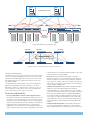
Virtual Chassis Technology
The QFX5100 supports Juniper Networks’ unique Virtual Chassis
technology, which enables up to 10 interconnected switches to
be managed and operated as a single, logical device with a single
IP address. Virtual Chassis technology enables enterprises to
separate physical topology from logical groupings of endpoints
and, as a result, provides efficient resource utilization. All
QFX5100 switches can participate in the same Virtual Chassis
configuration, along with any combination of EX4300, QFX3500,
and QFX3600 Ethernet switches, delivering highly flexible and
scalable configuration options for data center deployments.
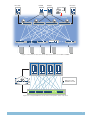
Virtual Chassis Fabric Switching Architecture
Existing Virtual Chassis technology is further scaled and enhanced
to support a spine-and-leaf topology that is ideal for highperformance and low-latency data center deployments. In its
first instance, this topology, called Virtual Chassis Fabric, enables
up to 20 QFX5100 switches to be deployed in a spine-and-leaf
configuration, with two to four QFX5100s in the spine and up to 18
QFX5100s as leaf nodes. This architecture provides any-rack-toany-rack deterministic throughput and less than 2 microseconds
of latency, while significantly simplifying network operations
through a single point of management. EX4300, QFX3500, and
QFX3600 switches can also act as leaf nodes in a Virtual Chassis
Fabric deployment, providing support for data centers with
mixed 1GbE, 10GbE, and 40GbE servers as well as environments
transitioning from 1GbE to 10GbE or 40GbE servers while
protecting existing EX4300, QFX3500, and QFX3600 investments.
QFabric System
The QFX5100-48S can also act as a QFabric Node device in a
QFX3000-M and QFX3000-G QFabric System. The QFX510048S is fully interoperable with existing QFX3500 and QFX3600
QFabric Nodes, providing backward compatibility and investment
protection. With a mixture of QFX3500, QFX3600, and QFX5100
Nodes, a QFabric System can scale on a node by node basis
without being limited by the lowest common denominator.
Data Center Deployments
Today’s data centers are built with high-performance, small
form-factor, multicore blade and rack servers. The greater
compute capacity and server densities enabled by these devices
is increasing traffic levels, creating the need for high-speed, lowlatency, storage- and I/O-converged networking solutions that can
maximize performance for physical servers, virtual servers, and
storage in the data center.