1
The QFX5100 line offers a portfolio of switches that deliver the
low-latency, lossless, high-density 10GbE and 40GbE interfaces
with the Fibre Channel over Ethernet (FCoE) transit switch
functionality demanded by today’s data center. All QFX5100
models are designed to consume the lowest power possible while
optimizing space, thereby reducing data center operating costs.
Flexible airflow direction options enable the QFX5100 to support
back-to-front and front-to-back cooling, ensuring consistency
with server designs for hot- and cold-aisle deployments.
packet size (including jumbo frames) in both modes. All QFX
Series switches support extensive Layer 2 features, enabling
the device to support high-density 10GbE/FCoE Layer 2 access
deployments. With features such as multi-chassis link aggregation
group (MC-LAG), the QFX5100 supports active/active server dual
homing and can utilize full bisectional bandwidth from server to
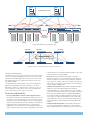
switch. When the QFX5100 is deployed in the aggregation layer,
MC-LAG at the access and aggregation layers provides maximum
resiliency and full Layer 2 multi-pathing in the network (see
Figures 1 and 2).
Data Center Server Access
The QFX5100 line of switches is ideal for top-of-rack deployments
of various densities and speeds.
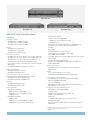
The compact 1 U QFX5100-48S offers 48 ports of native 10GbE
for server connectivity and up to six 40GbE ports for uplink
connectivity, providing very low oversubscription of 2:1 from access
to aggregation. Each 40GbE port can be further broken out into four
10GbE ports, providing additional 10GbE for server connectivity.
The 2 U QFX5100-96S is a high-density native 10GbE data center
access switch that is ideal for deployments with a high degree of
application redundancy. The highly efficient QFX5100-96S offers
96 ports of native 10GbE for server connectivity and eight 40GbE
ports for uplink connectivity, providing very low oversubscription of
3:1 from access to aggregation.
The QFX5100-24Q offers 24 QSFP+ ports in the base unit with an
option to scale up to 32 QSFP+ ports with two four-port expansion
modules. Each QSFP+ port can be used for native 40GbE server
port connectivity or channelized into four 10GbE ports for 10GbE
server connectivity, offering maximum flexibility and investment
protection for data center growth.
Each of the QFX5100 switches can operate in both cut-through
and store-and-forward modes, delivering sustained wire-speed
switching with sub-microsecond latency and low jitter for any
EX9200
The Junos operating system features the most advanced and
robust routing capabilities in the industry. All QFX5100 switches
include support for RIP and OSPF for both IPv4 and IPv6 in the
base software. Advanced routing capabilities such as IS-IS and
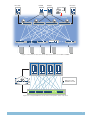
BGP are also supported. With additional capabilities like 64-way
equal-cost multipath (ECMP) and BGP add path, QFX5100 is an
ideal building block for deploying the most robust Layer 3 underlay
for software-defined networks (SDN) (see Figure 3).
In addition to MC-LAG-based Layer 2 and BGP-based Layer
3 to access deployments, the QFX5100 also supports Virtual
Chassis Fabric and QFabric System deployments. These fabric
technologies support both Layer 2 multi-pathing and Layer 3
ECMP paths within the same network fabric while dramatically
reducing the number of user configured protocols, thus eliminating
the need to run protocols such as Virtual Router Redundancy
Protocol (VRRP) for Layer 3 gateway load balancing and complex
multicast protocols to set up replication trees. Virtual Chassis
Fabric and QFabric technology dramatically reduce the complexity
and cost of managing the data center network by making multiple
switches appear as a single, logical device. Virtual Chassis Fabric
allows up to 20 individual switches to be managed via a single CLI,
while a QFabric System enables up to 128 Nodes to operate as a
single device (see Figures 4 and 5).
EX9200
QFX5100
4x40GbE
QFX5100
QFX5100
2x40GbE
EX4300
Virtual
Chassis
QFX5100
Figure 1: QFX5100 at the access layer
3