1
DATA CENTER
BEST PRACTICES
Fan-In Ratios and Oversubscription
Another aspect of data flow is the “fan-in-ratio” or “oversubscription”, in terms of source ports to target ports
and device to ISL’s. This is also referred to as the “fan-out-ratio” if viewed from the storage array perspective.
The ratio is the number of device ports that share a single port, whether ISL, UltraScale ICL, or target. This
is always expressed from the single entity point of view, such as 7:1 for 7 hosts utilizing a single ISL or
storage port.
What is the optimum number of hosts that should connect per to a storage port? This seems like a fairly simple
question. However, once you take into consideration clustered hosts, VMs, and number of Logical Unit Numbers
(LUNs) (storage) per server the situation can quickly become much more complex. Determining how many hosts
to connect to a particular storage port can be narrowed down to three considerations: port queue depth, I/O
per second (IOPS), and throughput. Of these three, throughput is the only network component. Thus, a simple
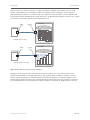
calculation is to add up the expected bandwidth usage for each host accessing the storage port. The total
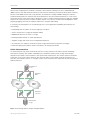
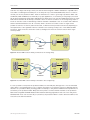
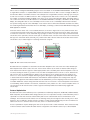
should not exceed the supported bandwidth of the target port, as shown in Figure 12.
32 × 4 Gbps Host Ports
1:1
16 × 8 Gbps Target Ports
fig12_SAN_Design
1:1 Oversubscription
for Hosts to Target Ports
Figure 12. Example of one-to-one oversubscription.
In practice, however, it is highly unlikely that all hosts perform at their maximum level at any one time. With
the traditional application-per-server deployment, the Host Bus Adapter (HBA) bandwidth is overprovisioned.
However, with virtual servers (KVM, Xen, Hyper-V, proprietary Unix OSs, and VMware) the game can change
radically. Network oversubscription is built into the virtual server concept. To the extent that servers leverage
virtualization technologies, you should reduce network-based oversubscription proportionally. It may therefore
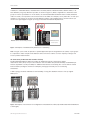
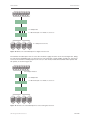
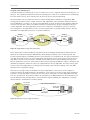
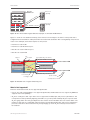
be prudent to oversubscribe ports to ensure a balance between cost and performance. An example of 3 to 1
oversubscription is shown in Figure 13.
12 × 4 Gbps Host Ports
3:1
2 × 8 Gbps Target Ports
fig13_SAN_Design
3:1 Oversubscription
for Hosts to Target Ports
Figure 13. Example of three-to-one oversubscription.
SAN Design and Best Practices
17 of 84