1
2
Warnings
A-2000 7 Channel Amplifier
Please Read First
CAUTION: To reduce the risk of electric shock, do not remove the cover. No user
serviceable parts inside. Refer to qualified personnel.
WARNING: To reduce the risk of fire or electric shock, do not expose this appliance
to rain or moisture.
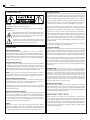
The lightning flash with arrowhead, within an equilateral triangle, is intended to alert the user to the presence of uninsulated “dangerous voltage”
within the product’s enclosure that may be of sufficient magnitude to
constitute a risk of electrical shock to persons.
The exclamation point within an equilateral triangle is intended to alert
the user to the presence of important operating maintenance (servicing)
instructions in the literature accompanying the appliance.
Precautions
Verify The Line Voltage
Your new amplifier has been factory configured for 120 or 230 (+/- 3%) volt AC lines
depending on what country you purchased it in. Connecting the amplifier to a line voltage other than that for which it is intended can create a safety and fire hazard, and may
damage the amplifier. If you have any questions about the voltage requirements for your
specific model, or about the line voltage in your area, contact Atlantic Technology before
plugging the unit into a wall outlet.
Verify AC Circuit Capacity
The high power output of your amplifier may require heavy power draw under full load
conditions. To insure proper performance, and to avoid potential safety hazards, we
recommend that it be connected to a minimum 20 Amp capacity circuit. Connecting
multiple amplifiers to the same circuit, or connecting it to a circuit used by other heavyuse power devices, such as air conditioners, may cause circuit breakers to trip.
NOTE: It is always a good idea to avoid using any audio or video equipment on the same AC
circuit as equipment with motors, such as air conditioners or refrigerators. This will lessen the
possibility of power variation and electrical start-up noise affecting your sound system.
Extension Cords and Power Strips
We do not recommend that extension cords be used with this product unless they are
of sufficient gauge to pass the necessary current during full load conditions. Most inexpensive extension cords are not capable of such high-current loads.
Similarly, should you use a power strip, surge protector or any type of AC power line
conditioning equipment, make certain that it is also able to handle the high current
loads this product will draw.
Handle the AC Power Cord Gently
When disconnecting the power cord from an AC outlet, always pull the plug, never pull
the cord. If you do not intend to use the amplifier for any considerable length of time,
disconnect the plug from the AC outlet. If the power cord is replaced, make certain that
it is of similar gauge. As with all electrical devices, do not run power cords under rugs
or carpets or place heavy objects on them. Damaged power cords should be replaced
immediately with cords meeting factory specifications.
Wiring
Cables that are run inside of walls should have the appropriate markings to indicate
compliance with, and listing by the UL, CSA or other standards required by the UL, CSA,
NEC or your local building code . Questions about cables inside of walls should be referred
to a qualified customer installer, or a licensed electrician or low-voltage contractor.
Installation Location
To assure proper operation and to avoid the potential for safety hazards, place the unit
on a firm and level surface capable of supporting 100 pounds or more. When placing the
amplifier on a shelf, be certain that the shelf and any mounting hardware can support the
weight of the amplifier and any additional items in the equipment rack, or on the shelf.
When positioning the amplifier in its final location, make certain that it has adequate
ventilation on all sides, as well as on the top and bottom. In particular, it is a good idea to
provide at least two or three inches of room above the amplifier for air circulation.
DO NOT place CDs, DVDs, videotapes, owner’s manuals, or other paper on top of, or
beneath, the unit, or in-between multiple amplifiers in a stack. This will block airflow,
causing heat build-up, degraded performance, and may create a possible fire hazard.
If the unit is to be enclosed in a cabinet or rack, make certain there is adequate air circulation. Sufficient ventilation should be provided so that hot air may exit, and cool air
may enter the cabinet. In some instances, a small cooling fan may be required to insure
adequate airflow through the cabinet. If you are in doubt as to the ventilation requirements for your specific installation, please contact us. Also, do not place the amplifier
directly on a carpeted surface, as this will inhibit airflow underneath as well as create a
potential fire hazard.
Avoid installation in humid locations, in extremely hot or cold locations, or in areas that
are exposed to direct sunlight or space heating equipment.
Loudspeaker Ratings
The Atlantic A-2000 has adequate power to drive most loudspeakers without producing
audible distortion. Most modern speakers are rated at four to eight ohms nominal impedance, but within some frequency ranges, the impedance may drop to two ohms. The
A-2000 is designed with substantial power reserves to protect you from experiencing any
problems at these low impedances, unless you demand excessively high volume levels.
Due to the high power output capability of the A-2000, it is important that the amplifier
not be used with speakers that aren’t capable of handling the A-2000’s power output or
in a manner that could lead to speaker damage. Before using the A-2000 for the first
time, make certain that your speakers are capable of handling its rated power output, at
the impedance rating of your speakers and that you read and understand the following
important note.
IMPORTANT NOTE Given the right set of circumstances any amplifier is capable of
damaging any loudspeaker, no matter what their respective power ratings. Damage can be
done either through excessive power output to the speaker or excessive distortion from the
amplifier due to clipping. Amplifier clipping is the result of asking the amplifier to deliver
substantially more power than it is capable of producing without excessive distortion. This
is the single most common cause of speaker damage and can happen no matter how high
the power rating of the attached speakers or amplifier may be. Atlantic Technology is not
responsible for damage to any speaker system or other component that is caused by using
products whose power rating is lower than that of the amplifier or in a manner that results
in amplifier clipping and therefore component damage.
Do Not Open The Cabinet
There are no user serviceable components inside this product. Opening the cabinet may
present a shock hazard, and any modification to the product will void your warranty. If
water or any metal object, such as a paper clip, coin or a staple, accidentally falls inside the
unit, disconnect it from the AC power source immediately, and contact Atlantic Technology
or your Dealer/Installer for further instructions.
IMPORTANT SAFETY NOTE
Before connecting a new component such as power amplifier to your audio or home
theater system it is always good practice to make certain that all components are turned
off, and preferably unplugged from their AC power source. Many modern electronics
products feature automatic turn-on circuits that may be activated during an installation,
causing the potential for damage to electronic components and/or speakers. Such damage is not covered by product warranties and Atlantic Technology specifically disclaims
responsibility for any such damage.