1
Zi gBi t™ O EM M odule s
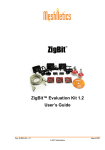
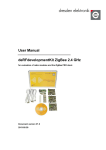
To jumpstart evaluation and development, MeshNetics
also offers a complete set of evaluation and development
tools. The ZigBit Development Kit [6] comes with
everything you need to create custom applications
around ZigBit module.
The kit features MeshBean development boards with an
easy-to-access extension connector for attaching
third party sensors and other peripherals, and a JTAG
connector for easy application uploading and debugging.
The kit also includes sample applications in C to
speed up application development, open source
hardware interface layer and reference drivers for the all
the module interfaces, intuitive development environment
from Atmel, and comprehensive set of application notes
and product tutorials.
ZigBit modules comes bundled with ZigBeeNet, a 2nd
generation embedded software stack from MeshNetics.
ZigBeeNet is fully compliant with ZigBee PRO and
ZigBee standards for wireless sensing and control [3],
[4], [5] and it provides an augmented set of APIs which,
while maintaining 100% compliance with the standard,
offer extended functionality designed with developer's
convenience and ease-of-use in mind.
Depending on end-user design requirements, ZigBit can
operate as a self-contained sensor node, where it would
function as a single MCU, or it can be paired with a host
processor driving the module over a serial interface. In
the former case, a user application may be used with the
ZigBeeNet software allowing customization of embedded
applications through ZigBeeNet’s C API.
Product Datasheet
ZDM-A1281-B0 Block Diagram
VCC (1.8 – 3.6V)
IRQ
UART
USART/SPI
I2C
JTAG
Analog
ATmega1281
Micro
controller
GPIO
AT86RF230
RF
Transceiver
RF I/O
SPI Bus
ZDM-A1281-A2 Block Diagram
VCC (1.8 – 3.6V)
IRQ
UART
USART/SPI
I2C
JTAG
Analog
ATmega1281
Micro
controller
GPIO
AT86RF230
RF
Transceiver
Chip
Antenna
SPI Bus
ZigBeeNet™ Block Diagram
In the latter case, the host processor controls data
transmission and manages module peripherals via an
extensive set of SerialNet AT commands. Thus, no
firmware customization is required for a successful
module design-in. Additionally, third-party sensors can
be connected directly to the module, thus expanding the
existing set of peripheral interfaces. The over-the-air
control via AT-commands eases network configuration
and speeds up application prototyping. It also enables
wireless module configuration during OEM massproduction process, providing a flexible commissioning
protocol for installation and maintenance of ZigBit-based
devices.
© 2008 MeshNetics
Page 5 of 24