1
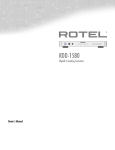
RDD-1580
DIGITAL-TO-ANALOG CONVERTER
Introduction
The purpose of this document is to provide in
depth background information about the Rotel
RDD-1580 Digital to Analogue Convertor and
its features.
We shall cover a range of related subjects.
Much of the information is obtainable elsewhere however it is unlikely that you will be
able to find all of this information appropriate
to the RDD-1580 in one place.
Product Overview
The RDD-1580 is an audiophile quality DAC
(digital to analogue convertor) designed to
take full advantage of the digital audio sources
available today and then convert these signals
to very high quality stereo analogue signals for
connection to a stereo amplifier or pre-amplifier/power amplifier combination. The product
also contains all of the key electronic circuits
and connections to interface with a wide range
of digital signal sources.
The heart of the product contains two stereo
specialist integrated circuit DACs configured
to use one for each channel. Each internal
DAC feeds custom designed filter and output
stage circuits to provide XLR (balanced) or
standard phono outputs.
These days most people are familiar with
the iPod™ and audio content on smartphones,
all of which use digital music files. Here you
have two options to greatly enhance the
audible fidelity obtainable from these devices.
Firstly, you can connect your device directly
wired to the USB socket on the front panel.
Secondly, this USB socket can also be used
for Bluetooth operation between your device
(Android or Apple based) and the RDD-1580.
(A dongle is provided for just this purpose).
This is a great way to play audio content
stored ‘in the cloud’ – for example via the
Amazon cloud player, which is available
in many countries.
Another benefit of the RDD-1580 is its ability
to dramatically improve TV sound from either
a flat-screen display or a satellite/terrestrial
set-top box. A flat-screen display will often
feature tiny speakers about the same size
as in a pair of headphones. Fortunately,
these products typically feature a digital
signal output of some kind, either as a ‘phono’
type socket (known as S/PDIF - after Sony/
Philips Digital Interface); or more likely a
‘Toslink’ (aka Toshiba Link) optical cable
socket. The RDD-1580 is equipped with
both kinds of socket on the rear panel –
in fact, there are two of each making it
easy to connect to your TV or set top box –
and/or your CD or DVD player – refer to 1
and 2 below.
this socket to one of the appropriate inputs
of the RDD-1580. You must remember to configure the menu of the DVD player to down-mix
the movie soundtrack to stereo from the original multi-channel audio mix. In the absence
of a movie sound processor, this is a great
way to get excellent wide-band movie sound.
If you have not noticed it before it is likely
that your CD player and your DVD player
will be equipped with a digital audio output
socket – very often the S/PDIF type. (This
uses a phono-type socket.) The CD player
will connect directly with no further adjustment
being required and this is a fine way to
enhance reproduction from CD recordings
using an older player.
Connecting your computer via the PC/USB
feature enables you to replay tracks stored
on a computer hard drive using media software
programs such as iTunes and Windows Media
Player to do so. You might also consider the
use of more sophisticated software that offers
greater compatibility of digital audio file formats, such as Asset, JRiver or Media Monkey.
Such programs make use of file formats
that can reproduce signals of much higher
resolution than those available from iTunes
or Windows Media Player. We shall discuss
these later in the document.
The DVD player may be a little trickier. It will
feature either socket and this would normally
connect to some kind of movie sound processor. However, if you do not have a surround
processor there is no problem in connecting
Finally, for the digital audio enthusiast there
is a PC/USB input, which is also on the rear
panel – 3 below. This ultra wide-band input
makes use of an asynchronous design to
maximise digital signals recorded up to 24-bit
192 kHz sampling frequency. As you might
expect from the name this socket and its
circuits are intended to be directly connected
to one of the USB sockets of your computer.
1
2
3