1
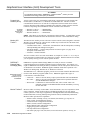
Just as with a mechanical arrangement, the accuracy errors can build up with every link from
the beginning to the end. The overall worst case accuracy error will be the sum of all the
sources of error listed below. The errors fall into two broad categories, namely, master
measurement errors and slave errors. These both ultimately affect slave accuracy, because the
commanded slave position is based on the measured master position.
It is important to understand how master measurement errors result in slave position errors.
In many applications, master and slave units will be the same (e.g., inches, millimeters,
degrees). These applications will require linear speeds or surface speeds to be matched (i.e., a
1:1 ratio). For example, suppose that in a rotary knife application, there were 500 master
steps per inch of material, so an error in master measurement of one encoder step would result
in 0.002 inches of slave position error.
If the master and slave units are not the same, or the ratio is not 1:1, the master error times
the ratio of the application gives the slave error. An example would be a rotary master and a
linear slave. For instance, suppose one revolution of a wheel gives 4000 master counts, and
results in 10 inches of travel on the slave. The ratio is then 10 inches/revolution. The slave
error which results from one step of master measurement error is (1/4000) ∗ 10
inches/revolution = 0.0025 inches.
Resolution of
the Master
The best case master measurement precision is the inverse of the number of master steps per
user's master unit. For example, if there are 100 master steps/inch, then the master
measurement precision is 0.01 inches. Even if all other sources of error are eliminated, slave
accuracy will only be that which corresponds to 1 step of the master (e.g., 0.01 inches in the
previous example).
Resolution of
the Slave
The best case slave precision is the inverse of the number of slave steps per user's position
unit. For example, if there are 1000 slave steps/inch, then the slave resolution is 0.001
inches. Even if all other sources of error are eliminated, slave positioning accuracy will only
be that which corresponds to 1 step of the slave. This must be at least as great as the
precision required by the application.
Position
Sampling
Accuracy
The position sampling rate for the 6000 controller depends on whether it is a servo or a
stepper. The sample period for a stepper is 2 ms. The sample period for a servo is the system
update period, which is affected by the current SSFR and INDAX command settings (see SSFR
description in the 6000 Series Software Reference).
The repeatability of the sampling rate, from one sample to the next, may vary by as much as
20 µs for servos and 100 µs for steppers. This affect may be eliminated by using non-zero
master position filter (FFILT) command values. Otherwise, measurement of master position
may be off by as much as (20 to 100 microseconds ∗ master speed). This may appear to be a
significant value at high master speeds, but it should be noted that this error changes in value
(and usually sign) every sample period. It is effectively like a noise of 200-600 Hz; if the
mechanical frequency response of the motor and load is much less than this frequency, the load
cannot respond to this error.
Accuracy of the The precision also depends on how accurately the drive follows its commanded position while
Slave Motor and moving. Even if master measurement were perfect, if the drive accuracy is poor, the precision
will be poor.
Drive
In the case of stepper drives, this amounts to the specified motor/drive accuracy.
In the case of servo drives, the better the drive is tuned for smoothness and zero Following
error, the better the precision of the positioning. Often, this really only matters for a specific
portion of the profile, so the drive should be tuned for zero Following error at that portion.
Accuracy of the The accuracy (not repeatability) of the load mechanics must be added to the overall build up of
Load Mechanics accuracy error. This includes backlash for applications which involve motion in both
directions.
Chapter 6. Following
217