1
3-18
Hardware modifications
quadrupole). For example, it is well established that the correct alignment of the anode
grid is critical to the operation of RGA spectrometers: a misalignment as small as 0.010”
can result in decreased sensitivity, decreased resolution and peak shape deterioration ( i.e.
peak splitting).
The alignment and symmetry of the repeller are not as critical as that of the anode grid.
Repeller removal
It is possible to operate the ionizer without the repeller. The repeller is held in place by a
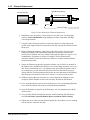
single, easily accessible screw (See RGA Probe Assembly drawing) . It is sometimes
eliminated when a smaller ionizer insertion volume is needed, when a laser beam needs to
be focused into the anode grid or when a collimated beam of molecules needs to be
directed through the anode grid without molecular scattering taking place at the repeller’s
wires.
The repeller serves several purposes in the ionizer that must be carefully considered
before removal:
1. It mechanically protects the delicate filament while the probe is being mounted on the
vacuum system. The filament might easily be damaged during installation without
that protection.
2. It constrains the electrons to the ionizer volume, minimizing cross talk with other
gauges in the vacuum system (Free electrons can affect the readings of neighboring
ion gauges).
3. It increases the ionization efficiency by folding the electron trajectories back into the
anode grid (multiple-pass configuration). A decrease in ionization efficiency will
usually be noticed when the repeller is removed.
Operation without a filament
It is possible to use the quadrupole mass filter to detect ions originating from sources
other than the standard electron impact ionizer. For example, the filament and the grids
can easily be removed to expose the quadrupole to ions from a SIMS or Laser desorption
ionization experiment. All the measurement and scanning functions of the mass
spectrometer are still operational when the filament is not installed or not emitting
electrons As mentioned previously, optimum performance of the quadrupole can only be
achieved if the ions are injected into the filter in the form of a beam of low energy (2 to
15 eV) and low divergence (i.e. close to and parallel to the axis of the quadrupole).
Whenever possible, complete removal of the filament and the grids should be avoided so
that the residual gas analysis functions of the RGA are still available. For example, since
service is not interrupted if a single filament burns out, it might be possible to keep one
of the sides of the filament intact instead of removing it completely.
W filament replacement
The standard SRS RGA filament is made out of thoriated iridium. In order to replace the
standard filament with tungsten wire, remove the dual filament (full circle) and connect a
single 0.003” diameter tungsten wire between the two filament rods. Make sure to use
filament quality tungsten wire, and do not attempt a dual filament configuration since the
filament heater will not be able to power the assembly.
SRS Residual Gas Analyzer