1
Installation Instructions
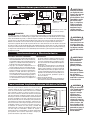
Refer to wiring diagram (See Figure 5) for proper wiring of heating unit to thermostat. Illustrated in Figures 6,
7, and 8 are wiring diagrams typical of a single unit controlled by a single pole thermostat, a single unit controlled by a double pole thermostat, and two units controlled by a double pole thermostat.
Line
Line
Line
Thermal
Load
Switch
On/Off
Switch
Limit switch
Limit switch
On/Off
Switch
Heater
Figure 6. Single pole thermostat
Thermal
Load
Switch
Limit switch
Limit switch
Heater
Figure 7. Double pole thermostat
Heater #1
Heater #2
Figure 8. Double pole thermostat
with multiple units
STEP 4 THERMOSTAT
For best results, use a Cadet wall thermostat or an EBKA 1-24 end cap DPST thermostat kit. It is recommended that a thermostat be provided for each room. In extremely large rooms, a Cadet low-voltage thermostat
with double relays will give the most comfortable results. The location of the thermostat should be selected
carefully. Thermostats should not be located near drafts from an open doorway or within 18" (45.7cm) of an
outside wall, or in direct sunlight or unusual heat sources. A television set or appliance that builds up heat
near a thermostat will prevent the thermostat from functioning properly. A wiring diagram illustrating typical
wiring of the thermostat is included in literature provided with the thermostat, and on a simple diagram provided on the thermostat.
Operation & Maintenance
How To Operate Your Heater
WARNING!
Element filled with
heat transfer fluid
containing 20%
Ethylene Glycol. In
the unlikely event of
leakage, if consumed, call your
local poison control
center or seek
medical attention
immediately.
Maintenance
1. Switch the power on at the electrical panel
Softheat hydronic baseboards are virtually mainboard. PLEASE NOTE: Upon initial start-up, the
tenance-free. However, a certain amount of lint
heater may emit a burning odor. This is not danand dust will accumulate inside the unit and
gerous and is due to a protective lubricant used
should be periodically cleaned.
during the manufacturing process.
1. Turn the electrical power off at the electrical
2. Turn the thermostat fully clockwise.
panel board (circuit breaker or fuse box). Lock or
3. When the room reaches your comfort level, turn
tag the panel board door to prevent someone
the thermostat knob counterclockwise until a
from accidentally turning the power on while you
clicking sound is heard (if using a digital thermoare working on the heater. Failure to do so could
stat, set at desired room temperature). The
result in serious electrical shock, burns, or possibaseboard will automatically cycle around this
ble death.
preset temperature.
2. Remove front panel.
3. Vacuum inside the unit, being careful not to
damage the aluminum fins on the heater tube.
How Softheat Hydronic Baseboards Work
Inside a Softheat baseboard a hermetically sealed water and
anti-freeze solution is heated by an electric heating element. As
the solution is heated, warmth is generated and transmitted
through dozens of aluminum fins along the heater tube (it
could initially take 30 to 60 minutes to warm a room, depending
on the room size). As the warmth spreads outward from the
heater, cooler air from the floor and wall naturally flow toward
the base of the heater. "Convection air heating" (See Figure 9),
means no noisy fans are needed and the room is warmed with
even, comfortable heat. There will be no cold and hot spots in
the room as found with other types of heaters. Softheat won't
blow or burn dust particles, making it allergist recommended for
patients with respiratory ailments or allergies.
Cold Air
Warm Air
Room Air
Figure 9.
WARNING!
Risk of Electrical
Shock. Connect
grounding lead to
grounding wire provided. Keep all
foreign objects out
of heater.
WARNING!
Risk of Fire. Heaters
must be kept clean
of lint, dirt and
debris.
Failure to follow
warnings may
cause heater to
eject sparks, ignite
materials, or cause
electrical shock.
WARNING!
Risk of Electrical
Shock. When
working with electricity, turn the electrical power off at
the electrical panel
board and lock or
tag the circuit
breaker door.
Failure to do so
could result in
serious electrical
shock, burns, or possible death!