1
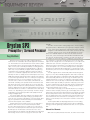
Bryston SP3 Preamplifier / Surround Processor
rations of components
to see if there are some combinations that operate without the extra 2 to 3 second “stutter” while re-syncing after the
video signal is interrupted or changes format. Equipment used with the
SP3 included: Sony VPL-VW1000ES projector; Epson 5010 projector;
Sharp XV-Z30000 projector; a Lumagen Radiance XE 3D video processor; a DirecTV HD tuner; Oppo and Sony Blu-ray Disc players; a Mac
Mini computer with HDMI; and a Windows 7 laptop with HDMI.
Bass management in general is a bit tricky and does not always do
what you want it to do depending on the logic built-in to the product. I
didn’t find any particular surprises in SP3’s bass management except
for stereo analog inputs. If you have full-range front left and right loudspeakers and set them to Large, the LFE subwoofer will not be used if
xtraBass mode is set to OFF. All bass will be sent to the front left and
right loudspeakers for any of the surround sound modes. If you set
xtraBass mode to ON, all bass will be sent to both the main front loudspeakers and to the LFE subwoofer, but at the same level for both and
that will result in bass being about 3 dB louder than it should be…
Hence the xtraBass name for this option. To get the LFE subwoofer to
work in surround sound modes for analog stereo inputs, you must set
the front main loudspeakers to small and select a crossover setting for
them. The SP3’s lowest crossover setting is 40 Hz which may not be
low enough if you want to use all or most of your main loudspeakers’
bass range, but the SP3 requires a crossover setting in order to use
the LFE channel with analog stereo inputs. Personally, I’d like to see
crossover options of 30 Hz and 20 Hz just so you have more options to
use as much of the main loudspeakers’ bass capability as possible
while still being able to use the LFE subwoofer if you choose to do so.
Stereo Sound Quality
There had better be some reason to spend this kind of money on a
preamplifier/processor when processors as good as Cary’s Cinema 12,
AudioControl’s Maestro M3, and Anthem’s D2v are available for $5,000
to $7,500. For me it was the SP3’s performance as a high-end analog
stereo preamplifier with optional digital processing. When I listen to
high quality analog sources, there are times when I want completely
untouched analog sound and other times when I want something different… like having the music converted to 7.1 channels with DTS
Neo:6 Music mode. Provided I make all the right setup choices, I can
get exactly that from the SP3. I had not encountered a
preamplifier/processor that could stand alone as a superb analog
stereo preamplifier until the SP3. My oldish but still amazingly excellent-sounding analog stereo preamplifier (Belles/Power Modules 28A
solid state) always sounds a bit better than the best surround processors when listening to analog sources. But the SP3 is the first surround
sound processor that can hold its own, sound quality-wise, with the
venerable 28A preamplifier.
The 28A is a bit richer-sounding, and just a little romantic/seductive
4
Widescreen Review • Issue 118 • March 2007
sounding. The SP3 doesn’t have those characteristics. It has more of a
Joe Friday attitude: “Just the facts, mam.” The SP3 is resolutely neutral,
adding or subtracting absolutely nothing from the music. Transients
aren’t accentuated or softened. Detail isn’t pushed forward or missed.
There’s no grayness, grit, or “solid-state sound” of any kind. If I was a
recording engineer, this is exactly the sound quality I’d want in my studio. It may sound like an insult, but the SP3 is the most characterless
preamplifier product I’ve heard so far. But that’s absolutely not an
insult. There are a lot of people (including “reviewers”) in high-end
audio who glamorize products that alter sound in ways that are attractive but inaccurate. The way they talk and write about such products,
you’d think these inferior designs were produced on Mount Olympus
and delivered directly to your door directly from Superman’s Fortress of
Solitude by Wonder Woman in her invisible plane. They will think the
SP3 is boring. They are wrong. The SP3 is right and what they like listening to is the audio equivalent of rose colored glasses… a
PhotoShop-ped version of the real world.
Lacking Audyssey or other room correction capabilities means that
the SP3 may not be the best choice if your room has poor acoustics.
But in a room with the loudspeaker locations and listening seat location
optimized for sound quality with good acoustics (room treatments
allowed if used properly so as to not over-damp the room), the SP3
produces the musical truth without sugar-coating or otherwise flavoring
or prettifying the sound. The SP3 is well up to the task of producing an
excellent sense of space within recordings where space is encoded in
the recording itself. But it doesn’t add space to recordings that are as
flat as the Bonneville Salt Flats. Nor do you get romance or seductiveness unless the recording is imbued with those qualities. Back in the
late 1950s and early 1960s, three record labels, RCA Living Stereo,
Mercury Living Presence, and Everest all produced some of the finest
sounding classical recordings from the tube electronics era. A few
other labels (Decca, for example) made some good attempts during
the same period. The SP3 reproduces these recordings with exactly
the amount of “tube sound” that was captured without altering the
recordings in any way. When I listen to those recordings using a tube
preamplifier, I find there’s too much identifiable tube character. The
SP3’s neutrality gave me the clarity and precision those recordings
deserve. Different recording venues produced different spatial perspectives and every flutter of the pages of the score being turned were
right there to hear if you wanted to hear them without being too obvious or buried in mix so that they were less obvious than they should
be.
The neutral character of the SP3 is my idea of perfect performance
in an audio component in spite of the lurid prose often spilled on very
inaccurate audio products by too many “reviewers” who think $20,000
is “reasonable” for a stereo preamplifier. The very idea of spending
$10,000 or more on a preamplifier with such identifiable characteristics
(distortions), is just creepy to me. Giving up a high quality (and neutralsounding) analog stereo preamplifier for high quality analog sources
and using a surround processor for both digital and analog sources
isn’t something I would have considered before hearing the SP3. I feel
the Belles/Power Modules 28A preamplifier still outperforms the other
1/2