1
B r y ston B D P - 1
its four USB 2.0 ports. When a file is selected
for play, the BDP-1 first copies the file from
the external drive to an internal buffer, thus
avoiding the usual jitter problems when data
are streamed directly from a USB port. The
BDP-1’s soundcard outputs the stream via the
player’s S/PDIF and AES/EBU ports to feed
an external D/A processor. Bryston didn’t include a TosLink output because its restricted
bandwidth limited the player’s output quality.
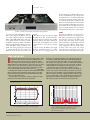
The BDP-1 is basically a Linux computer optimized for streaming audio data.
processing unit with multitasking demands.
Like a CD transport, the BDP-1’s only job
is to output a digital stream from its S/PDIF
BNC or AES/EBU XLR outputs. The opensource Linux software was selected to ensure
the BDP-1’s long-term viability. The BDP-1
differs from the Auraliti L-1000 in two ways:
it has AES/EBU output in addition to S/
PDIF, and a front-panel display and keypad
to control playback, the latter freeing the
BDP-1 from the L-1000’s dependence on a
network.
The BDP-1 accepts uncompressed AIFF
and WAV music files, lossless FLAC files,
and lossy-compressed formats such as MP3.
Though it will not play Apple’s Macintoshformated files, this limitation may be fixed
in future iterations of the player’s operating
system.
Like the L-1000, the BDP-1 plays digital
files from external flash drives or portable
hard drives that can be plugged into one of
measurements
I
examined the measured behavior of the Bryston BDP-1 using
the Audio Precision SYS2722 system (see www.ap.com and
“As We See It” in the January 2008 issue, www.stereophile.
com/content/measurements-maps-precision), as well as the
Miller Audio Research Jitter Analyzer. I played test tones, at various
sample rates and bit depths, that I’d copied to a USB memory
stick and plugged into one of the BDP-1’s two front-panel USB
ports. For the analog-domain jitter measurements,1 I fed the BDP1’s AES/EBU data output to our original review sample of the Bryston
BDA-1 D/A processor (serial number 00100) via the 2' Hosa AES/
EBU datalink LG had used for his review. (This datalink uses highquality, 110-ohm Belden cable.)
I used the BDP-1’s front-panel controls to navigate the audio
files stored on the USB stick. Their use was intuitive.
Inside
Removing the BDP-1’s top panel reveals a
simple circuit layout free of moving parts.
The analog and digital power-supply circuit
boards are kept separate, each with its own
ground plane. The analog circuit’s toroidal
power transformer is just behind the left half
of the front panel, while the digital circuit’s
power supply sits at the rear of the chassis.
A ribbon cable carries power and control
signals from the power-supply board at the
rear of the chassis to the front panel’s display,
The BDP-1 successfully played files in the following formats (all I
had available): WAV, AIFF, Apple Lossless, AAC (both self-ripped
and purchased from iTunes), and MP3. It correctly handled data
with sample rates ranging from 32kHz to 192kHz. Most important,
its data output was bit-accurate, and the active bits in its digital
output followed the bit depth of the file being played, 16 or 24.
The primary test for a product whose output is a serial
datastream is the timing accuracy of that datastream. (While the
master clock may have very low timing error, factors such as the
impedance of the transmitter and the bandwidth of the datalink
will increase jitter.) The BDP-1’s AES/EBU output produced a very
clean eye pattern (fig.1), with very little timing uncertainty at the
beginning and end of the unit-sample waveform when tested
with 16-bit J-Test data. The Audio Precision calculated the
1 A primer in how and why I measure jitter can be found at www.stereophile.
com/content/case-jitters.
Fig.1 Bryston BDP-1, eye pattern of AES/EBU data output carrying 16-bit
J-Test signal (±500mV vertical scale, 175ns horizontal scale).
Fig.2 Bryston BDA-1, high-resolution jitter spectrum of analog output
signal, 11.025kHz at –6dBFS, sampled at 44.1kHz with LSB toggled
at 229Hz, 16-bit AES/EBU data from Bryston BDP-1. Center
frequency of trace, 11.025kHz; frequency range, ±3.5kHz
(left channel blue, right red).
77www.Stereophile.com, June 2011
www.Stereophile.com, June 2011