1
CANON
EOS-1V/EOS-3
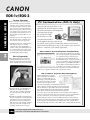
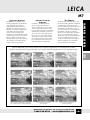
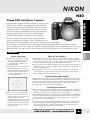
45-point Area AF
◆
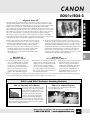
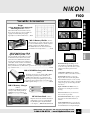
Each of the 45 focusing points within the Area AF is composed
of horizontal line detection sensors. These sensors operate with
EF lenses having a maximum aperture of f/5.6 or larger. They
are particularly well-suited to focusing on moving subjects.
◆ The central seven points of the Area AF sensor also incorporate
vertical line detection sensors, six of which operate with EF
lenses with maximum apertures of f/2.8 or larger and
theoretically provide focusing precision three times as high as
the vertical sensors.
◆
◆
19
AI Servo AF
One-Shot AF
(for stationary subjects)
◆ At its simplest level, all 45 focusing points
can be used simultaneously for optimum
auto focus results. Focusing of this kind
has the power to transform a simple
snapshot into a precisely balanced image.
However, the true benefits of 45-point
focusing become more apparent when
applied to more demanding situations.
The design of the Area AF sensor effectively creates seven cross-type
central points capable of unrivaled object recognition and exceptional
accuracy. The central focusing point is capable of cross-type focusing
with EF lenses having a maximum aperture of f/4 or greater, or focusing with horizontal component detection with EF lens/extender combinations having a maximum aperture as small as f/8. The result is an
Area AF sensor system ideally equipped for excellent performance
regardless of subject pattern; a system that brings out the true potential
of Canon EF lenses and lens/extender combinations.
(for tracking moving subjects)
◆ The predictive AI Servo AF system allows the
◆ The precision and focusing accuracy of the
tracking of fast-moving objects while mainAI Servo AF system functions within a
taining precise focus. Sequential processing
high level of synergy for results that are
regulates an array of events within the
nothing short of incredible. Using the EF
exposure process, including the arithmetic
300 mm f/2.8L IS USM lens, they can
processing of AE and AF, the driving of the
pursue, focus and continually shoot an
lens, aperture control, and movement of the
approaching subject at speeds of up to 30
mirror and shutter curtains.
mph until it’s as close as 26´ away.
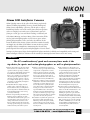
The 45 focusing points of the EOS-1V provide unique functionality and a new level of focusing control. This system minimizes the problems of
focus lock and recomposition, and brings an improved degree of fluidity to the creative process.
EOS-1v and EOS-3 Exclusive Focusing Features
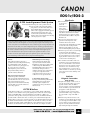
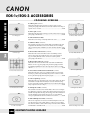
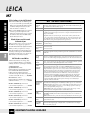
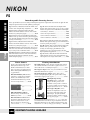
EOS-1V: Focusing Assist Button
It’s easy to switch to a preselected focusing
point simply by pressing the Assist Button.
When shooting conditions fluctuate, or
fleeting photo opportunities arise, even the
most agile photographer will be hard
pressed to select just the right focusing
point in time. Fortunately, the EOS-1V
allows users to register any focusing point as a home position (HP)
that can be restored from any focus setting, with a single press of the
Assist Button. This extremely handy feature allows photographers to
adapt quickly to almost any situation.
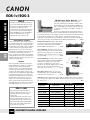
EOS-3: Eye Control Response
Eye Controlled Focus is a feature that lets the 45-Point
Area AF exhibit its full value.
ORDER & INFO. (212) 502-6340 • FAX: (212) 239-7770 (800) 947-7008
1-800-290-6750 • www.bhphotovideo.com
CAMERAS & LENSES
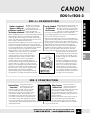
The result of Canon’s pursuit of an AF system that allows continuous shooting ease and
expanded framing freedom, the 45 focusing points are densely packed within an 8 x 15mm
zone and can be manually or automatically selected to meet the needs of the situation. When
multiple points are selected, AF system capabilities are significantly extended. While
photographers have the freedom to frame images through the viewfinder as they choose, the
lens is automatically brought into focus as soon as the active focusing points cover the subject.
Like a human eye, Canon’s 45-point Area AF tracks and aims true. This is typical of Canon’s
state-of-the-art AF technology, recognized by professional photographers everywhere.
The system is comprised of two kinds of sensor elements that are capable of remarkable
focusing efficiency. Because they are able to complement and compensate for each other, they
vastly expands the range of lens/extender combinations with AF capability.
PHOTO - VIDEO - PRO AUDIO