1
1 INTRODUCTION
Congratulations!
With Adapt9S12DP256, you are now ready to explore the power and flexibility of Motorola’s
most advanced 16-bit microcontroller! Whether you’re new to Motorola microcontrollers or you’ve
used some of the earlier ones, such as 68HC05, 68HC11, or 68HC12, you’ll be impressed with the
well thought-out design and implementation of the HCS12 family. And Adapt9S12DP256 gives you
the opportunity to explore this MCUs potential at an incredibly affordable price! Add to that the
proven advantages of the modular design approach, and the wide variety of available accessories,
and you’ll see why you picked a real winner!
Support
To help you get the most out of this product, and to make the experience as enjoyable and
productive as possible, we have put together a comprehensive website with technical support,
resources, and applications information. If you experience any difficulties, or need help with your
application, the World Wide Web is arguably the most valuable resource available to you. There
you’ll find the latest information, software, and troubleshooting help, as well as discussion groups
where you can network with people around the globe to get the answers you need. So if you still
need help, or have questions after reading this manual, visit our website: www.technologicalarts.
com and tap into the collective!
The 9S12DP256 in Perspective
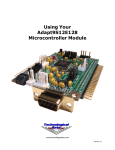
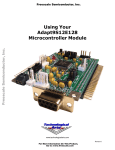
Adapt9S12DP256 was designed as an evaluation and application tool for the Motorola 9S12
microcontroller family. Based on the most feature-packed flavour of the chip, 9S12DP256, it is
perfect for developing applications for any of the lower-function derivatives. The “D” series includes
DP256, DT128, DG256, DJ256, etc. All of these feature some at least one CAN or J1850 interface,
popular in automotive and industrial applications. The lower-cost “A” series excludes these subsystems. All the other subsystems are identical, however, with the differentiating factor being the
amounts each memory type and the quantity of I/O lines.
Adapt12 vs. traditional evaluation boards
Most evaluation and development systems available tend to be too expensive and bulky for
embedding into a real application, so it lies gathering dust once you’ve reached a certain point in the
learning curve. Or maybe you have to come up with clever ways to hack it apart to make it fit inside
your robot. Even then, the prototyping area provided is often limited, and does not lend itself to
re-usability. And what if you burn out a motor driver chip the night before the contest? What a mess
to repair or re-design!
The Adapt12 system solves all of these problems and then some! Since it brings out all I/O
lines and control signals to two standard 50-pin interface connectors, it is modular and re-usable.
Interface cards can be unplugged and upgraded, or the whole system can be re-configured at the
last minute. And with several connector options to choose from, you can use the module in whatever way best suits your needs-- board-stacking, end-to- end (planar), backplane, ribbon cables,
etc. A full range of accesories including backplanes, prototyping cards, and application-specific
cards is available, and more accessories are being developed all the time. Visit our website frequently to see what’s new.
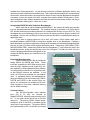
The connector options (“RA1”) supplied in the Evaluation Package support the use of prototyping cards on each of the H1 and H2 I/O connectors, forming a planar arrangement. Advantages of this configuration are easy access of all I/O pins for probing and measurement, and easy
prototyping of your interface circuits. What’s more, the detachable nature of the prototyping cards
means that you can easily replace them with other cards, including some of the application cards
2