1
15
It is also important to keep the detector head as close to the ground as possible. Ideally, you
should 'iron' the ground with the search head of the detector, so that you do not lose any
detection range. Similarly, if you work slowly and carefully you should be able to distinguish
the faint signals as well as the clear-cut signals and further increase your finds.
The technique of getting the best out of your detector is not learnt overnight. You need to get
as much experience as possible so that you can recognise every kind of signal. Indeed, a good
detector operator can often tell you what is being detected before it is unearthed.
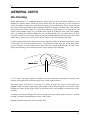
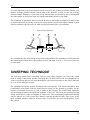
Search Head Position
A
B
C
D
It is essential that the search head is kept close and parallel to the ground as in B. Do not hold
the search head too high above the ground, or at an odd angle as in A, C, D as you will be apt
to miss finds.
SWEEPING TECHNIQUE
For extremely small object searching, such as coins, rings, nuggets, etc. lower the search
head to within 1 inch of the ground. Sweeping the coil from side to side in a straight line in
front of you. Keep the coil at a constant height as you sweep from side to side. Move the head
at a rate of 0.5 metre per second.
The optimum sweep rate must be determined by each operator. The detector should be held
comfortably in the hand, with the head held as closely to the ground as possible. As the
detector is scanned from side to side in front of the operator, the search head should be
advanced approximately two-thirds the diameter of the coil. This keeps the operator moving
ahead, and it allows some overlapping of each sweep. This overlapping ensures that nothing
will be missed. It is well to note here that the operator should not rush. This is one of the
most common mistakes made by detector users. If you rush, you will not adequately cover
the ground.
15