1
83 / 86
http://entropy.brneurosci.org/radio-misc.html
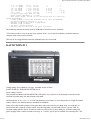
Loop antennas have been used since the early days of radio. Their most important features are directivity and
reduced susceptibility to local interference. However, most of these loop antennas had one serious drawback in
that they had to be tuned in step with the receiver.
The Active Loop solves the problem of having to tune the loop by using a broadband amplifier. The loop can be
mounted remotely from the receiver away from local interference, whereas traditional antennas require a lot of
space and can pick-up local noise.
BROADBAND LOOP FEATURES
1.
2.
3.
4.
5.
6.
7.
8.
Very low intermodulation products ensures good performance in a strong signal environment
Up to 30dB rejection of locally radiated noise compared to active whip and dipole antennas
Figure of eight directivity and deep nulls to further reduce interference.
Ideal for LW/MW with antenna rotator
Up to 60dB rejection of mains borne noise compared to active whip and dipole antennas
Rugged construction, 1m diameter aluminium loop, supplied with Antenna Interface and 12 volt PSU
Broadband, no tuning necessary or matching unit
No planning problems, mounted at ground level
LOOP ANTENNA ADVANTAGES Active antennas are necessary for several reasons: The difficulty of
matching a conventional wire antenna to a 50 ohm feeder and still retaining a broadband response is not easy. At
certain frequencies; conventional wire antennas can deliver excessive signal strength, leading to receiver
overload. Planning regulations restrict antenna erections.
The active antenna solves the problem of impedance matching to the feeder and yet the performance is
comparable with larger antennas. However, most active antennas are of the whip or dipole type and respond
mainly to the electric-field. The Broadband Loop is balanced antenna and responds primarily to the
magnetic-field, this ensures high rejection of nearby electric-fields. The intensity of the electric-field is usually
higher than the magnetic-field when an antenna is close to interference sources such as TVs, fluorescent lamps,
computers, mains wiring etc.
Therefore, by rejecting the electric-field there will be a reduction in local interference compared to other types of
active and passive antennas. Interference reduction is further enhanced by the deep nulls of the 'Figure-of-Eight'
directivity pattern.
INTERMODULATION
Some active antennas generate intermodulation products which can appear as spurious signals interfering with
reception. This interference or second order intermodulation is caused by non-linearity in the amplifier,
producing signals which are the usually the sum and difference of strong Broadcast stations.
The second order intermodulation performance of a broadband active antenna is very important because active
antennas do not have any selective circuits to reduce intermodulation. The second order intercept (IP2) point
needs to be +66dBm considering the very high signal levels in Europe.
The Broadband Loop has been specifically designed to reduce intermodulation products to a minimum. The
second order and the third order intercept points are typically +70dBm (IP2) and +40dBm (IP3) respectively.
Thus the level of the intermodulation products are generally below the atmospheric and man made noise.
ANTENNA DESIGN
The Loop antenna consists of a rigid aluminium loop or a semi-rigid polyethylene loop, and a balanced gain
optimised broadband amplifier using low noise RF power transistors. The amplifier is encapsulated in epoxy
resin and housed in a uPVC box, this ensures reliable operation in all weather conditions. The antenna provides
low noise performance and large signal handling ability. Rejection of mains borne noise is accomplished by a
balanced amplifier and a feeder isolation transformer in the Antenna Interface.
The ALA 2000 is designed for direct connection to the 12 volt power supply and is supplied with a 5m feeder
28.8.2007 13:16