1
Sequences of Operation
Sequences of Operation
The following sequences of operation are for a unit equipped
with MicroTech III, an economizer, 4-compressor/4-stage
cooling, 3 to 1 turn down burner, variable frequency drives
(VFD), and an external time clock. These sequences describe
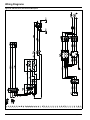
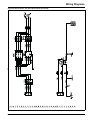
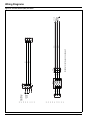
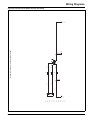
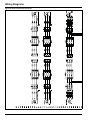
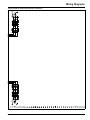
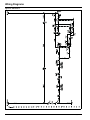
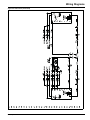
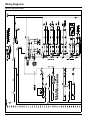
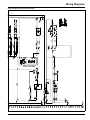
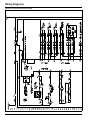
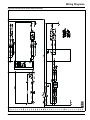
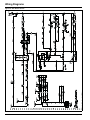
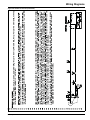
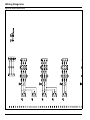
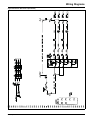
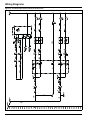
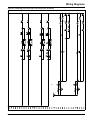
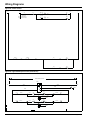
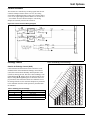
the ladder wiring diagram logic in detail; refer to “Wiring
Diagrams” on page 40 as you read them. Note that your unit’s
sequences of operation may vary from those described here.
Refer to the wiring diagrams supplied with the unit for exact
information.
For detailed description of operation information relating to
the MicroTech III controller's software, refer to the appropriate
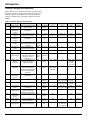
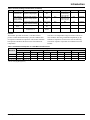
operation manual (see Table 1 on page 3). These manuals
describe the various setpoints, parameters, operating states,
and control algorithms that affect rooftop unit operation.
Power-up
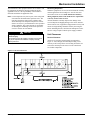
When primary power is connected to the unit, 115 V (ac)
power is fed through control circuit transformer T1 and control
circuit fuse F1C (line 166, Figure 46 on page 43) to
compressor crankcase heaters HTR-1, HTR-2, HTR-3 and
HTR-4 (lines 836 - 848, Figure 58 on page 55).
When system switch S1 (line 203, Figure 53 on page 50) is
closed, low voltage transformers T2 (line 203, Figure 53 on
page 50), T3 (line 251, Figure 54 on page 51) and T9 (line
802, not shown) energize, and 115 V (ac) power is supplied to
the following:
• The supply fan VFD (line 135-137, Figure 46 on page 43)
• Heating control panel (line 603, Figure 55 on page 52)
• Economizer actuator (lines 256-257)
Transformer T2 supplies 24 V (ac) power to terminals 24V and
COM on the main control board MCB (lines 207 and 208).
Transformer T2 supplies 24 V (ac) power to the following (see
Figure 45 on page 42 and Figure 46 on page 43):
• Switch S7 On-Auto-Off (line 217)
• Enthalpy sensor OAE (line 247)
• External time clock contacts (line 215)
• Airflow interlock switch PC7 (line 228)
• Dirty filter switches PC5 and PC6 (lines 242 and 247, not
shown)
• Gas furnace alarm relay R24 (line 225, not shown)
• Smoke detector SD2 (line 237)
The time clock, S7 switch, and emergency shutdown terminals
(lines 217-222) control fan operation.
Note: Unit ships with factory installed jumpers between TB2
101 and 105 and between 101 and 106.
Fan Operation
When the main control board (MCB) commands the supply
and return fans to start, the unit enters the Startup operating
36
state. As a result, a 3-minute timer is set, output MCB-BO3
(line 307) energizes, and relay R26 energizes (line 306, not
shown).
After the 3-minute timer expires, the unit enters the Recirc
operating state. As a result, output MCB-BO1 energizes relay
R67 (line 401). This gives a start signal to supply fan drive
AFD10 (line 445). Four seconds after MCB-BO1 is energized,
output MCB-BO2 energizes relay R68 (line 404).
Within 120 seconds after the fans start, the controller expects
airflow switch PC7 (line 228) to close and thus energize binary
input MCB-BI6. (If MCB-BI6 does not energize, the controller
assumes the fans did not start. It then shuts down the unit and
generates an alarm.)
During the Recirc operating state, the outside air damper is
held closed. The controller does this by energizing output
MCB-BO5 (line 318). On VAV units, output MCB-BO12, the
VAV box output, is also de-energized (line 309) during the
Recirc state.
The supply fan adjustable frequency drive (AFD10) is
modulated to maintain the duct static pressure setpoint. When
energized, output MCB-BO14 (line 407) drives AFD10 toward
increased capacity; MCB-BO13 (line 405) drives it toward
decreased capacity. On VAV units or CAV units equipped with
return fan capacity control, the adjustable frequency drive
(AFD20) is modulated to maintain an acceptable building
static pressure. When energized, output MCB-BO16 (line 409)
drives AFD20 toward increased capacity; MCB-BO15 (line
411) drives them toward decreased capacity.
Economizer Operation
Refer to Figure 54 on page 51. When the outdoor air is suitable
for free cooling, the switch in enthalpy sensor OAE is in
position “3” (line 248, Figure 54 on page 51) energizing
analog input AIX5. When AIX5 energizes, the economizer is
enabled. (Note: If selected from the keypad, the enthalpy
decision can be made based on outdoor temperature. In that
condition, if the outdoor air temperature is less than or equal to
the changeover set point, the economizer is enabled.) If
cooling is required, the economizer dampers (ACT3) are
modulated to maintain the discharge air temperature setpoint.
Analog input AIX5 drives the outdoor air dampers toward the
open and closed (line 256) position. If the outdoor air dampers
are wide open and more cooling is required, the dampers hold
their positions and mechanical cooling is activated (see
below).
When the outdoor air is not suitable for free cooling, the
switch in enthalpy sensor OAE is in position “1,”
de-energizing analog input AIX5. (Alternatively, the outdoor
air temperature is above the changeover setpoint plus the
economizer changeover differential). When the economizer is
disabled, the dampers are held at their minimum position.
McQuay IM 991